PayPal’s 2025 Performance: E-Commerce Growth Slows Amid Broader Retail Pressures
PayPal’s 2025 performance raises an uncomfortable question: Is the payments leader facing limits to its growth momentum? The answer lies in the rising tension within its e-commerce business.

Article in a Nutshell:
Increasing revenue at slower growth rate: PayPal reached US$33.2 billion in net revenue in 2025, but growth decelerated to 4.3%.
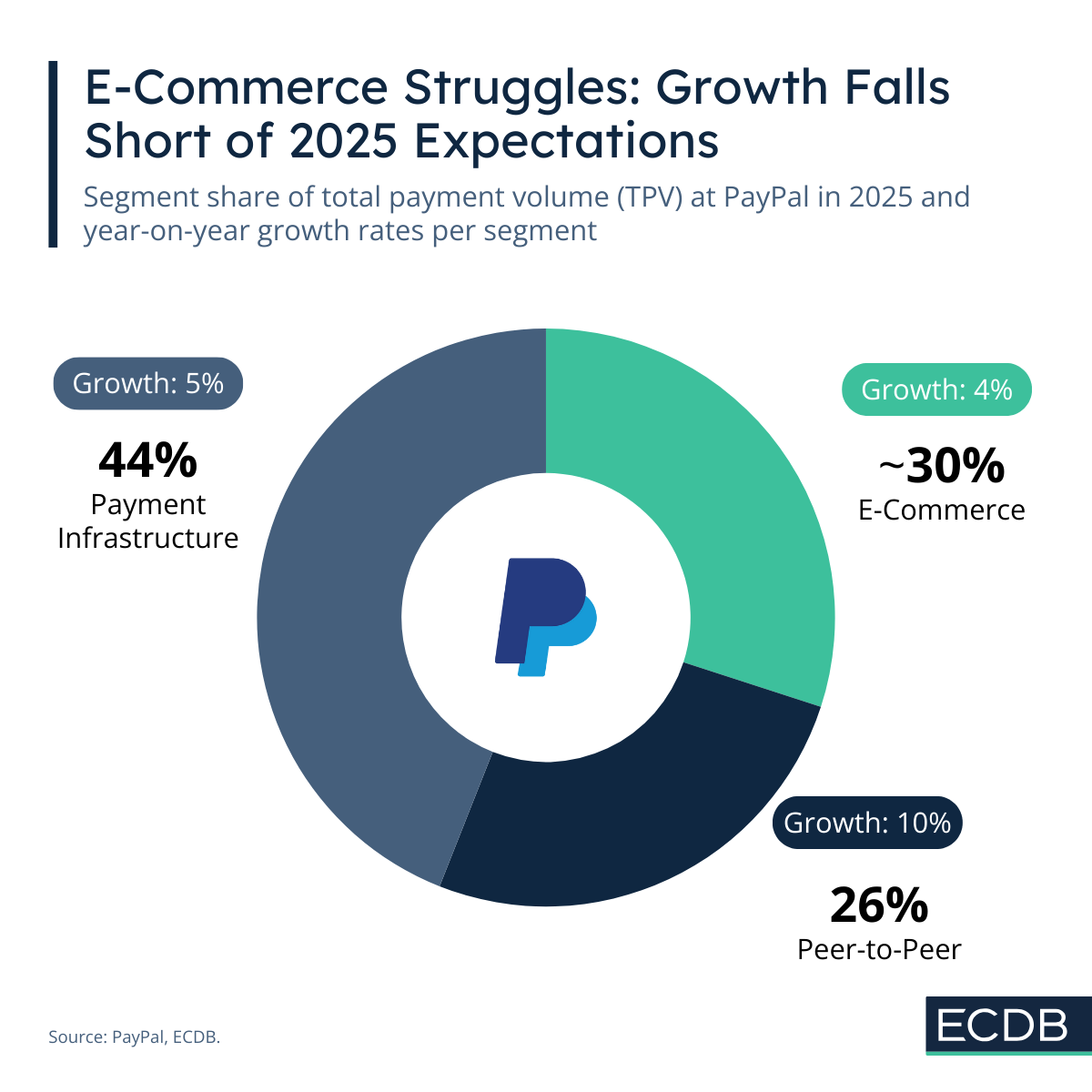
E-commerce underperformance: Online branded checkout grew just 4%, impacted by US retail weakness, international headwinds (notably Germany), decelerating high-growth verticals, and operational challenges.
Shifts in consumer behavior: Users are buying less frequently but spending more per transaction.
Bright spots and strategic focus for 2026: Venmo, BNPL, and enterprise payments performed strongly, while PayPal plans to win back checkout, scale omnichannel and Venmo, drive PSP profitability, and advance next-generation growth initiatives.
PayPal’s latest Q4 and full-year results offer the picture of a payments giant in transition. While the company reached a new all-time high in net revenue of US$33.2 billion in 2025, the underlying story is less about scale and more about momentum. Growth is slowing, e-commerce has not rebounded as strongly as anticipated, and execution challenges are becoming harder to ignore.
At the same time, PayPal is far from struggling across the board. Several business lines are performing exceptionally well, particularly regarding peer-to-peer payments (P2P) like Venmo, as well as BNPL services.
PayPal's Growth Trajectory Loses Momentum
PayPal's net revenue reached US$33.2 billion in 2025. While this marks a further increase from previous years, PayPal's revenue growth rate is decelerating. From 6.8% in 2024, this year's growth reached only 4.3%.
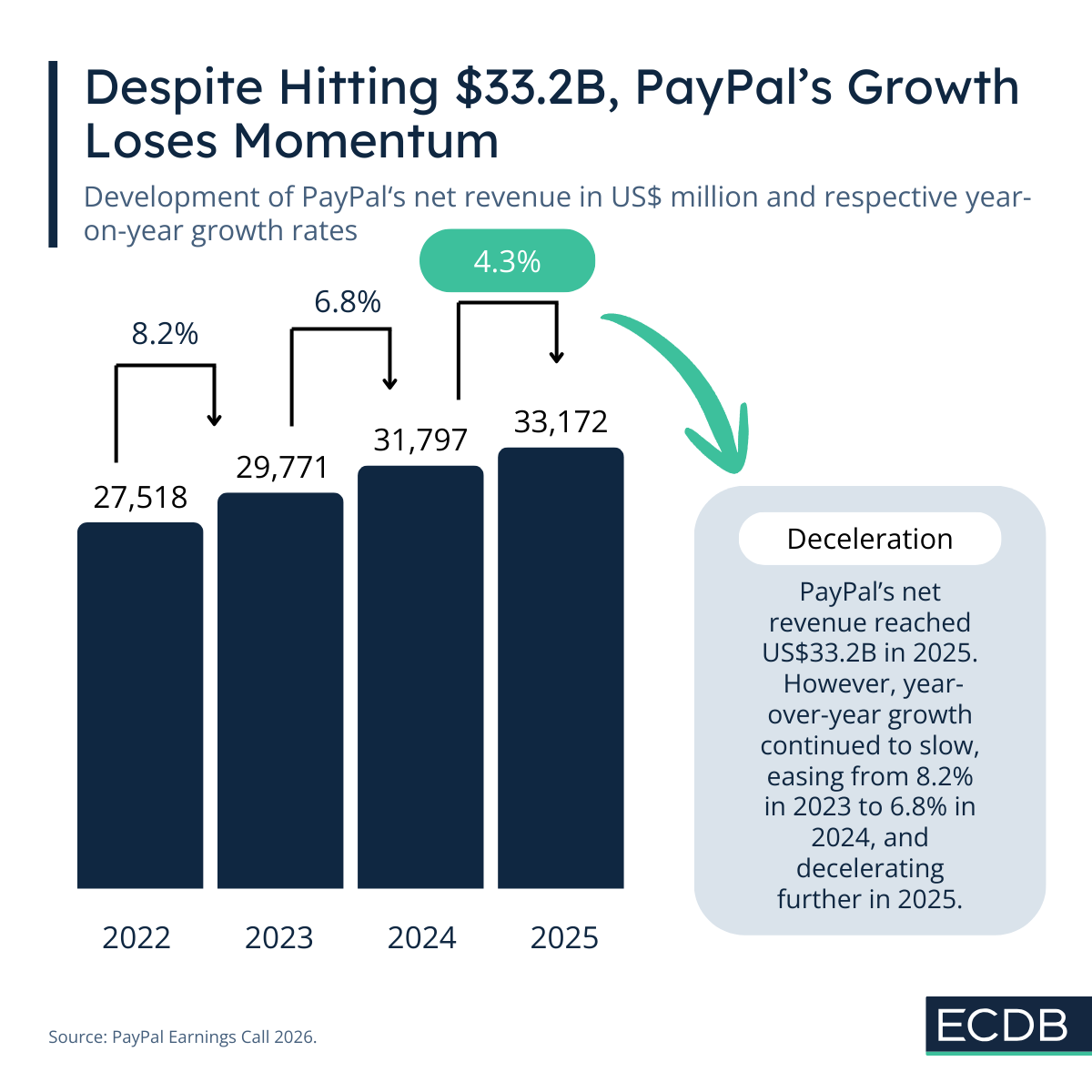
The slowdown does not point to revenue contraction, but rather to a maturing growth profile. Growth increasingly depends on how well PayPal executes: improving checkout conversion, pricing services effectively, reducing costs, and getting more revenue out of each transaction rather than just more transactions. Additionally, the company is impacted by its broader environment, one of which includes e-commerce.
Online Branded Checkout: Below-Expectation Development of E-Commerce
One of the most closely watched segments is online branded checkout, a cornerstone of PayPal’s e-commerce strategy. Despite representing a substantial share of PayPal’s transaction volume, performance here fell short of expectations.
In 2025, branded checkout grew just 4%, down from 6% in 2024, and momentum deteriorated sharply toward year-end. In Q4, TPV (transaction payment volume) growth slowed to 1% on a currency-neutral basis, compared with 5% in Q3. This marks a four-percentage-point deceleration, which was significantly worse than expected. That subpar development led to a devaluation of PayPal stocks.
PayPal identified several weaknesses that contributed to the underperformance:
US Retail Weakness: Especially low-income consumers' priorization of other expenses hurt PayPal's growth in the US environment last year.
International Headwinds: This regarded particularly Germany, one of PayPal's strongest markets, where macroeconomic softness, leadership normalization, and intensified competition from alternative platforms weighed heavily.
Deceleration in High-Growth Verticals: Historically promising verticals like travel, ticketing, crypto, and gaming decelerated in 2025, affecting PayPal in the process.
Operational and deployment issues: Amplified external pressures and limited PayPal’s ability to respond quickly.
Notably, PayPal acknowledged that a combination of biometric adoption and competitive product positioning has become critical for branded checkout performance. While macroeconomic challenges are real, the company also admitted that execution has not met internal standards, particularly around delivering a compelling new value proposition for merchants and customers.
Shifting Consumer Behavior Adds Complexity
The results also reveal a meaningful shift in user behavior. Consumers are purchasing less frequently but spending more per transaction, even though the overall number of active users slightly increased. The downturn reflects cautious spending patterns in a weak retail environment.
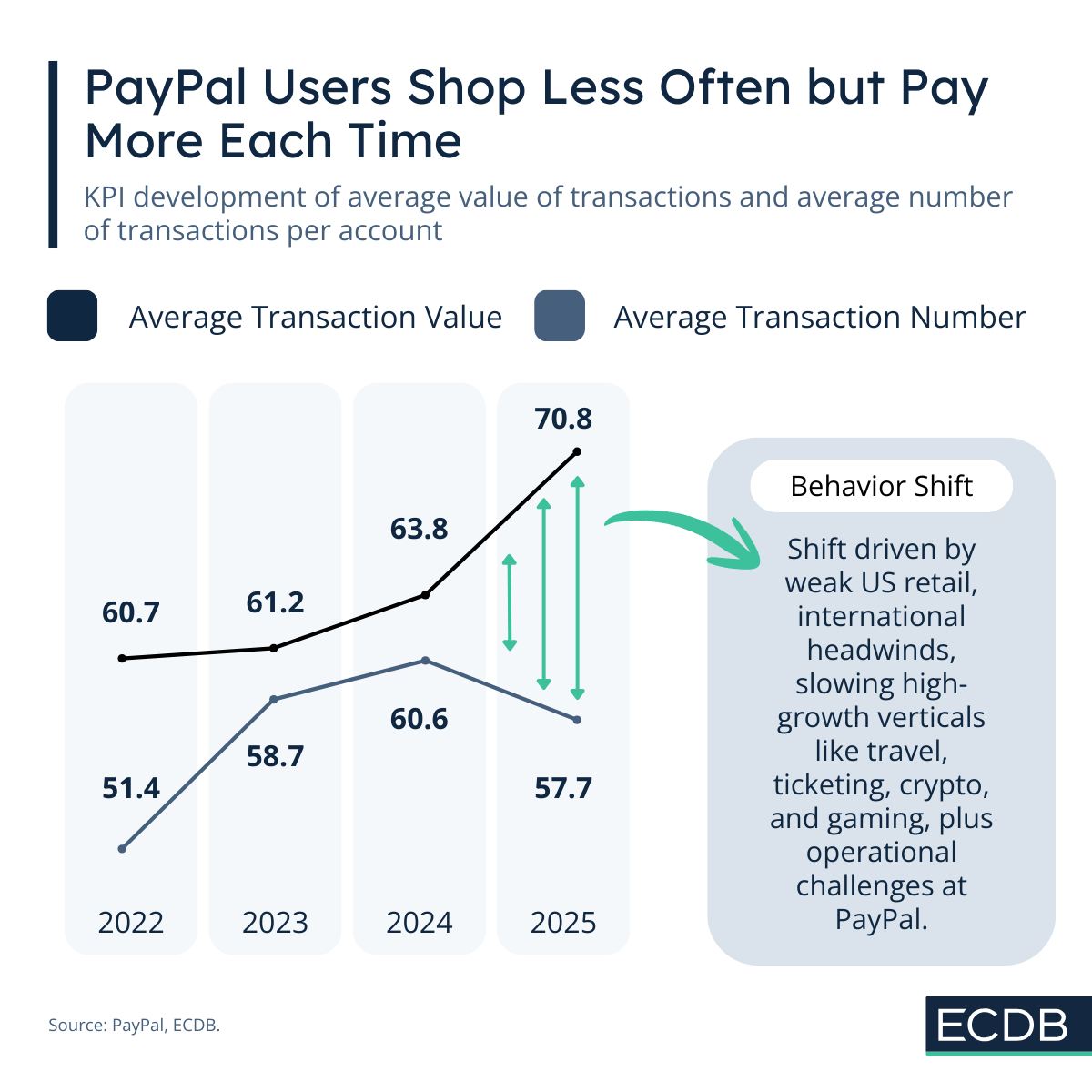
Still, slower frequency growth puts added pressure on PayPal to improve conversion, engagement, and checkout experience, rather than relying on transaction volume alone.
Conclusion
Despite these challenges, PayPal’s 2025 performance wasn’t all bad news, far from it. Good news for the company was that Venmo continues to shine, the enterprise payments business has quietly turned around, and Buy Now, Pay Later (BNPL) remains a strong growth engine. PayPal is also investing in omnichannel commerce, wallet interoperability, crypto capabilities, and early agentic commerce concepts, thereby laying groundwork for future differentiation.
2026 is going to be a defining year for strategy and execution, and PayPal defined clear steps for growth: They include to win checkout back, in other words to increase e-commerce activity once more, scale omnichannel and grow Venmo further, drive PSP profitability and scale next-generation growth vectors.
Related Articles
All ArticlesReady to Unlock the Full Power of ECDB?
Book a demo to see how ECDB's market intelligence can support your business.