Monthly E-Commerce Recap August 2026: Summer Slowdown But Year-on-Year Rise
High summer brought another e-commerce slowdown, but the year-on-year trajectory points upwards. August revenues reached US$427.9 billion this year, up 7.2%.
Top eCommerce countries
Growth rates are an analyst's favorite indicator as they imply future potential. What does that look like in the top 10 eCommerce markets?

Antonia Tönnies
Data Journalist
December 02, 2024
Market Trends
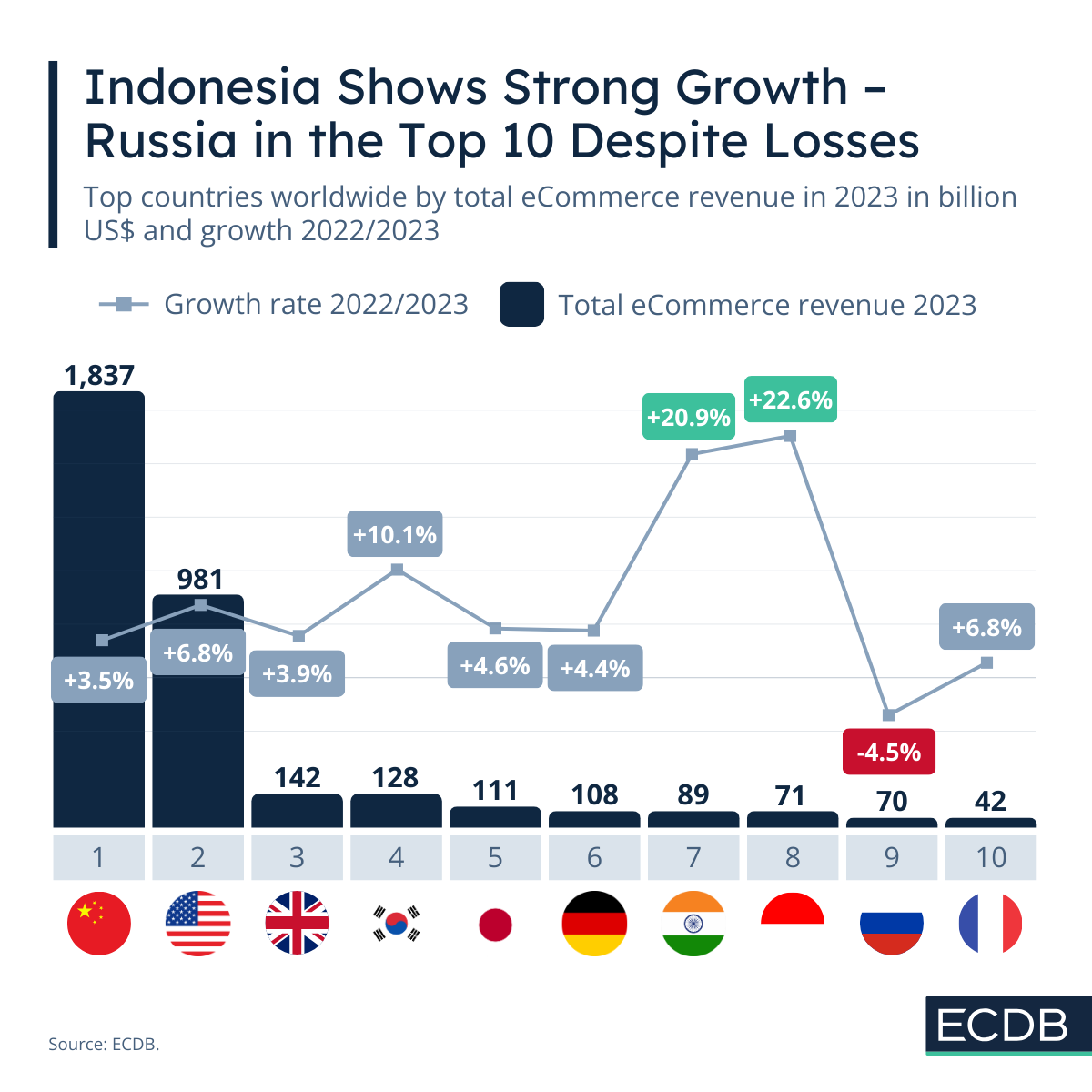
The eCommerce markets in Indonesia and India are both making great strides among the top 10 eCommerce countries. These two countries in particular offer opportunities for rapid growth, along with South Korea, albeit a little further down the list with an increase of 10.1%. At the same time, China and the United States continue to lead the way in terms of eCommerce revenues, despite lower growth rates.
The success story of China's eCommerce markets continues. Last year, China generated US$1.8 trillion in revenues, twice as much as the United States with US$981 billion. But while turnovers are hitting new records year after year, the growth rate is going in the opposite direction.
Mature markets like the U.S. and China are already quite large, meaning that small percentage growth rates can result in high absolute growth for large eCommerce nations. It is therefore normal to experience single-digit growth rates, while less developed markets such as India and Indonesia are growing at double-digit rates.
In general, the Chinese and U.S. market are characterized by a well-developed eCommerce infrastructure, thanks to large companies and retailers such as Amazon and eBay in the U.S. along with Alibaba and Pinduoduo in China. However, their market size is also critical to success, as both are large in terms of geography and population, offering more opportunities for growth.
While the top eCommerce countries, China and the U.S., stand out for their high revenue figures, lower ranked countries catch the eye with their high growth rate. Specifically, India and Indonesia stick out with annual growth rates of 22.6% and 20.9% between 2022 and 2023, respectively. Both eCommerce markets can be considered developing countries.
Compared to similar eCommerce countries such as Germany or Japan, India and Indonesia showed remarkable growth opportunities in 2023. Although saturation is already high in major cities such as Mumbai or Jakarta, the potential lies mainly in the suburbs and rural areas. The main challenge here is logistics and local accessibility, as smartphone penetration and internet access are already quite high.
The Russian eCommerce market contrasts with the positive trend seen in Southeast Asia. Between 2022 and 2023, the country experienced a sharp decline in growth from 36.8% between 2021 and 2022 to -3.5% recently. This trend is mainly due to the Russo-Ukraine conflict that began in February 2022 and its subsequent effects, such as sanctions imposed on Russia by states and organizations.
Nevertheless, the country managed to land in the top 10 in 2023, right ahead of France. According to the forecast of ECDB analysts, the country's eCommerce markets expected to grow again in the coming years. It is therefore possible that Russia will remain in the top 10 in 2024, but more will be known at the 2024 closing.

Related Articles
High summer brought another e-commerce slowdown, but the year-on-year trajectory points upwards. August revenues reached US$427.9 billion this year, up 7.2%.
Africa grows at a compound annual growth of 13.9% from 2025 to 2030. But mature markets add most of the absolute gains. Here is what factors account for its development.
Central European category splits show a distinct pattern, which fits the mix in Germany, Austria and Switzerland. Poland shows a different pattern. Here is why.

Click here for
more relevant insights from
our partner Mastercard.
Book a demo to see how ECDB's market intelligence can support your business.