TikTok Shop Is on Track to Nearly Double Its GMV in a Single Year
TikTok Shop is projected to reach €106.0 billion GMV in 2026, up 86% in one year. Its main markets could not be more different, which hints at the platform's universal appeal.
E-Commerce Membership Programs
Amazon Prime is the clear winner when it comes to subscriber count, but Walmart+ has taken over a complimentary role to stay relevant.

Nadine Koutsou-Wehling
Data Journalist
April 28, 2026
Retailers
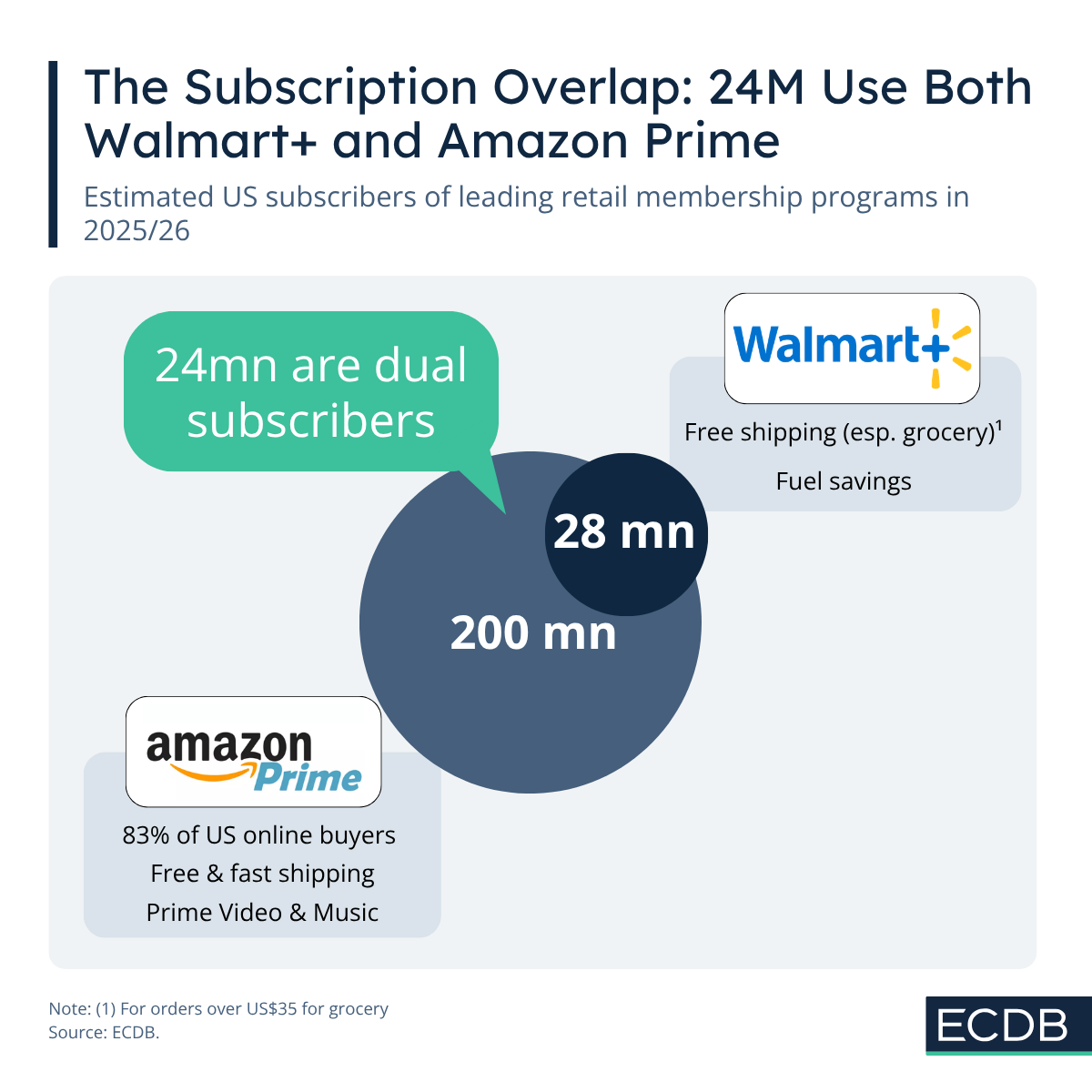
Amazon and Walmart are the two leading e-commerce retailers in the United States. Both offer membership programs to their customers. Amazon Prime is clearly ahead in subscriber count, with 200 million versus Walmart +'s 28 million. But what's most important - 24 million of those are dual subscribers. This rewrites the rules of loyalty in e-commerce.
Amazon commands an enormous share of US consumers, estimated at 83%. By delivering on speed, convenience, and an ever-expanding bundle of digital perks, Prime is a huge ecosystem including streaming, devices, and integrated services that keep users engaged daily.
Walmart's strength lies in everyday essentials: Groceries, household items and fuel savings, supported by an expansive physical store network that facilitates pickup options for consumers. It is far behind Amazon's subscriber count, and acts rather as a complementary service to users as is shown by the large portion of dual subscribers.
The dual-subscriber data makes that dynamic clear. For millions of users, Amazon Prime is the default layer, covering a broad range of needs from shopping to entertainment. Walmart+ is used more selectively, often for high-frequency, necessity-driven purchases.
Apart from their competitive dynamic, the wide overlap of subscribers shows that consumers selectively use either of these retailers to get most of their shopping experience. For Amazon and Walmart, these memberships are strategic tools designed to influence customer behavior and collect valuable behavioral data.
Customers repeatedly return to the platforms that serve their specific needs best. Convenience, speed, price, and product availability all shape those micro-decisions, and over time they create a pattern of selective loyalty rather than exclusive commitment.
For platforms, the dual-subscriber dynamic makes one thing clear: trying to fully displace Amazon is, for most competitors, an unrealistic goal. But that doesn’t mean there’s no room to compete. Instead of attempting to overshadow Amazon, companies like Walmart are better positioned when they focus on complementarity, or owning specific, high-frequency use cases that Amazon doesn’t fully dominate.

Related Articles
TikTok Shop is projected to reach €106.0 billion GMV in 2026, up 86% in one year. Its main markets could not be more different, which hints at the platform's universal appeal.
Temu ranks as the number one retailer in Finland, Croatia, Hungary and Slovenia. Across the continent, Temu fairs well overall. Here is how it performs.
Amazon generated US$847.4 billion in 2025, and 86% of this figure come from only seven markets. Outside that group, even within its own top 10, Amazon's lead already thins.

Click here for
more relevant insights from
our partner Mastercard.
Book a demo to see how ECDB's market intelligence can support your business.