Bullion eCommerce Gains Traction With India and Russia Leading the Way
Germany is the second-biggest eCommerce market for Bullion & Precious Metal, ahead of China, India and Russia. The U.S. is leading.

Bullion & Precious Metal is a subcategory of Hobby & Leisure here at ECDB. This category includes bars and coins made of gold, silver, platinum or palladium, as well as storage solutions. But it excludes jewelry and watches, as well as precious metal investment services.
As an eCommerce category, Bullion & Precious Metals is popular, but its share as a subcategory of Hobby & Leisure is predicted to decrease. In the world online market, revenues are expected to grow.
This is how its top markets come about.
Germany Is the Second-Largest Market for Bullion & Precious Metal
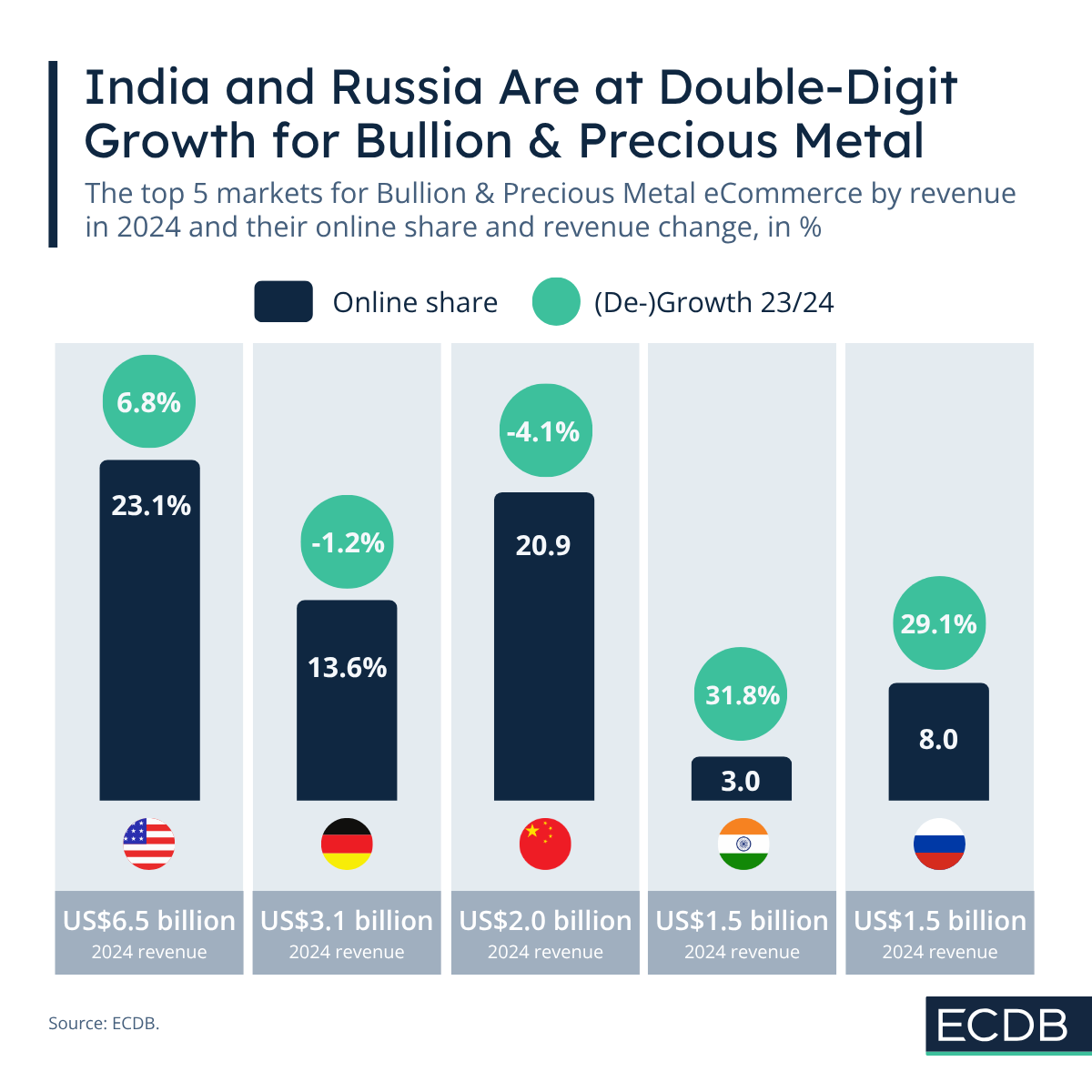
In 2024, the top five online markets for Bullion & Precious Metal eCommerce, ranked by revenue, are the United States (US$6.5bn), Germany (US$3.1bn), Greater China (US$2.0bn), India (US$1.5bn) and Russia (US$1.5bn). Germany stands out in this ranking as a relatively small country, at least compared to the other four.
Germany’s dominant position is underscored by its moderately high online share of the Bullion & Precious Metal market, which is 13.6%. This share comes with a revenue degrowh of -1.2% from 2023 to 2024. Germany’s current economic stagnation contributes to a possible hesitancy to buy precious metals.
Consumers compare prices for Bullion & Precious Metal online and use the products as a tangible store of value. Particularly in countries where the economic future is uncertain or the risk of trade in currencies is sought to be alleviated by a physical component, Bullion & Precious Metal is relevant.
India and Russia Hold High Potential for Market Growth
India and Russia are two countries with a low online share and a high market revenue and growth rate. Their market size certainly plays a role in their top position, but it is not the whole story.
The former argument of economic security and currency trade applies here. Russia is the second-largest gold producer in the world and is home to Nornickel, the largest supplier of palladium worldwide. But since Russian gold trade is under Western sanctions and the country’s trading capacities are limited, its heavy resources contribute to high domestic and select international routes. (1)
India’s status as the most populous country certainly benefits its top spot in combination with a low online share in the Bullion & Precious Metal market. The market has a lot of unused potential, given its high precious metal reserves and consumer demand, but not many structures in place to utilize it. In the coming years, an increase in revenue and online share is expected, as well as a subsequently rising position.
Both India and Russia accordingly saw notably high growth in the online Bullion & Precious Metal market from 2023 to 2024. India's growth was a little higher, at 31.8%, while Russia followed with 29.1%. Consider how news of an imminent BRICS trading agreement for the exchange of precious metals may affect an optimistic market outlook.
Mature Markets Combine Structure, Demand and Policy
The two largest eCommerce markets in the world, the United States and China, occupy the first and third spots, respectively, with low growth rates in the U.S. and degrowth in China.
This ranking highlights how the Bullion & Precious Metals eCommerce category is shaped not only by economic factors and resource availability but also by local infrastructure, consumer behavior, and trade regulations. While some countries lead due to sheer market size or production capacity, others show untapped potential or rely on the category as a hedge against uncertainty.
Related Articles
All ArticlesReady to Unlock the Full Power of ECDB?
Book a demo to see how ECDB's market intelligence can support your business.