Just Seven Countries Carry 86% of Amazon's Global GMV
Amazon generated US$847.4 billion in 2025, and 86% of this figure come from only seven markets. Outside that group, even within its own top 10, Amazon's lead already thins.
Zara, Bershka and Pull&Bear Crack the Billion Mark
Inditex flagship Zara generates seven times the net sales of the second-placed domain, bershka.com. Together with pullandbear.com, those three drive Inditex success at a concentration of 80%.

Nadine Koutsou-Wehling
Data Journalist
June 02, 2025
Retailers
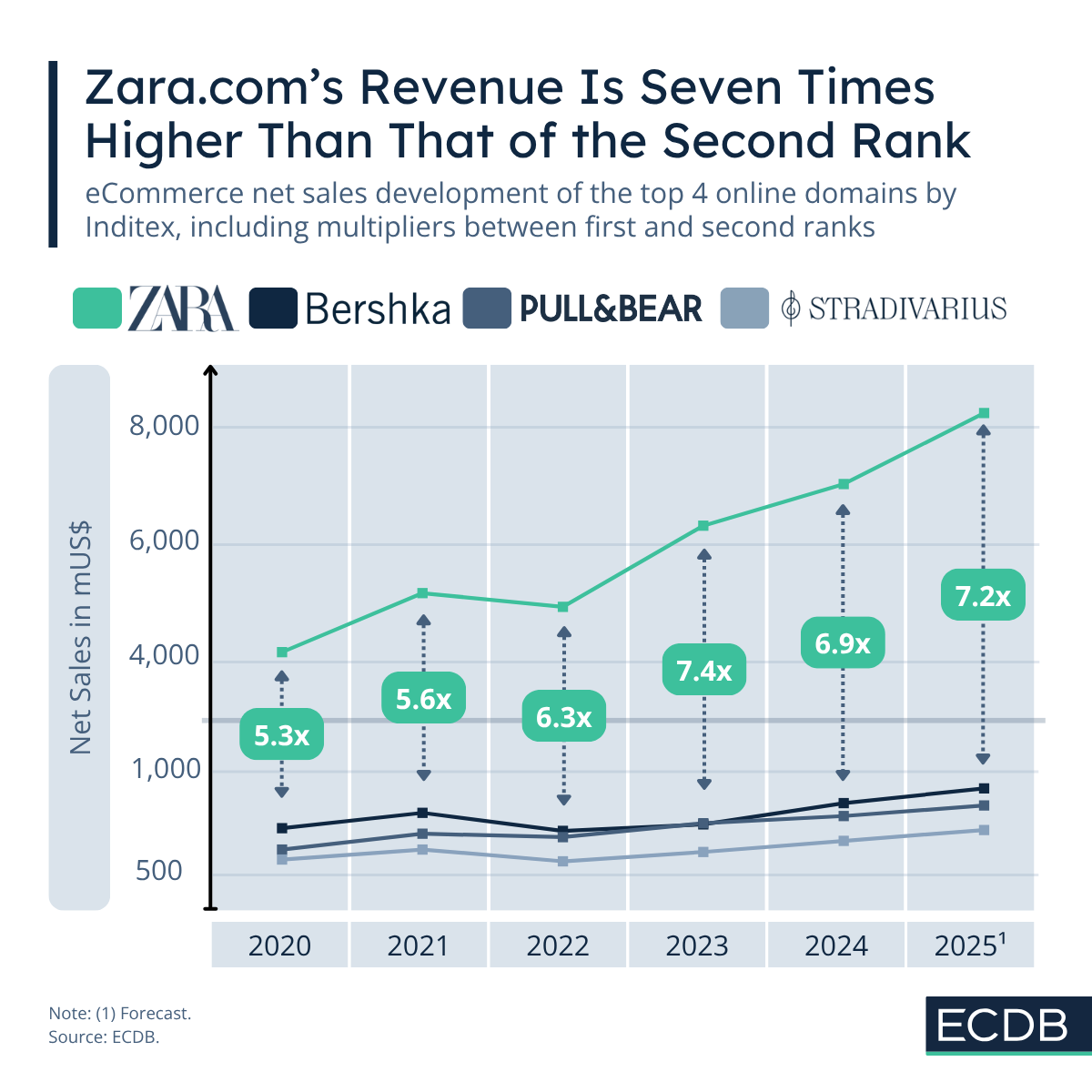
Inditex is currently enjoying its heyday, as the post-pandemic years have seen steep increases in revenues across all its top domains. While primarily known for its flagship brand, Zara, Inditex’s other brands are also nothing to scoff at. Bershka.com and pullandbear.com, in particular, are reaching revenue milestones as we speak.
Here is a comprehensive view on Inditex’ online domains and concentration.
Zara.com has always been far ahead of the other brands in the Inditex portfolio. Its share of Inditex’ overall eCommerce net sales has grown in recent years. While it was around 60.0% from 2020 to 2022, Zara continues to grow. From a developmental perspective, Zara surpasses billions of dollars in revenue every few years.
Zara.com eCommerce revenues jumped from US$4.4 billion in 2020 to US$5.3 billion in 2021, just to surpass the US$6.0 billion mark two years later, in 2023. The Inditex flagship generated US$7.0 billion in 2024 and is projected to reach US$8.2 billion by 2025.
In relative terms, more precisely in relation to Inditex’ overall eCommerce net sales, zara.com generated 58.5% in 2020. It is now at around 64.0% in 2024 and 2025. Our recent fashion market analysis pointed out Zara’s quick growth compared to its arguably biggest rival, H&M.
Zara’s success is also evident compared to the other brands in the Inditex portfolio. That is why we cut off the Y-axis in the infographic to display the growth of the lower domains more clearly, as otherwise zara.com would simply dwarf the others.
Despite their sister domain being a giant in comparison, the others are not doing bad either. Among the top four, bershka.com and pullandbear.com are in a switch-up for the second biggest Inditex domain.
Bershka.com has so long been ahead of pullandbear.com, with a gap of around US$200 million in 2020. Pullandbear.com closed that gap in the following three years and even surpassed bershka.com in 2023. This was only at a close range, however, with revenues of US$868.1 million for the former and US$859.1 million for the latter.
That lead was only temporary though. In 2024, bershka.com is ahead again, with net sales of US$1.0 billion. By 2025, pullandbear.com is expected to follow suit, predicted to surpass the US$1.0 billion threshold as well.
In that way, three of Inditex’ top domains are forecast to surpass revenues of US$1.0 billion this year. This is a huge advancement for the company, which has been in international headlines due to environmental concerns about fast-fashion conglomerates.
Inditex is highly concentrated across its top domains. As previously mentioned, Zara accounts for 64.0% of the total in 2024. Including bershka.com and pullandbear.com into the mix yields a revenue share of just over 80.0%.
That means the remaining domains account for the remaining 20.0% of Inditex eCommerce revenues. They include Stradivarius as number four, with revenues of around US$600 million between 2020 and 2023 and an increase to US$730 million and US$815 million in 2024 and 2025.
Following this is massimodutti.com in fifth place. Together, these top 5 domains generate almost 94.0% of eCommerce revenues by Inditex in 2025. The smaller domains encompass oysho.com, zarahome.com and uterque.com. Particularly zarahome.com is notable, with online revenues into the several hundreds of million dollars.
It emphasizes of Inditex is not only a fashion leader for global audiences, but a force to be reckoned with for the years to come.

Related Articles
Amazon generated US$847.4 billion in 2025, and 86% of this figure come from only seven markets. Outside that group, even within its own top 10, Amazon's lead already thins.
Sephora is the biggest online beauty retailer by GMV, but that doesn't mean it wins on every other KPI. Here is why it still emerges on top.
Market concentration is a law of retail. On Amazon, this becomes particularly evident. Four in five dollars land in just five countries, the US on top.

Click here for
more relevant insights from
our partner Mastercard.
Book a demo to see how ECDB's market intelligence can support your business.