Chinese E-Commerce Exports Still Go Primarily Through the US, Despite Trade Dispute
Political tension between the United States and China has defined headlines for years, but e-commerce data tells a different story.

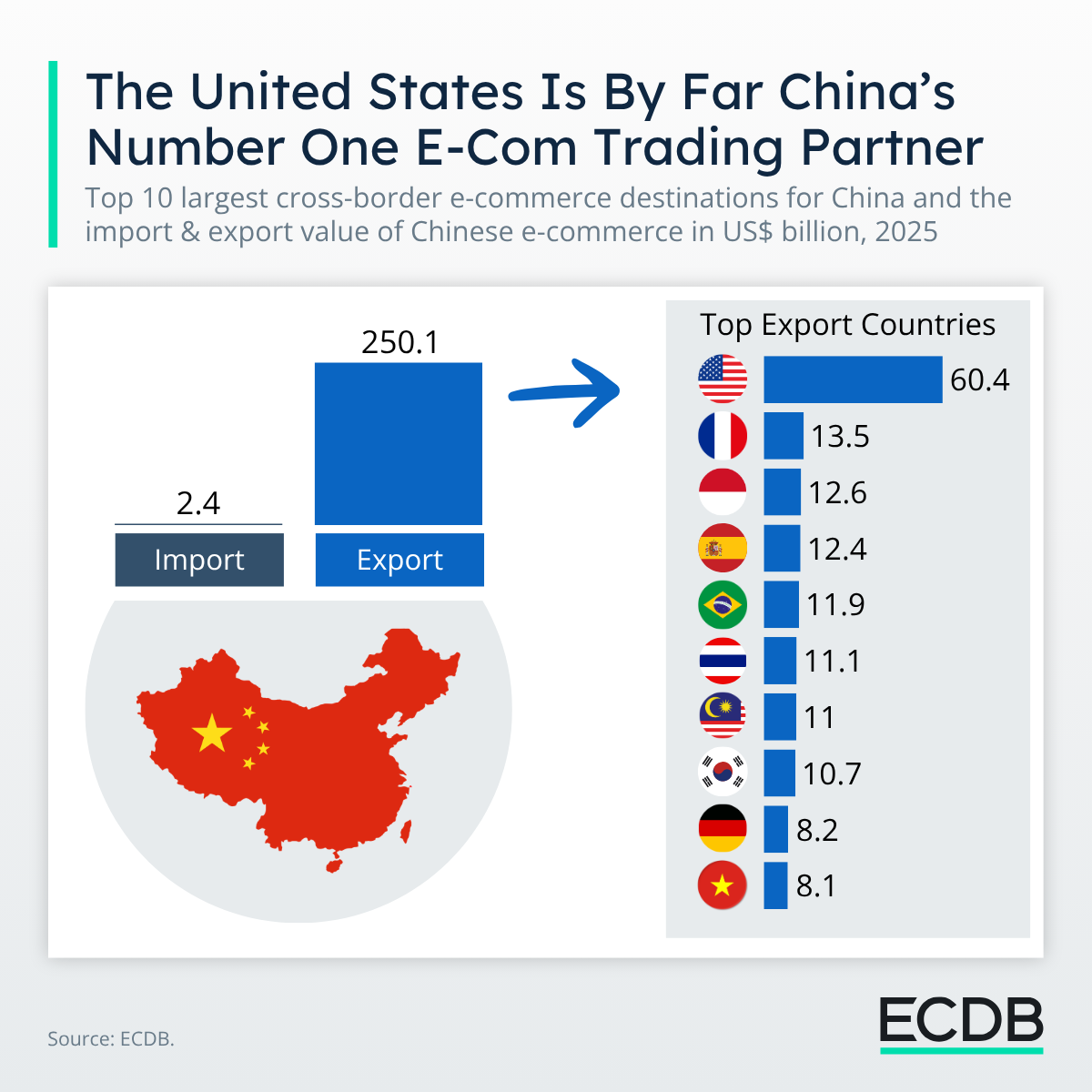
Political tension between the United States and China has defined headlines for years, but e-commerce data tells a different story. Trade rhetoric aside, the two markets remain deeply connected, and nowhere is that clearer than in cross-border parcel flows.
An Imbalanced Relationship: US-China Cross-Border E-Commerce Flows
China shipped US$250.1 billion worth of e-commerce goods abroad in 2025, and no single destination came close to matching the United States. American consumers received US$60.4 billion of that total, close to a quarter of all Chinese outbound e-commerce value. Despite tariffs, political friction, and repeated calls to reduce dependence on Chinese imports, the US remains by far the largest buyer of Chinese e-commerce goods.
The relationship looks completely different when the flow reverses. Very few cross-border parcels make their way into China. The country's e-commerce ecosystem is largely closed off to foreign sellers, with domestic platforms controlling most of what Chinese consumers buy online. Foreign retailers hoping to reach Chinese shoppers through cross-border channels operate in a market that gives them little room to gain ground. That closure appears to be deepening rather than easing. Inbound parcel values into China were actually higher in 2024 than in 2025, meaning the market grew even more domestically focused over the past year.
China's European Focus Deepened Over the Past Year
Outside the US, China's export pattern points increasingly toward Europe. France has become China's second-largest export destination, receiving US$13.5 billion in e-commerce shipments, a sign of Europe's growing weight in China's overall outbound strategy.
Southeast Asia remains another core region, anchored by Indonesia, Thailand, Malaysia, South Korea, and Vietnam. Indonesia stands out within that group, receiving US$12.6 billion in Chinese e-commerce shipments in 2025. That places Indonesia just behind France and narrowly ahead of Spain, which received US$12.4 billion.
Outlook: China Keeps Exporting, Regardless of Politics
These numbers make clear that China is fundamentally an exporter of e-commerce goods, not an importer, and that its export strategy still runs disproportionately through a small number of markets. The US sits at the top of that list by a wide margin, and Europe, led by France, is becoming increasingly important alongside it.
The broader lesson is that geopolitics and consumer commerce do not always move together. Trade tensions between Washington and Beijing have escalated repeatedly in recent years, yet Chinese e-commerce exports to the US have not meaningfully retreated. Consumers keep buying, platforms keep shipping, and for now, political rivalry and cross-border shopping habits are simply running on separate tracks.

Related Articles
All ArticlesReady to Unlock the Full Power of ECDB?
Book a demo to see how ECDB's market intelligence can support your business.