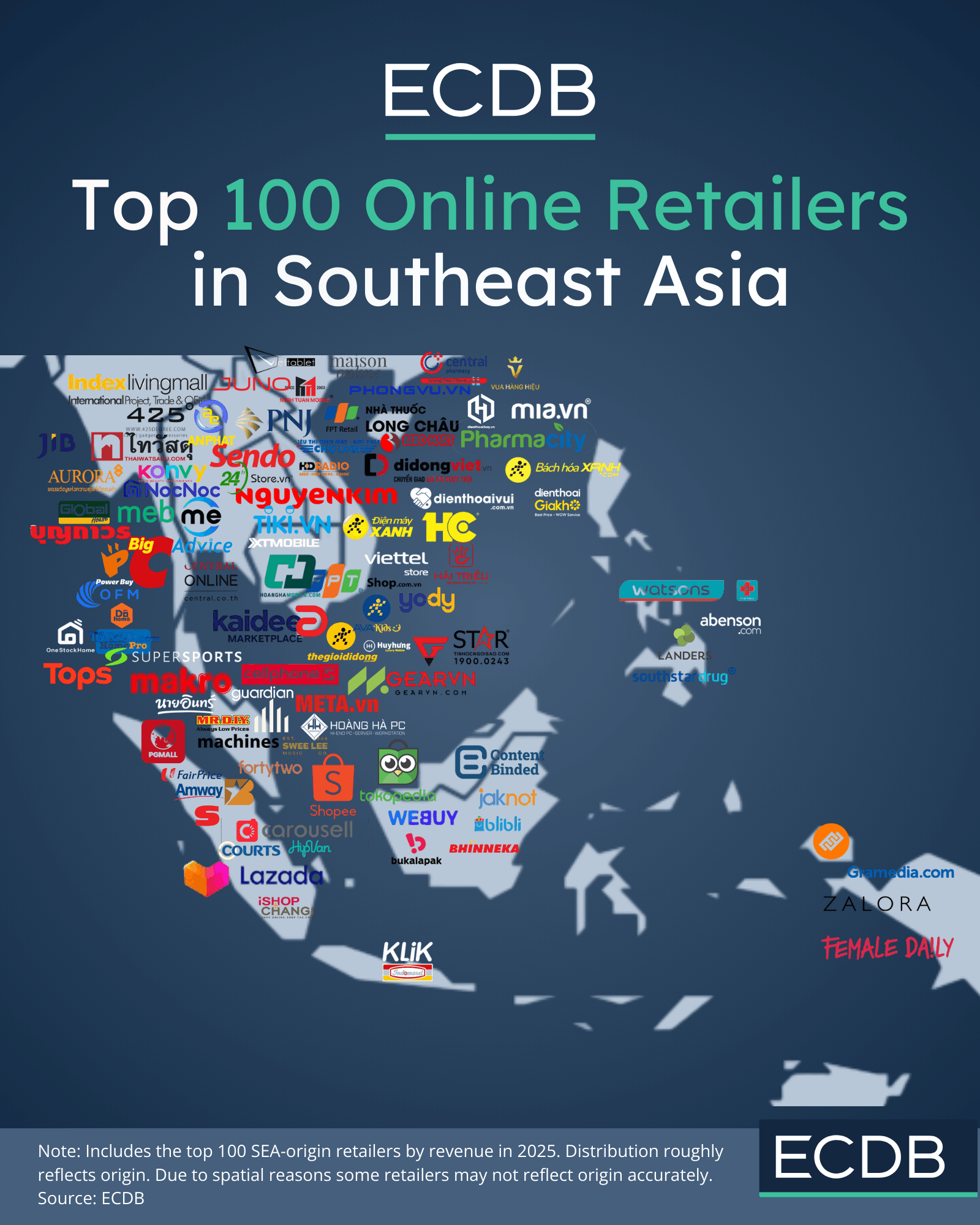
Key Takeaways from the Map:
Indonesia leads in revenue. Platforms such as Shopee and Lazada generate enormous GMV. They reinforce Indonesia’s role as the region’s e-commerce heavyweight.
Vietnam and Thailand are buzzing with activity. These markets host a large number of online retailers, but most operate at a smaller GMV scale: an unmistakable signal of untapped growth potential.
Many players, few giants. The map captures a dual reality. Widespread participation across countries, paired with revenue dominance by a small group of major platforms.
When we mapped the top 100 online retailers in Southeast Asia, two hotspots immediately jumped off the page: Vietnam and Thailand. The density of retailers in these two markets is so high that their footprint spills across borders, reaching into Laos, Myanmar, and Cambodia, and even stretching toward the South China Sea.
This visual concentration tells a much bigger story than geography alone. It reveals a region in the midst of rapid digital transformation, where e-commerce adoption is accelerating and competitive dynamics are still taking shape.
A Region Full of Energy and Imbalance
Southeast Asia is one of the world’s fastest-growing e-commerce regions, driven by a young population, rising smartphone penetration, and improving digital infrastructure. Yet despite the sheer number of active retailers, revenue remains highly concentrated.
A handful of large marketplaces dominate total GMV, while dozens of smaller players compete for the remaining share. The result is a market that feels both crowded and wide open at the same time.
What This Means for Southeast Asia's E-Commerce Future
This imbalance between activity and revenue suggests that Southeast Asia’s e-commerce story is far from finished. As logistics improve, cross-border trade expands, and consumers become more comfortable shopping online, today’s smaller retailers could become tomorrow’s regional leaders.