E-Commerce Company Graveyard of Failed Businesses in 2025
2025 has been a challenging year for many businesses, with some facing worst-case scenarios. For e-commerce and retail companies, this has meant bankruptcies, insolvencies, or closures of online stores by parent companies. Who has been affected most notably in 2025?

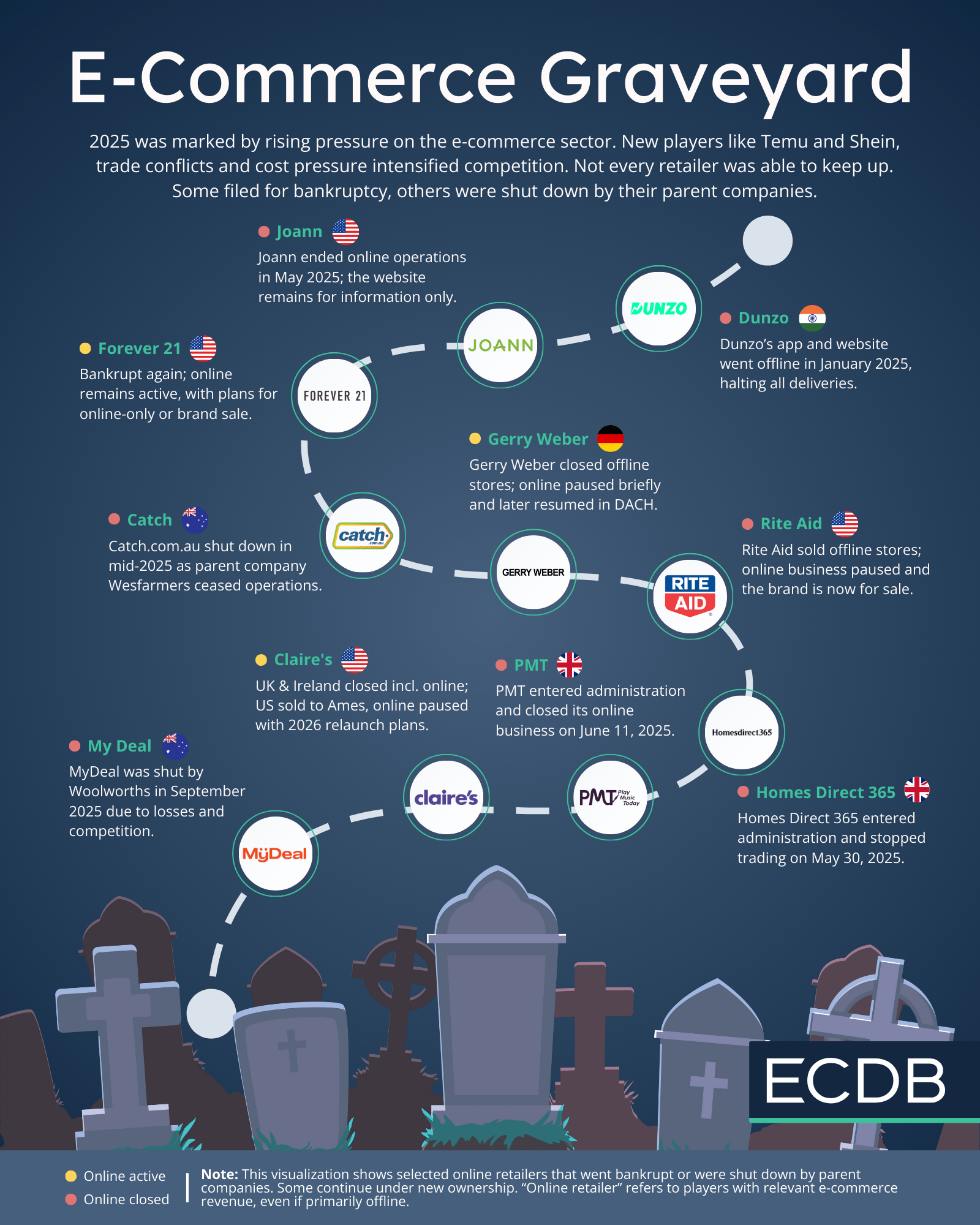
2025 has been a challenging year for many businesses, with some facing worst-case scenarios. For e-commerce and retail companies, this has meant bankruptcies, insolvencies, or closures of online stores by parent companies. Which brands have been hit this year, either discontinuing operations altogether or being sold to new owners?
US Retail Faces High-Profile Failures Amid Rising Competition from Low-Cost E-Tailers
Competition never sleeps, and struggling retailers found themselves outpaced by more profitable ventures and low-cost online platforms.
Two of retail’s household names, Joann and Claire’s, suffered in this environment. Joann ended its online operations in May, with its website remaining online for informational purposes only. Claire’s was acquired by private equity firm Ames Watson; while current stores are closed, plans for a relaunch are slated for 2026.
One of the most notable US bankruptcies involved Rite Aid, the long-struggling drugstore chain. Both offline and online operations were shuttered in spring 2025, with remaining assets now being acquired by competitors.
European Retailers Met Same Harsh Environment, Led to Closures Across Specialties
Across Europe, specialty retailers faced similar challenges. PMT (pmtonline.co.uk), a musical instrument specialist, found market conditions unsustainable, entering administration in summer 2025 and closing both its online and offline stores. Its assets were sold to competitors.
In Germany, fashion brand Gerry Weber was acquired by Spanish firm Victrix in early 2025. While physical stores were closed, the online store remains operational in the GSA region (Germany, Switzerland, Austria), and wholesale operations continue through other retail chains.
Forever21 Closed Physical Stores For Good, Online-Only Continues
Fast-fashion brand Forever21 has been struggling for some time now, with numerous takeovers and developments over the years. In 2025, its physical stores were discontinued, with restructuring plans. Only the online store remains in operation now to compete with ultra-fast fashion rivals.
E-Commerce Platform Closures: Dunzo, My Deal, Catch, Homes Direct 365
Beyond physical retail, the online environment is not less competitive. Platforms such as Dunzo in India, My Deal and Catch in Australia, and Homes Direct 365 in the UK have either shut down operations or were absorbed by larger players. They reflect the pressure on digital-first businesses to maintain relevance in a crowded market with many similar ventures out and operating.
Graveyard of E-Commerce Companies 2025: What It Means
2025 has reinforced an important lesson for retailers: success increasingly depends on agility, competitive pricing, and embracing digital innovation. Brands that were slow to adapt often faced closures, while those that could restructure, merge, or shift to online-only models managed to survive and position themselves anew for 2026.
The depiction highlights the competitiveness of business around the world. Many of the challenges stem from structural shifts, including profitability pressures and the post-pandemic normalization of online shopping, which saw temporary e-commerce spikes return to more sustainable levels. For some companies, e-commerce has offered a lifeline to escape unprofitability; for others, it has become a complex liability that requires careful management and strategic investment.
Related Articles
All ArticlesReady to Unlock the Full Power of ECDB?
Book a demo to see how ECDB's market intelligence can support your business.