Amazon Competitors in Europe: A Split in the Center Reveals Market Schism
Amazon is known as the eCommerce leader in most contexts. Shedding the light on Europe, where does the U.S. retailer actually rank first?

Amazon is the eCommerce leader in the Western hemisphere, even though it is already being overshadowed by few of its Chinese competitors. Within Europe, however, the U.S. giant’s image is that of an undisputed leader.
In how far is this the case? A more detailed look into European country rankings shows that Amazon captures certain parts of Europe’s market, but not all of it.
Some markets see local competitors or the low-cost platforms from abroad take a leap at the top spot. Here are the emerging patterns.
Amazon as the Number One or Amazon Below That?
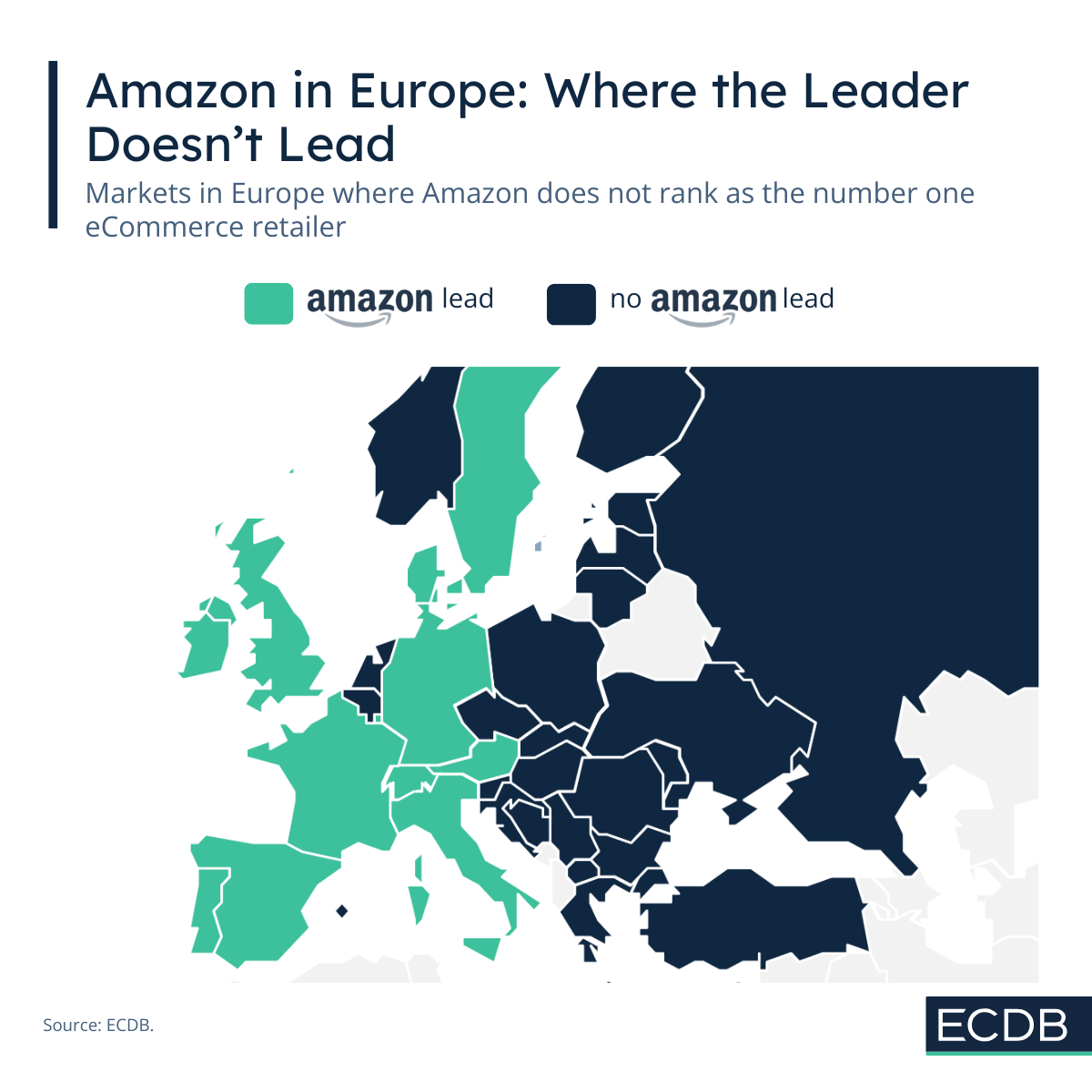
The map shows the countries in which Amazon ranks as the number one eCommerce provider. The dark blue shade does not mean that Amazon does not have a presence in the market, it is just not on the first spot.
The markets in which Amazon does not have a presence at all include most of Eastern Europe. To be fair, some consumers always find a way to order at Amazon cross-border, but these cases, especially if they are rare, are not implied in this analysis.
Where Amazon Does Not Lead or Is Not Present
A common conception about Amazon is that the company is the undisputed leader in Europe and North America. Where this may be the case in the latter, given it consists only of three countries, Europe is a more complicated case.
Europe is a quite diverse continent when it comes to culture, languages, and – shopping habits. Where Amazon may thrive in some markets, in others it is just not so competitive or accessible.
Then again, there are the markets where other companies hit a nerve that Amazon does not reach in the same way. For instance, in Poland Allegro takes the role as the number one marketplace that fulfills consumer needs left and right. Amazon.pl just launched recently, without much of a competitive edge to the already established number one, Allegro.
Having delayed launch is another case in the Center of Europe, the Netherlands and Belgium, where Bol ranks as the first provider. Bol started out as the eCommerce company to go for, remaining one step ahead of Amazon.
More generally though, Amazon is not present in other markets due to profitability reasons – either demand is not high enough or the landscape does not support a presence of Amazon logistics and fulfillment that is necessary to provide the trademark services having made the retailer distinct.
Amazon Takes the Lead in Western to Central Europe
In Western Europe, Amazon takes the lead as it is commonly referred to. The markets in which it places number one are the United Kingdom, Ireland, Spain, Portugal, France, the DACH region, Italy and Sweden.
For some of them, larger domains serve the smaller ones. Amazon.de has been a hub for neighboring countries where Amazon did not have an own presence. Only in recent years did these specific domains launch: amazon.nl (2020), amazon.pl (2021) and amazon.com.be (2022).
In addition to Amazon’s leadership in Central to Western Europe, the rise of Temu and AliExpress which has been rapid in the Eastern parts is also visible here. It is generally the case that if Amazon leads, it leads by a wide margin, but other competitors have risen so fast, the tables may turn in the medium long run.

Related Articles
All ArticlesReady to Unlock the Full Power of ECDB?
Book a demo to see how ECDB's market intelligence can support your business.