Article in a Nutshell:
Enabling independent commerce: Shopify powers millions of brands by providing infrastructure for direct-to-consumer models, allowing businesses to control their brand, customer relationships, and pricing.
Rapid and durable growth: In 2025, Shopify generated US$378 billion in GMV, a 29.3% year-over-year increase. It captured 6.2% of global e-commerce revenue in 2025.
Decentralizing e-commerce: The platform lowers barriers for small and mid-sized businesses, supports cross-border trade, and expands into payments and financing through Shopify Payments and Shopify Capital.
Regional strength and global potential: The Americas account for the majority of GMV. Shopify thrives where its language and ecosystem align with local markets, and its influence in global e-commerce is only growing.
Shopify is the company quietly powering millions of independent brands behind the scenes. Unlike marketplace models that aggregate sellers into a single consumer destination, Shopify provides the infrastructure that allows businesses to operate under their own brand, control their customer relationships, and build direct-to-consumer models at scale. It doesn’t compete as a retailer. It enables retailers.
Shopify Accounts for 6.2% of Global E-Commerce Revenues
Shopify’s 2025 annual results underline how large this ecosystem has become.
The company generated US$378 billion in Gross Merchandise Volume (GMV) in 2025. This marks a 29.3% increase year-over-year. It now accounts for 6.2% of global e-commerce revenue.
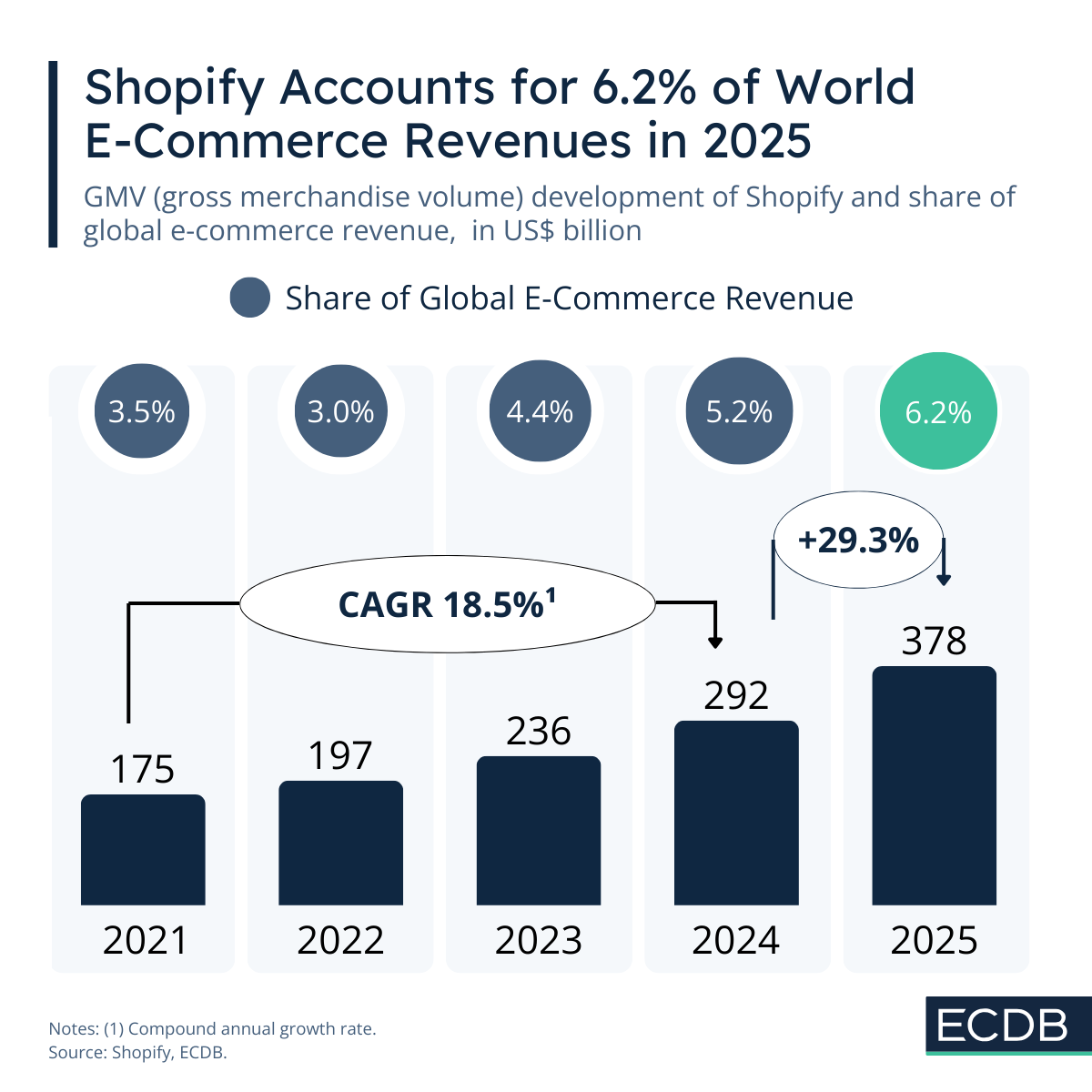
What’s particularly notable is that this growth is happening in a more mature e-commerce environment. The post-pandemic surge has normalized, yet Shopify continues to expand both volume and global share. This growth trajectory suggests that Shopify's concept is durable.
A Decentralizing Force in a Concentrated Market
Global e-commerce is becoming increasingly concentrated. Large marketplaces and countries dominate traffic, logistics, and consumer attention.
Yet Shopify reflects a countertrend: decentralization. It lowers barriers to entry for small and mid-sized businesses, enables cross-border commerce, and provides access to payments, financing, and operational tools that were once available primarily to large enterprises. Through services like Shopify Payments and Shopify Capital, the company has expanded from storefront software into financial infrastructure.
The result is a model where independent brands can scale globally without surrendering ownership of their customer data, pricing power, or brand equity.
The Americas as Core Engine
In 2025, US$238 billion of GMV was generated in the Americas, compared to US$79 billion in Europe. The company’s strength in North and Latin America reflects deep integration with the region’s small and mid-sized business ecosystem.
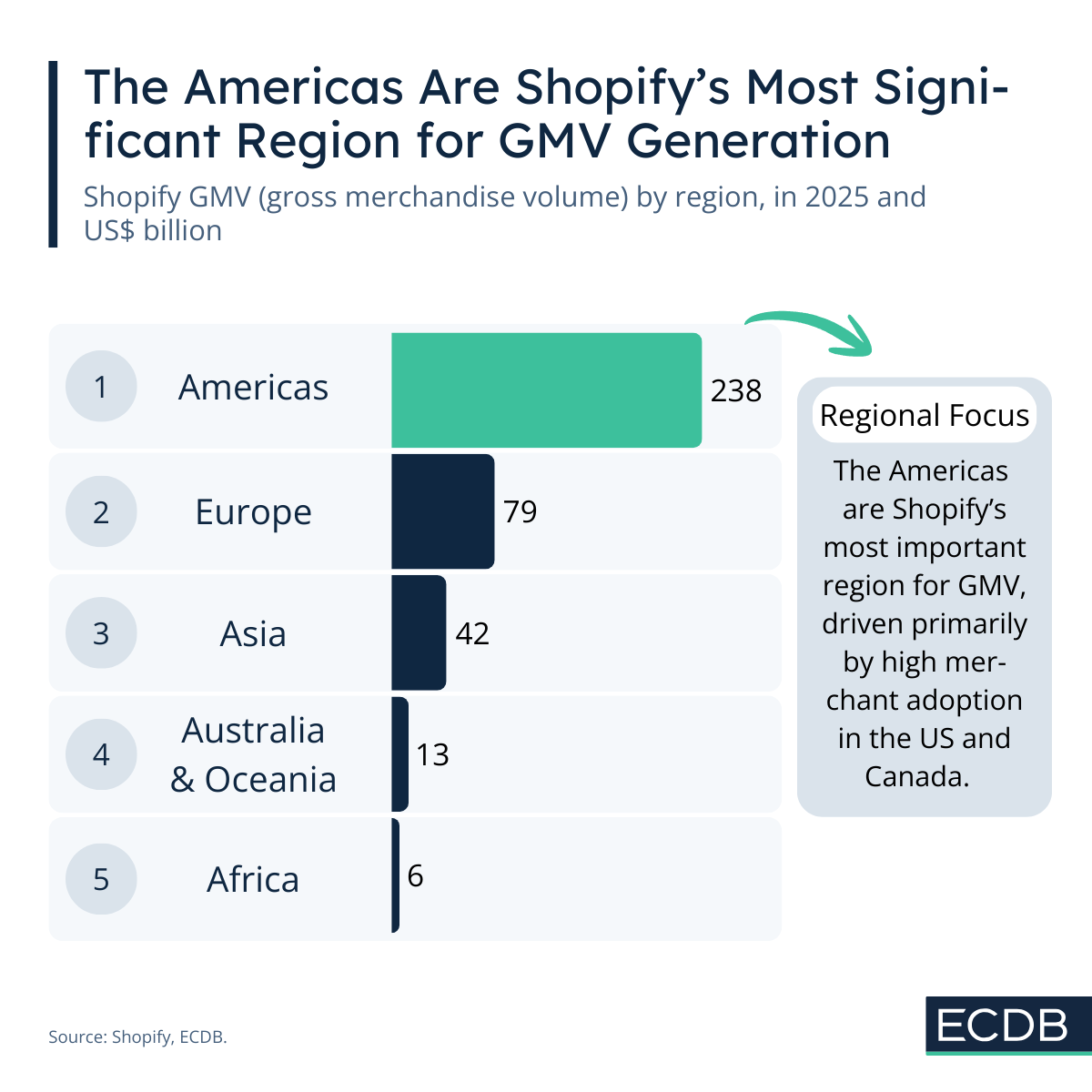
Shopify powers American online-first brands, omnichannel retailers, and cross-border sellers alike. It operates different than its competitor Magento in that sense, as Magento is widely adopted in European online retail. Even though Asia is not Shopify's core market, it is most widely used in APAC.
Language adoption plays a role because commerce platforms grow fastest where their interfaces, support, and partner networks align with local languages and business norms. Shopify’s English-first design fueled rapid adoption in North America, while Magento gained traction in Europe due to localization flexibility. In APAC, English proficiency and cross-border trade orientation have supported Shopify’s usage even though it is not the region’s primary market.
The Top 1% of Merchants on Shopify Drive 51% of Its Growth
Despite Shopify's significance for small and medium-sized businesses, its growth is nonetheless driven by professional/enterprise businesses selling through its service. Almost 90% of merchants on Shopify are small businesses, yet they account for less than 14% of GMV.
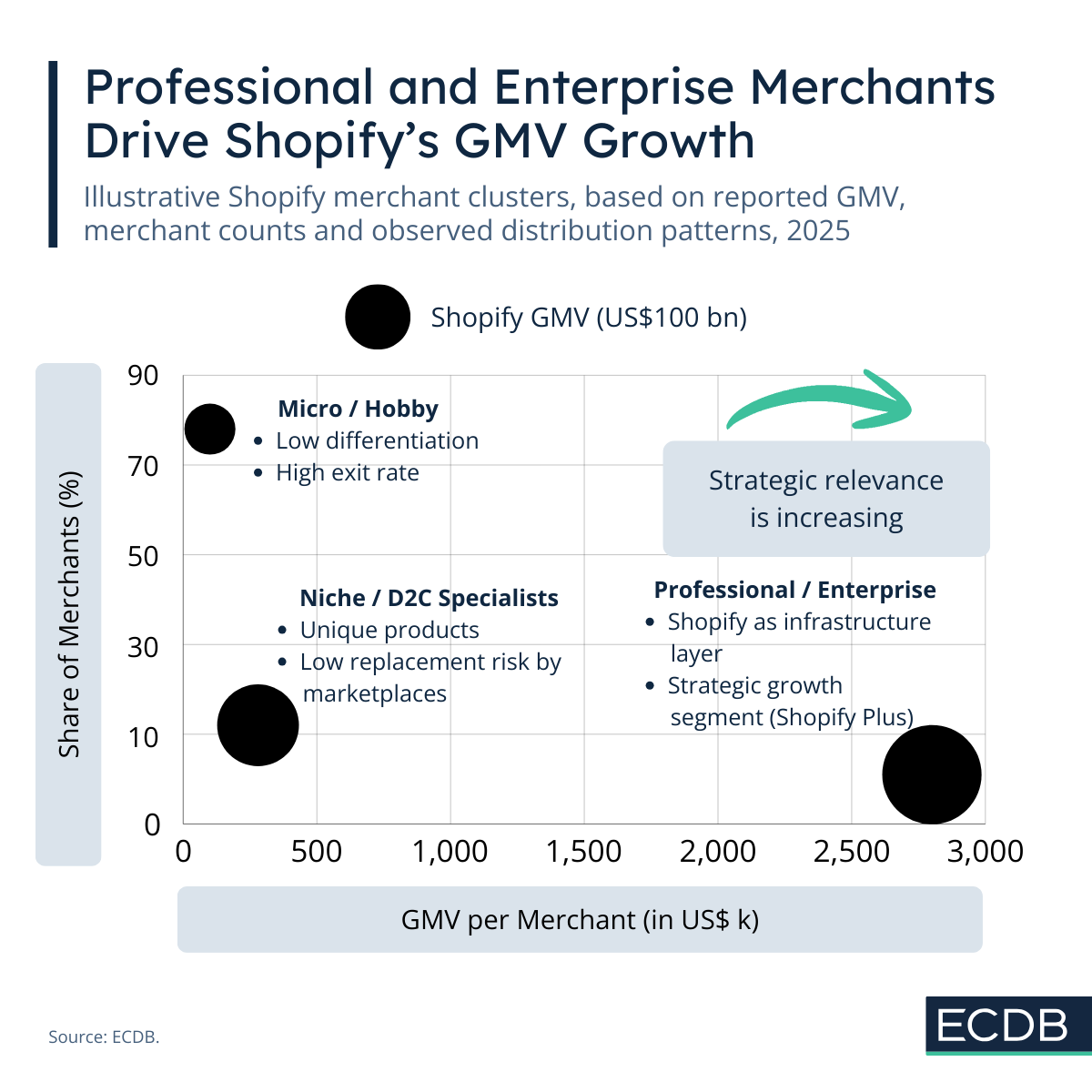
In 2025, 1% of merchants drove 51% of Shopify's GMV. This concentration illustrates a key dynamic: while Shopify enables millions of smaller businesses to launch and grow, its financial scale is heavily influenced by a core of professional sellers who leverage advanced features, omnichannel capabilities, and enterprise solutions like Shopify Plus.
The middle segment is more varied: 11% of merchants in the niche/D2C specialist category account for just over one-third of revenues. This highlights that mid-sized merchants can meaningfully scale with the right product-market fit and support and bridge the gap between micro-retailers and enterprise sellers.
Outlook: Shopify's Strength in Global E-Commerce
Shopify’s growth and geographic footprint show that digital commerce is no longer defined solely by marketplaces or regional dominance. Its platform empowers businesses to scale across borders while maintaining brand ownership and customer relationships. The software provider accounts for a substantial share of global e-commerce revenues, at 6.2%, and this influence will likely expand further in the years ahead.