Amazon Enters the Ultra-Value Race After Temu and Shein Gained Momentum
Amazon has launched Haul and Bazaar to compete in the ultra-value segment at a time when Temu and Shein have already built strong early traction. With both formats now live in 25 countries, Amazon is accelerating its global push toward budget-conscious shoppers.
Article in a Nutshell:
Amazon introduces Haul and Bazaar as a strategic response to ultra-low-price competitors.
Haul targets more developed, desktop-focused markets; Bazaar focuses on mobile-centric or less developed markets.
By late November, both formats were already active in 25 countries.
In the US, Temu (28%) and Shein (23%) show higher buyer penetration than Amazon Haul (16%).
Amazon enters the ultra-value competition later than its rivals — making the market outlook especially interesting.
Amazon is expanding into the ultra-value segment with two new formats: Amazon Haul and Amazon Bazaar. This move positions Amazon against a set of competitors that have already gained strong momentum, especially Temu and Shein. The rapid rise of ultra-low-price players has reshaped consumer expectations in many markets, creating a segment that Amazon can no longer ignore.
Amazon’s approach consists of two differentiated rollouts. Haul is introduced in more developed, desktop-oriented markets and is integrated into the existing Amazon ecosystem. Bazaar, in contrast, is aimed at more mobile-centric or less developed markets, where low-price formats often scale quickly. Together, both formats represent Amazon’s attempt to cover a broad spectrum of price-sensitive consumer groups.
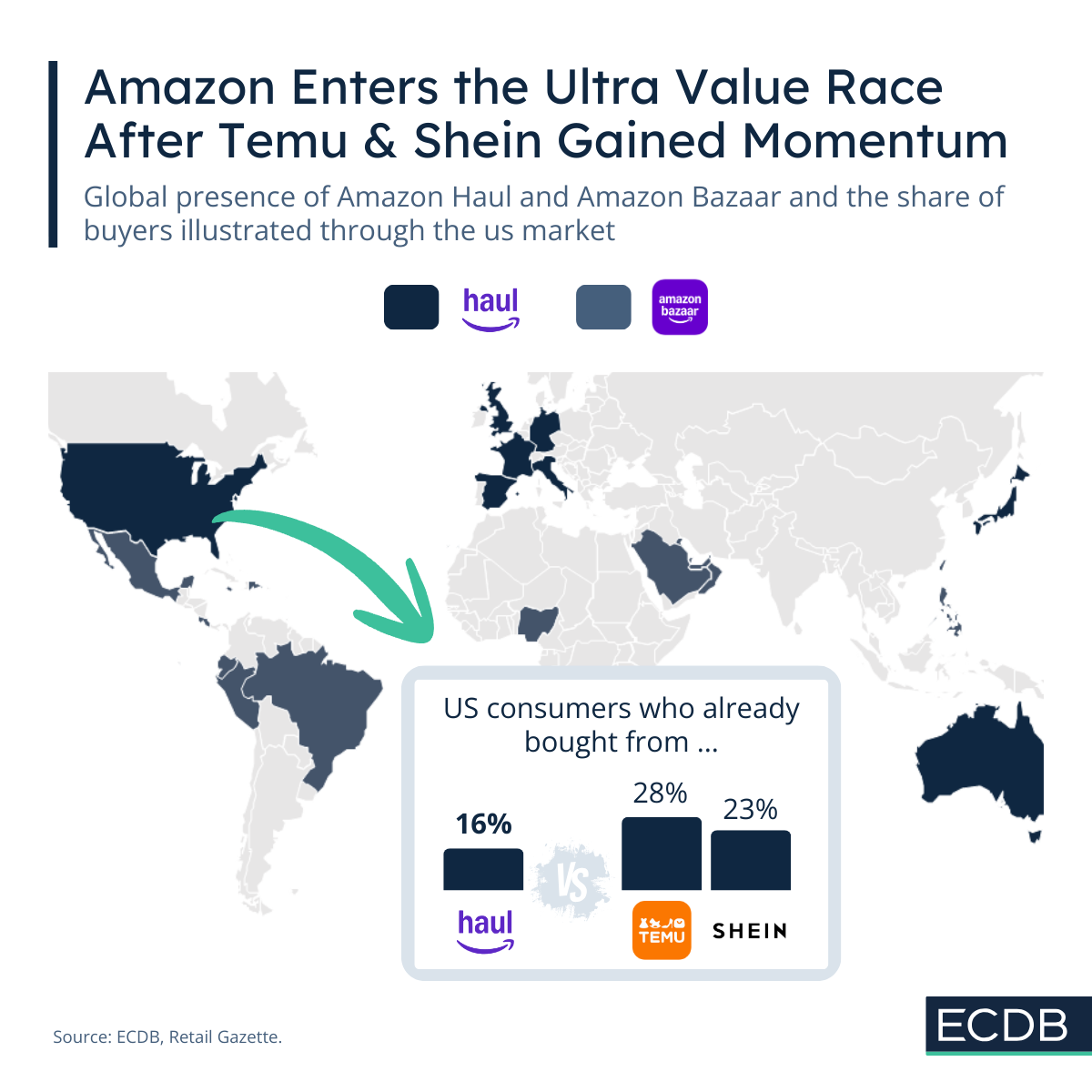
By the end of November, Haul and Bazaar were already live in 25 countries, demonstrating the speed at which Amazon is moving to strengthen its presence in this space. The geographic breadth of the rollout underlines that the ultra-value offering is not a niche initiative, but part of a larger strategic expansion.
The competitive intensity becomes especially clear when looking at the US market. A significantly larger share of consumers has bought from Temu (28%) or Shein (23%), compared with 16% for Amazon Haul. These numbers do not predict the long-term outcome for Haul or Bazaar, but they highlight one key factor: Amazon is entering the ultra-value market later than its competitors, who have already built meaningful traction.
As the global race for budget-conscious shoppers accelerates, Amazon’s late but highly coordinated move makes the competitive landscape increasingly dynamic. The coming year will show whether Haul and Bazaar can close the gap — and how strongly Amazon can position itself in a segment where others are already ahead.

Related Articles
All ArticlesReady to Unlock the Full Power of ECDB?
Book a demo to see how ECDB's market intelligence can support your business.