Temu Ranks First in Four European Markets in 2025
Temu ranks as the number one retailer in Finland, Croatia, Hungary and Slovenia. Across the continent, Temu fairs well overall. Here is how it performs.
Inside JD.com’s European Strategy
Joybuy appeared quietly across Europe just as JD.com secured control over MediaMarkt and Saturn. Traffic data reveals that Joybuy remains vanishingly small — but its footprint looks remarkably similar to MMS. Is JD Joybuy a strategic testbed rather than a full retail push? The numbers offer compelling clues.
David Niemeier
December 08, 2025
Retailers
Article in a Nutshell
Joybuy appeared in DE, NL, UK, FR, BE, and LU as JD.com advanced its MediaMarkt–Saturn acquisition.
Joybuy’s traffic is extremely small - only about 1/104 of MediaMarkt and on the scale of mediamarkt.ch.
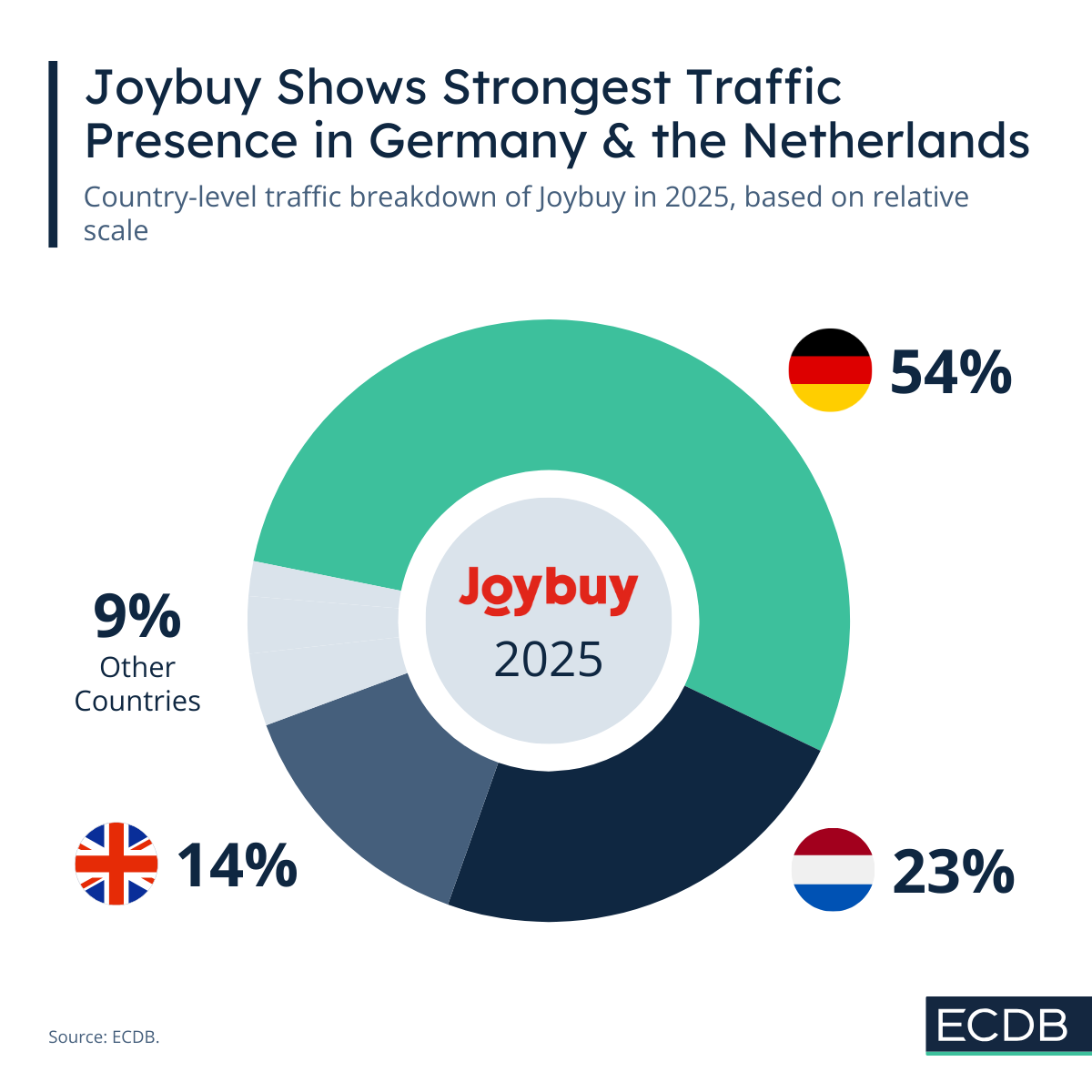
Germany and the Netherlands account for more than 75% of Joybuy traffic, closely resembling MMS’s European footprint.
The Netherlands’ share is inflated through redirects from Ochama.
Domains like joybuy.de existed since 2021, which indicates long-term planning.
The small scale, Beta label, and experimental Joybuy products suggest Joybuy JD is a testing sandbox, not a standalone competitor.
Signals indicate Joybuy may help validate assortment, logistics, pricing and demand patterns before MMS is fully integrated.
As JD.com finalizes majority control over MediaMarkt and Saturn (MMS), Joybuy has quietly emerged in six European markets: Germany, the Netherlands, the UK, France, Belgium and Luxembourg. In some cases, Joybuy replaced former JD presences, while in the Netherlands its traffic is notably strengthened through redirects from Ochama. This parallel development immediately raises the core strategic question: if MMS is the central European retail vehicle, what role does the Joybuy company play?
Traffic data provides the most objective signal at this early stage, and the result is unambiguous: Joybuy is vanishingly small in comparison to MMS. Its total traffic volume is around 104× smaller than MediaMarkt overall, and even Saturn achieves more than triple Joybuy’s visibility. Taken across all operational markets, Joybuy’s footprint sits roughly at the level of mediamarkt.ch — a country-specific MediaMarkt instance focused almost solely on Switzerland. That scale alone suggests that JD Joybuy is not positioned as a competitor or parallel electronics retailer, but something more exploratory in purpose.
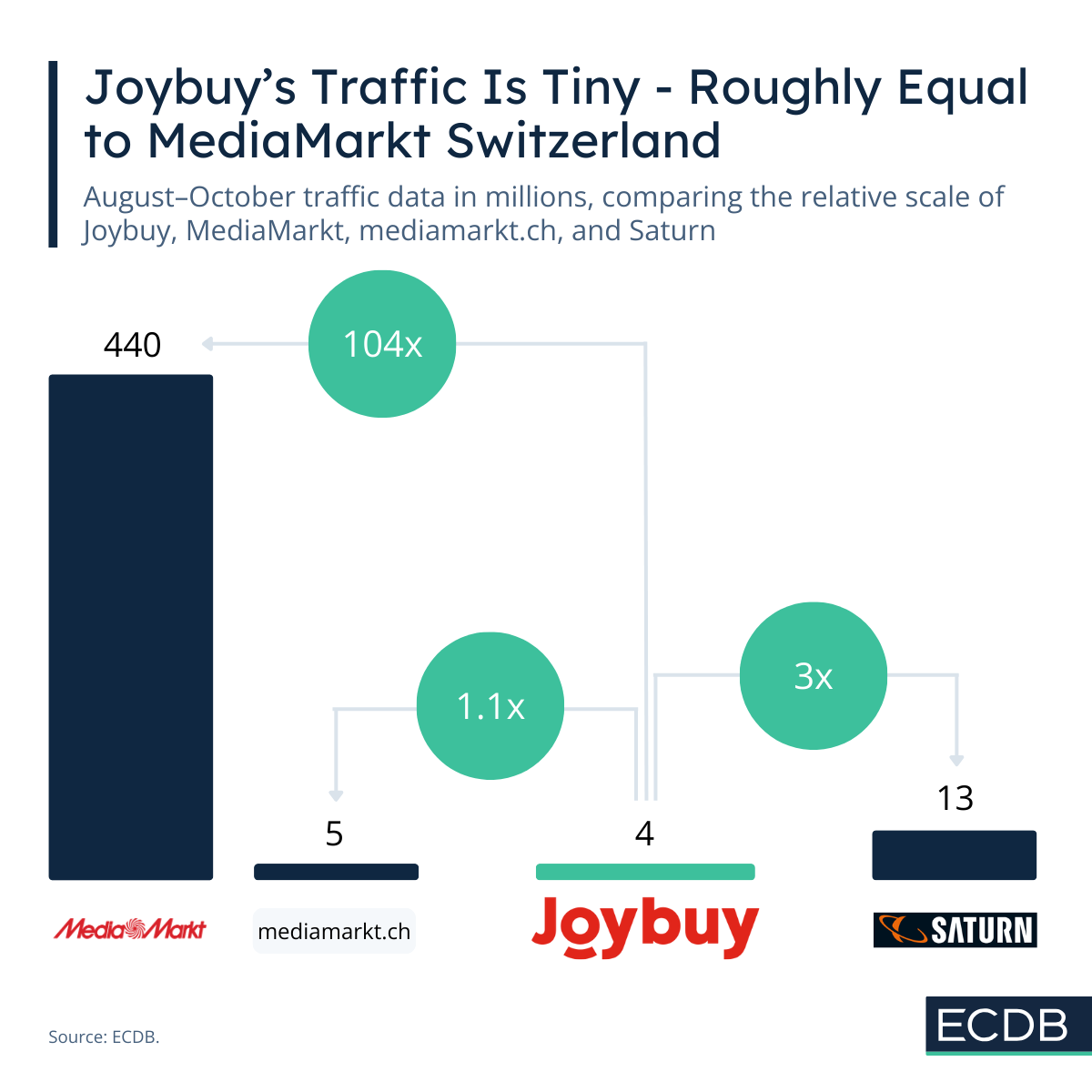
Given this, Joybuy JD currently looks commercially insignificant. But strategically, its minimal footprint is precisely what makes it interesting: it is small enough to run tests without market pressure, and present in the exact countries that matter most for MMS.
A closer look at the regional composition confirms that Joybuy mirrors MMS far more than random expansion patterns. 54% of all traffic originates from Germany, another 23% from the Netherlands, while the UK contributes 14%. France, Belgium and Luxembourg are share-wise marginal. In total, more than three-quarters of Joybuy traffic comes from just two markets - a proportion very similar to the MediaMarkt–Saturn footprint. The Netherlands’ inflated share is directly connected to redirects from Ochama, while Germany represents Joybuy’s most developed organic position.
The Joybuy company also carries signs of early planning. Domains like joybuy.de were registered as early as 2021, well before the MMS deal became public. Combined with the Beta label, inherited traffic and the constrained range of Joybuy products, the shop does not resemble a full commercial rollout. Instead, the numbers point toward Joybuy JD functioning as a controlled environment — one that can test demand signals, category interest, pricing corridors or logistical workflows in the same markets where MMS will later operate at scale.
In that sense, the imperfect assortment, uneven UX and limited output of Joybuy products are not evidence of failure, but indicators of intent. If Joybuy is meant as experimentation, refinement matters more than reach. And aligning its geographic structure with MMS markets makes that experimentation more meaningful.
Based on current data, Joybuy’s purpose becomes clearer. The shop is too small to indicate a standalone retail strategy, yet too strategically aligned with MMS to be dismissed as coincidence. A footprint that mimics MMS, domains registered long in advance, inherited traffic sources, Beta positioning and an immature selection of Joybuy products collectively form a pattern: JD Joybuy is almost certainly being used to test European assumptions before MMS becomes the operational core.
Traffic only on the level of mediamarkt.ch makes Joybuy irrelevant as a challenger, but useful as a pilot. Its deployment during the MMS acquisition process, and its quiet, low-risk visibility, fit the purpose of gathering signals on real customers, category performance and market sensitivity. At this stage, Joybuy is not designed to win - it is designed to learn. And once MMS is fully integrated under JD.com’s ownership, those learnings may turn into strategic execution at European scale.

Related Articles
Temu ranks as the number one retailer in Finland, Croatia, Hungary and Slovenia. Across the continent, Temu fairs well overall. Here is how it performs.
Amazon generated US$847.4 billion in 2025, and 86% of this figure come from only seven markets. Outside that group, even within its own top 10, Amazon's lead already thins.
Sephora is the biggest online beauty retailer by GMV, but that doesn't mean it wins on every other KPI. Here is why it still emerges on top.

Click here for
more relevant insights from
our partner Mastercard.
Book a demo to see how ECDB's market intelligence can support your business.