E-Commerce Maturity by Region: North America Sets the Pace
North America is wide ahead in e-commerce penetration, at an online share of 30.4% in 2026. Here is why the region leads.

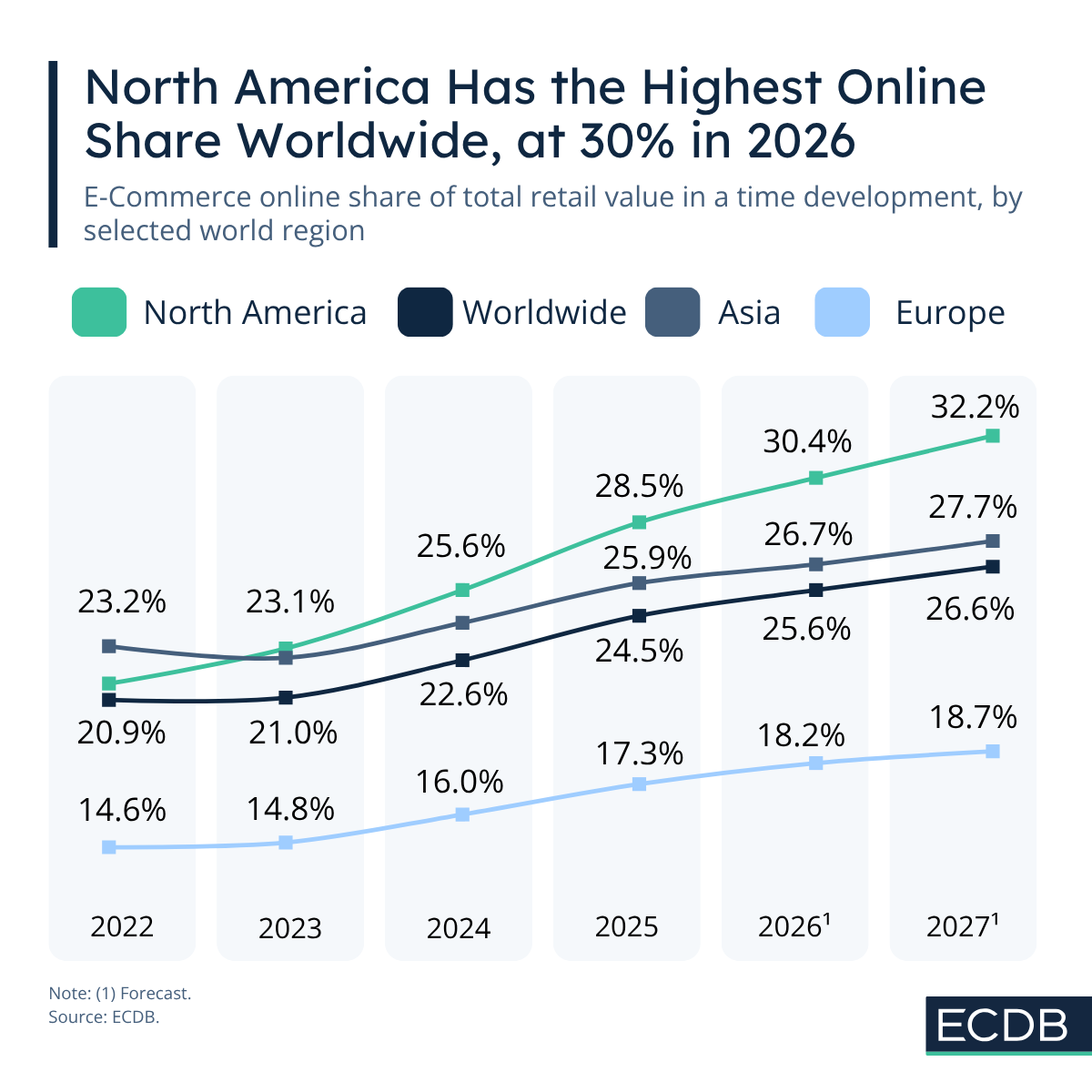
North America stands as the most mature e-commerce market worldwide, with 30.4% of total retail revenues generated through online channels. That’s nearly one in three retail dollars.
The North American online share stands significantly above global levels and is well ahead of other major regions. Find the reasons for its leadership in e-commerce penetration here.
A Global Snapshot
To understand the gap, it helps to zoom out:
Globally, e-commerce is expected to account for 25.6% of retail revenues in 2026
Asia slightly exceeds that average at 26.7%, driven by wide digital adoption and large-scale platforms
Europe lags, as its online penetration doesn't even reach 20% in the coming year
E-Commerce growth is a global phenomenon, but its pace of development varies widely.
Why North America Is Ahead
North America's lead is the result of several reinforcing factors:
Market Consolidation
A handful of dominant retailers have created a gravitational pull, which accelerates both business participation and consumer adoption.
Infrastructure Maturity
Highly developed logistics networks, reliable last-mile delivery, and seamless payment systems reduce friction across the entire buying journey.
Consumer Trust
Online shopping is deeply embedded in everyday life, from discretionary purchases to essential goods.
Together, these elements create a flywheel effect: better infrastructure drives adoption, which attracts more sellers, which in turn improves selection and convenience.
Europe's Structural Challenges
Europe's slower adoption shows how structural factors can limit growth. The region faces a more fragmented market landscape, with multiple languages, regulatory frameworks, and consumer preferences. Add to that a strong legacy of offline retail and stricter regulatory environments, and the result is a slower transition to online, especially in fast-moving categories like grocery and everyday commerce.
Outlook: The Role of Platforms and Unified Systems
North America and Asia benefit from higher levels of consolidation through dominant marketplaces. These platforms act as accelerators, bringing together supply and demand at scale.
Combined with unified logistics and payment ecosystems, they create the conditions for rapid e-commerce growth, across categories and customer segments alike.

Related Articles
All ArticlesReady to Unlock the Full Power of ECDB?
Book a demo to see how ECDB's market intelligence can support your business.