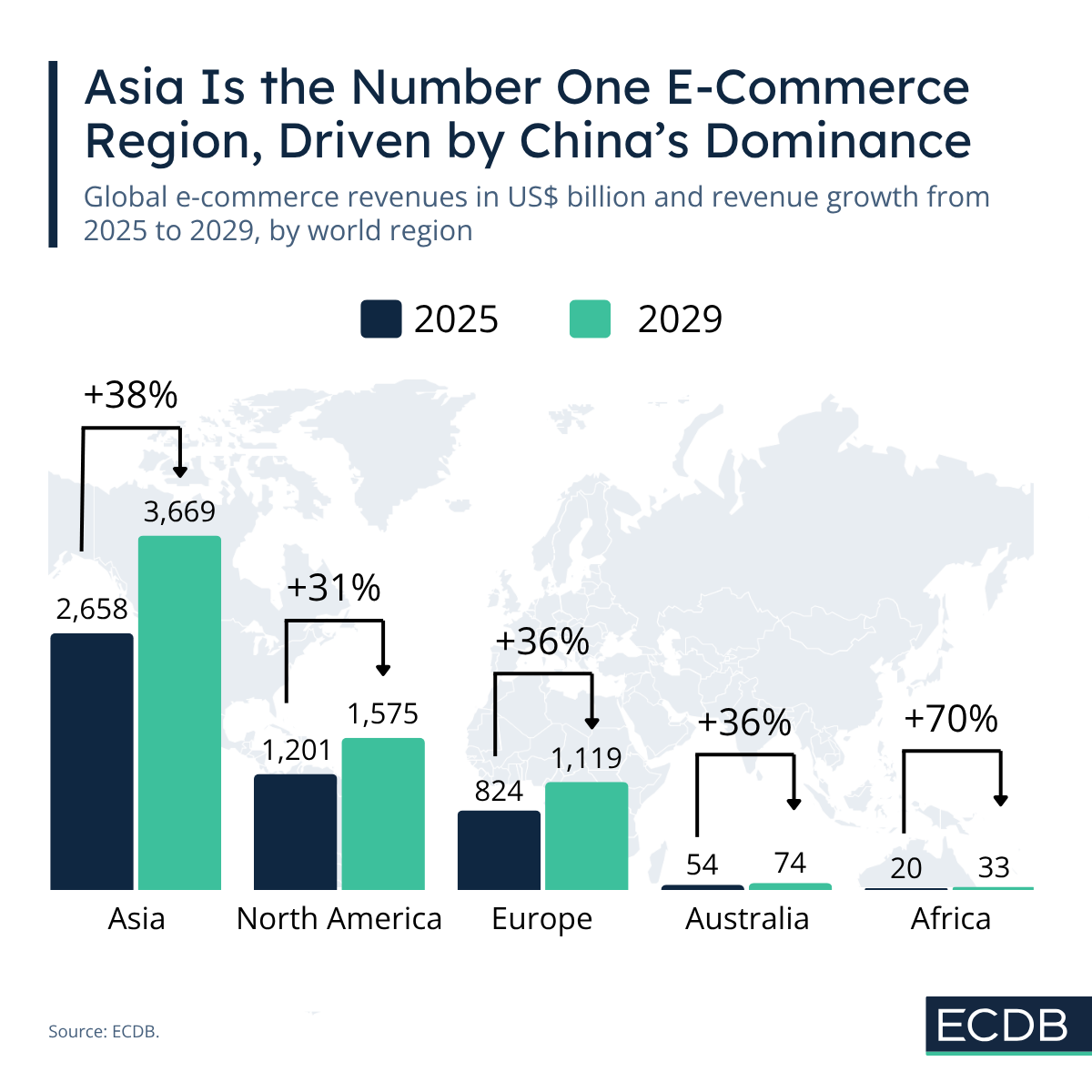
While North America and Europe remain among the world's largest online retail markets, Asia has established itself as the clear leader in e-commerce revenue and continues to widen the gap. The region's size, innovation, and ongoing digital transformation make it the undisputed number one region in global online retail.
Asia Ahead in E-Commerce Revenues and Growth
By 2029, Asia is projected to generate US$3.7 trillion in e-commerce revenues, more than double the expected size of North America's US$1.6 trillion market and well ahead of Europe's US$1.1 trillion. Australia and Africa are also expected to grow, reaching US$74 billion and US$33 billion respectively, but from a much smaller base.
The reasons behind Asia's dominance are both structural and strategic. While China remains the primary engine of growth, the region's future is increasingly being shaped by the rise of India and Southeast Asia.
China: The Foundation of Asia's E-Commerce Leadership
China has built one of the most sophisticated digital commerce ecosystems in the world. Its success is not simply the result of market size, but of years of innovation across the entire online shopping value chain.
The following factors account for its success:
The market's sheer size and quick digitization certainly account for a huge portion of China's dominance.
Mobile commerce adoption and integration of shopping into app ecosystems accelerate growth and normalize e-commerce.
Marketplace giants have built massive digital ecosystems that seamlessly combine product discovery, shopping, payments, logistics and customer engagement.
Social commerce and livestream shopping have become mainstream consumer behaviors, advertising products effectively.
Together, these factors have transformed China into the world's largest e-commerce market and the main reason Asia remains far ahead of every other region.
The Next Growth Wave Is Coming from India and Southeast Asia
India and Southeast Asia are emerging as some of the most promising digital commerce markets globally. Countries such as Indonesia, Vietnam, the Philippines, Thailand, and Malaysia are experiencing rapid growth in online retail adoption as internet access expands and digital infrastructure improves.
Why Europe and North America Are Behind
Europe and North America remain critical pillars of the global e-commerce industry. Together, they account for trillions of dollars in online retail spending and host many of the world's most established digital commerce businesses. But digital growth is more constrained by size, market maturity and slower adoption of fast-moving trends that accelerate growth.
Online shopping is already deeply embedded in consumer behavior, internet penetration is near saturation, and e-commerce accounts for a significant share of total retail sales. As a result, future growth is more likely to come from incremental gains rather than large-scale adoption shifts.
Outlook: Asia's Lead Is Built for the Long-Term
With China at its core, Asian e-commerce is shaped by China's leadership. The country remains the largest and most influential digital commerce market in the world.
But the region's continued growth is increasingly supported by a broader ecosystem of emerging markets that are still far from reaching their full potential.
India and Southeast Asia are adding millions of new online shoppers every year, marketplace ecosystems are expanding rapidly, and digital infrastructure continues to improve across the region.
Beyond Asia, several regions are also showing encouraging signs of development.
Africa's e-commerce sector remains relatively small today, but increasing smartphone adoption, expanding internet connectivity, and growing digital payment infrastructure are laying the groundwork for future growth.
Australia continues to benefit from high levels of digital adoption and strong consumer purchasing power, although its smaller population limits overall market size compared to larger regions.