We now have often reported about the increasing market concentration in e-commerce. Looking at examples across Europe helps turn this abstract trend into something concrete.
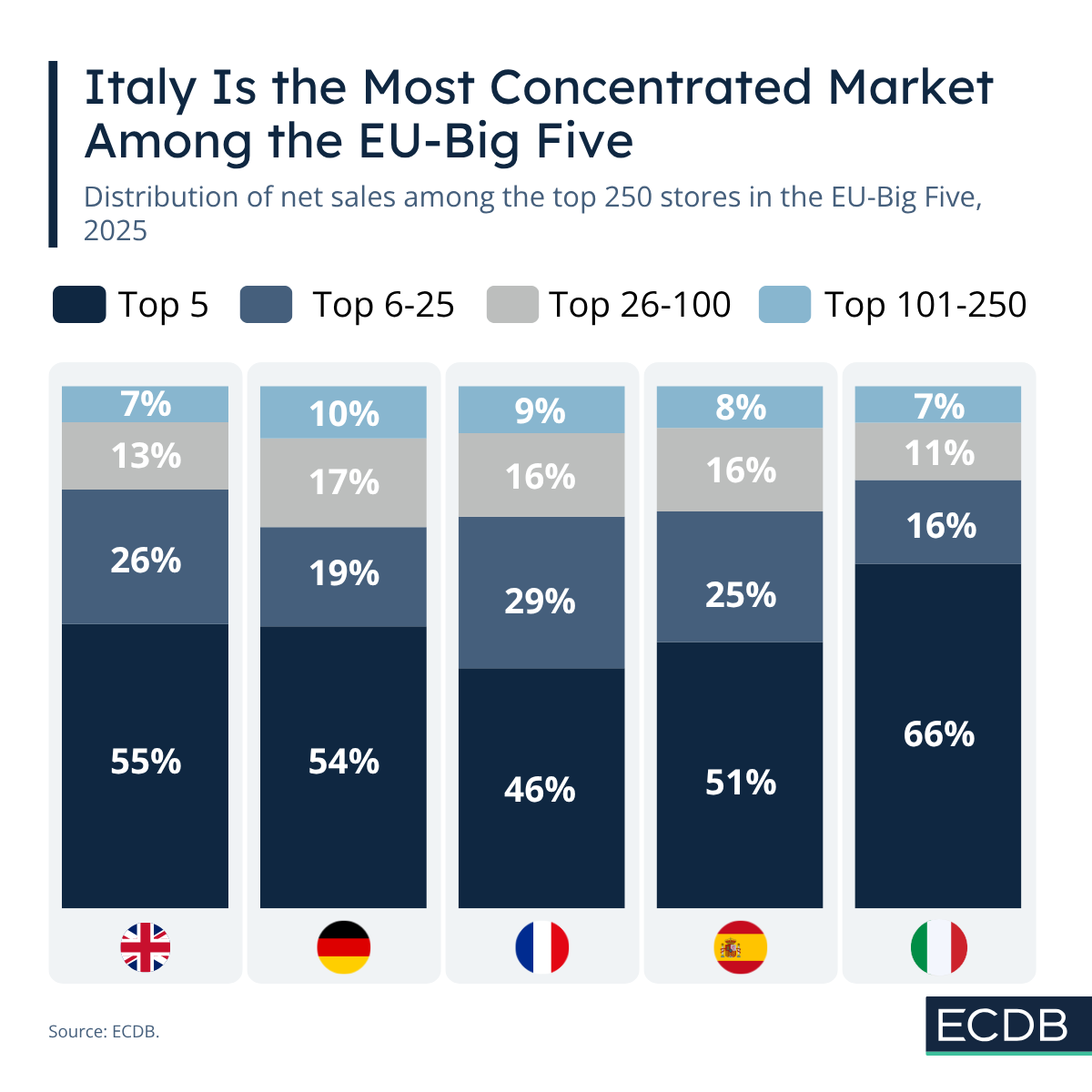
In Italy, market concentration is especially pronounced among the EU-Big Five. Just five players account for 66% of net sales among the top 250 online stores in the country.
The five stores doing the heavy lifting are Amazon.it, Shein.com, eBay.it, AliExpress.com, and Temu.com. Look closely at that list and a second story emerges alongside the concentration story: Asian platforms are no longer fringe players in Italy. They sit at the very top of the ranking, increasingly visible among the country's leading online stores.
How Italy Compares to the Rest of the EU-Big Five
Concentration varies a lot across Europe's largest markets. Here's how the top five players' share of net sales stacks up:
Italy sits clearly ahead of the pack. France anchors the other end, with the lowest concentration of the five and a noticeably larger share of sales spread across stores ranked below the top five.
Why Concentration Is a Competitive Question
Market concentration shapes how hard it is for challengers to grow. In a highly concentrated market, a handful of dominant players capture most of the available demand, leaving little oxygen for everyone else. In a more fragmented market, smaller and mid-sized retailers have more room to carve out a position and grow sustainably.
That's the real difference between Italy and France. It isn't simply about who leads, because the leaders look strikingly similar. France's top five are Amazon.fr, Shein.com, Temu.com, AliExpress.com, and Carrefour.fr. The same global platforms dominate the conversation across both markets.
The difference is what happens after the top five. In France, more demand flows into the long tail of stores beyond the leaders, which means challengers have more space to grow. In Italy, that space is far narrower.
Takeaway: Concentration Helps Indicate Entry Potential
Market size, consumer behavior, and competitive structure all influence how strongly dominant platforms shape a country's e-commerce landscape. For anyone planning where and how to compete, the leaderboard is only half the picture.
The more revealing questions are: How concentrated is the market? How much demand is actually distributed across the long tail? And where, exactly, can a challenger still find room to grow?
In Italy, the answer is sobering; most of the market already belongs to a few giants. In France, there's still meaningful room beyond the leaders. Knowing which kind of market you're entering is the difference between a viable growth plan and a costly miscalculation.