Poland vs. DACH/GSA: E-Commerce Category Mix Compared
Central European category splits show a distinct pattern, which fits the mix in Germany, Austria and Switzerland. Poland shows a different pattern. Here is why.
Acquisition Proposition
GameStop CEO Ryan Cohen claims that under his leadership, eBay could rival Amazon. Here’s what ECDB data reveals about the size gap, potential upside, and the execution challenge behind that vision.

Nadine Koutsou-Wehling
Data Journalist
May 06, 2026
Market Trends
Article in a Nutshell
GameStop has made a surprise $55.5B bid to acquire eBay, with CEO Ryan Cohen suggesting it could eventually rival Amazon.
The scale gap is significant: GameStop (~$11B) trails eBay (~$45B) and is dwarfed in GMV by both eBay (~$78.8B) and Amazon (~$893.9B)
Strategically, the deal would instantly expand GameStop’s global e-commerce reach, especially in Europe, where eBay holds strong market share.
Despite the ambition, analysts remain skeptical due to financing risks, integration complexity, and doubts over whether the combined entity could realistically challenge Amazon’s dominance.
GameStop, best known for its short squeeze during the pandemic, has just made a headline-grabbing move: a surprise offer to acquire one of the internet’s original giants, eBay.
Not only that, but GameStop CEO Ryan Cohen claims that under his leadership, eBay could be transformed into a serious competitor to Amazon.
Investors and analysts treat the bid with caution. The proposal itself values eBay at US$55.5 billion, or US$125 per share, structured as a cash-and-stock-transaction that is aimed at taking control of the global e-commerce marketplace. Here is what that would mean for all parties involved.
The challenge becomes clear when comparing the underlying scale of the businesses involved. GameStop sits at roughly US$11 billion in market value, contrasted by eBay's US$45 billion.
And when you move beyond valuation into actual marketplace activity, the differences widen further. In terms of Gross Merchandise Volume (GMV), eBay processes around US$78.8 billion, roughly 167 times GameStop's volume.
But Amazon operates at approximately $893.9B, more than 11x the combined GMV of GameStop and eBay.
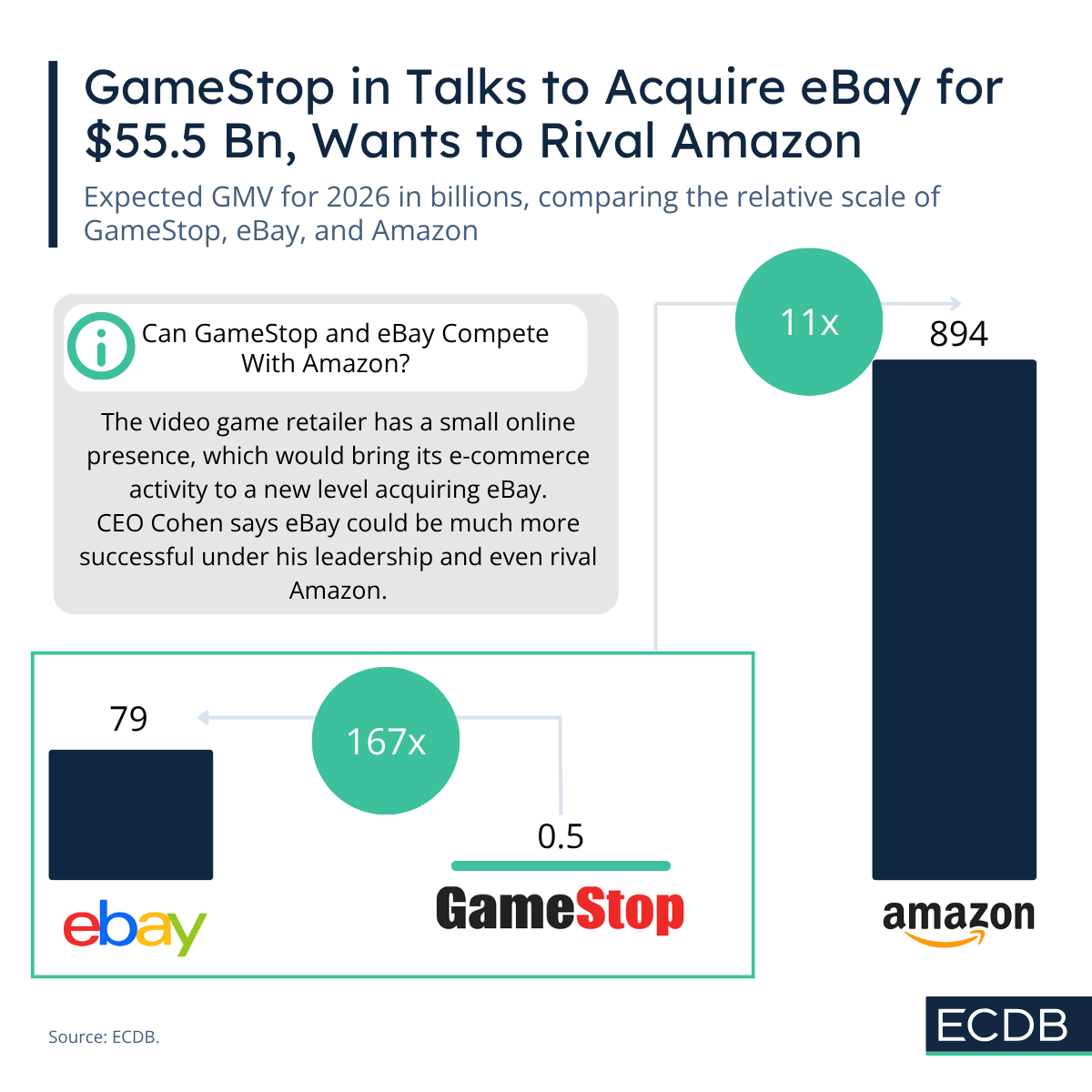
These differences raise the question whether a successful acquisition can realistically challenge Amazon's dominance in e-commerce. The three players reflect entirely different levels of platform maturity and ecosystem depth.
But even without it, GameStop would significantly improve its worldwide e-commerce standing.
From a strategic perspective, the logic behind the move is relatively straightforward. If successful, the move would give GameStop immediate access to global marketplace infrastructure, especially in Europe.
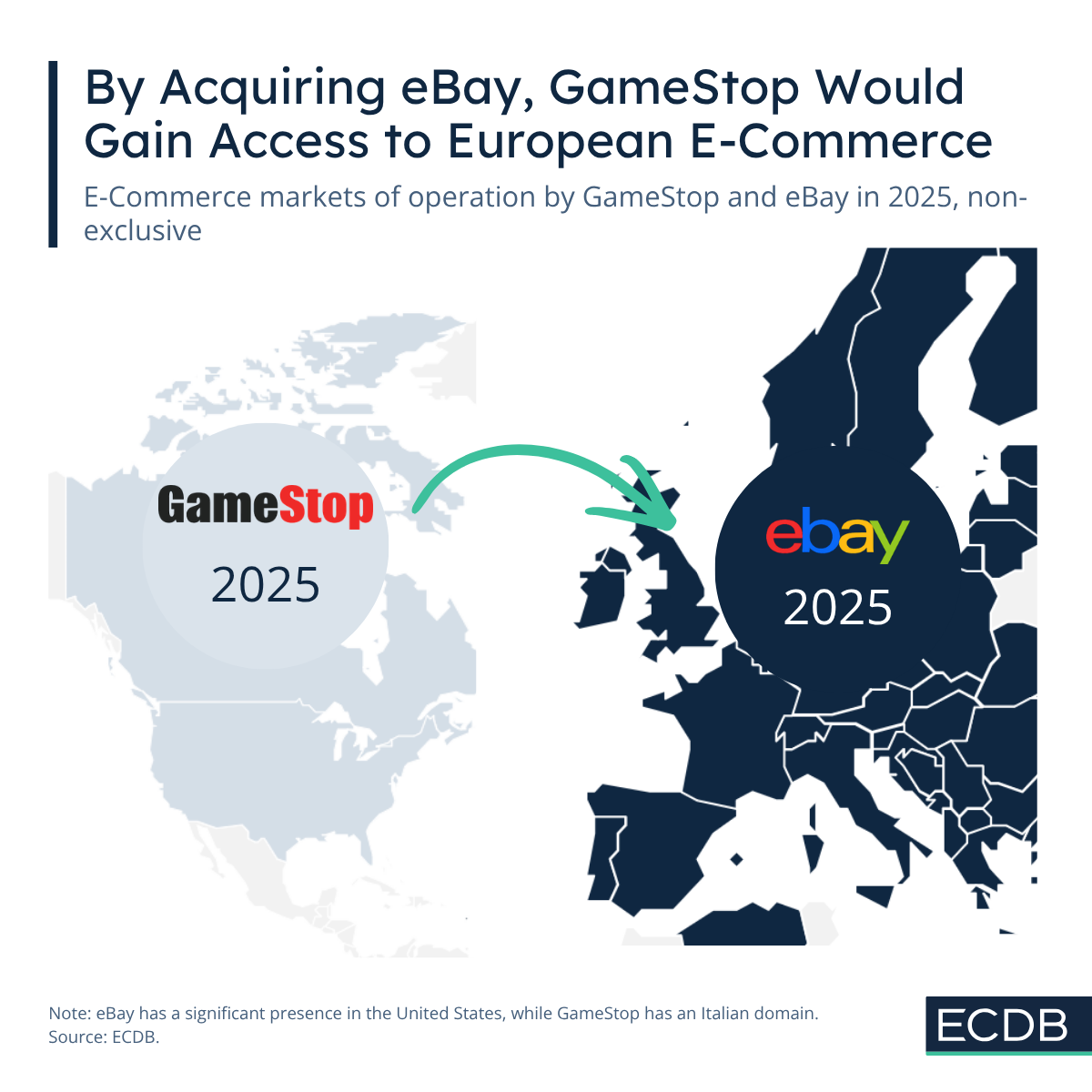
Right now, GameStop's e-commerce footprint is largely North American, with only a minuscule proportion of revenues generated in Europe.
eBay has a significant regional e-commerce share in North America, at 46%. European markets account for another 44%. The remaining 10% are generated in the rest of the world.
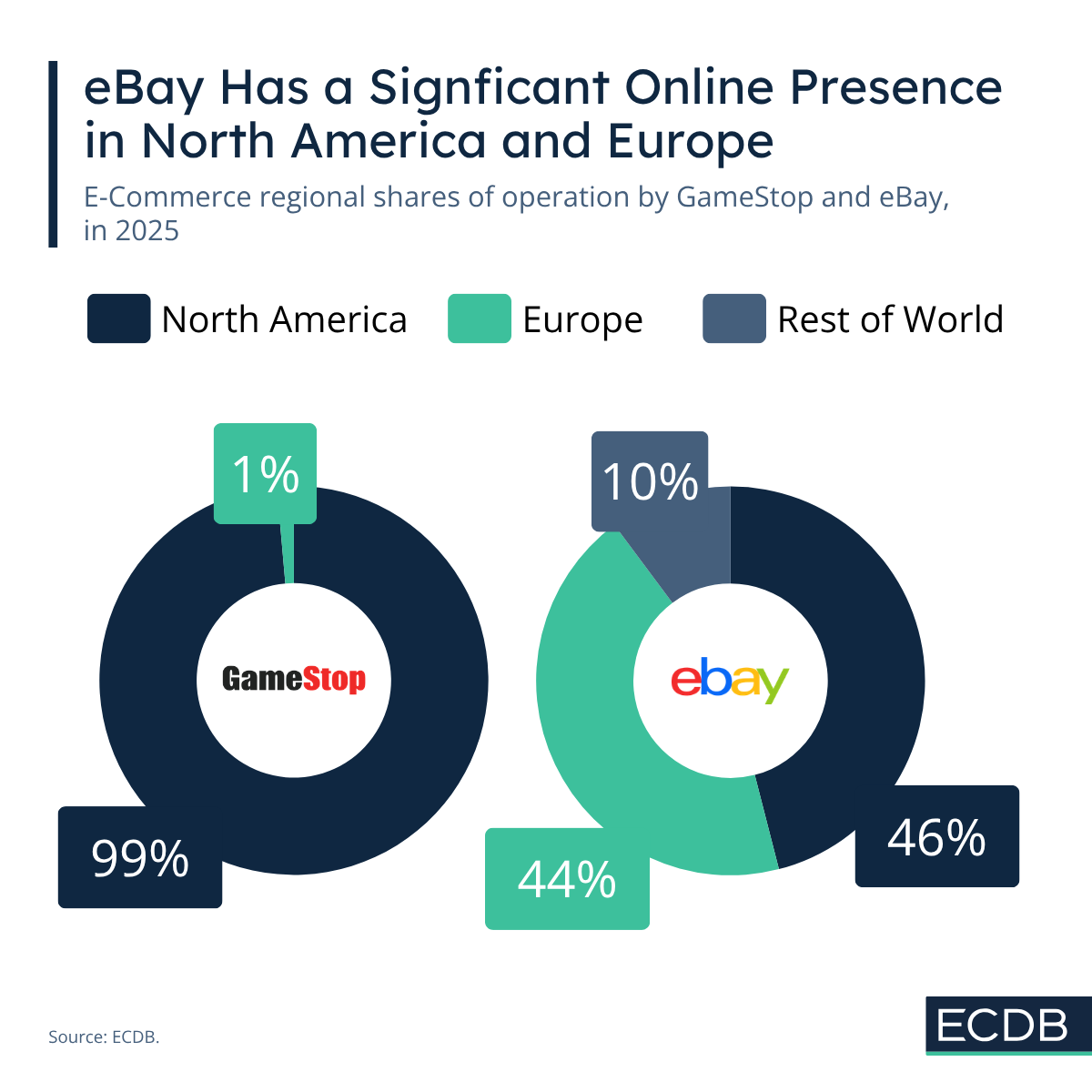
In contrast, GameStop's core e-commerce base is in North America, with only a small share generated in Italy. Acquiring eBay would grant GameStop access to a wide e-commerce network in North America, Europe, and even the rest of the world. But the move is seen far from optimistically among analysts and experts.
Despite the bold framing, there are several reasons the market is approaching the idea cautiously.
1. Financing risk
The structure and scale of the proposed deal raise questions about whether GameStop can realistically support the transaction without significant financial strain.
2. Execution complexity
Combining two large but fundamentally different companies introduces integration challenges that go far beyond cost synergies.
3. Strategic realism
The idea of repositioning eBay into a direct Amazon competitor sounds compelling in theory, but the operational and structural gaps between the companies make that outcome difficult to envision in practice.
Whether or not the deal advances, the proposal highlights something broader happening in markets right now.
Lines between legacy retail, platform economics, and speculative capital narratives are increasingly blurred. Turning bold ambition into operational reality remains the central challenge, especially at this size of operation.

Related Articles
Central European category splits show a distinct pattern, which fits the mix in Germany, Austria and Switzerland. Poland shows a different pattern. Here is why.
Central Europe is dominated by one market, but the interesting ones lie on the opposite end of the trend: Where low penetration meets high growth, the next hotspots of e-commerce development arise.
The global e-commerce market is entering a new era. By 2030, revenues are expected to exceed US$7 trillion, driven by a combination of technological innovation, expanding access, and changing consumer habits.

Click here for
more relevant insights from
our partner Mastercard.
Book a demo to see how ECDB's market intelligence can support your business.