Marketplaces Now Account for 83.4% of Global E-Commerce Revenues
The marketplace trend is in full swing. Globally, third-party marketplaces are gaining ground. But which region dominates? Find it out here.

Article in a Nutshell
Globally, marketplaces now generate 83.4% of e-commerce GMV, while first-party online stores account for just 16.6% in 2025.
Third-party marketplace adoption is growing in every region, though benchmarks vary significantly by location.
Europe sees moderate marketplace penetration at 60.8%, the Americas show mixed adoption, and Asia leads with 97% of e-commerce revenue flowing through marketplaces.
The trend toward third-party marketplaces is expected to continue, driving further concentration of top platforms worldwide.
E-commerce is no longer just about running your own online store. Around the world, marketplaces are taking a central role in shaping how consumers shop. In fact, 83.4% of global gross merchandise value (GMV) is now generated through marketplaces. But depending on which region you are operating in, the benchmark differs.
The Influence of 3P-Marketplaces on Global E-Commerce Is Immense
It is clear that marketplaces are becoming more prevalent globally, which is also why the share of global e-commerce revenues generated through third-party (3P) marketplaces grows. 3P means that revenues are generated through external sellers on a platform, in contrast to first-party (1P), which denotes revenues made from brand owners directly.
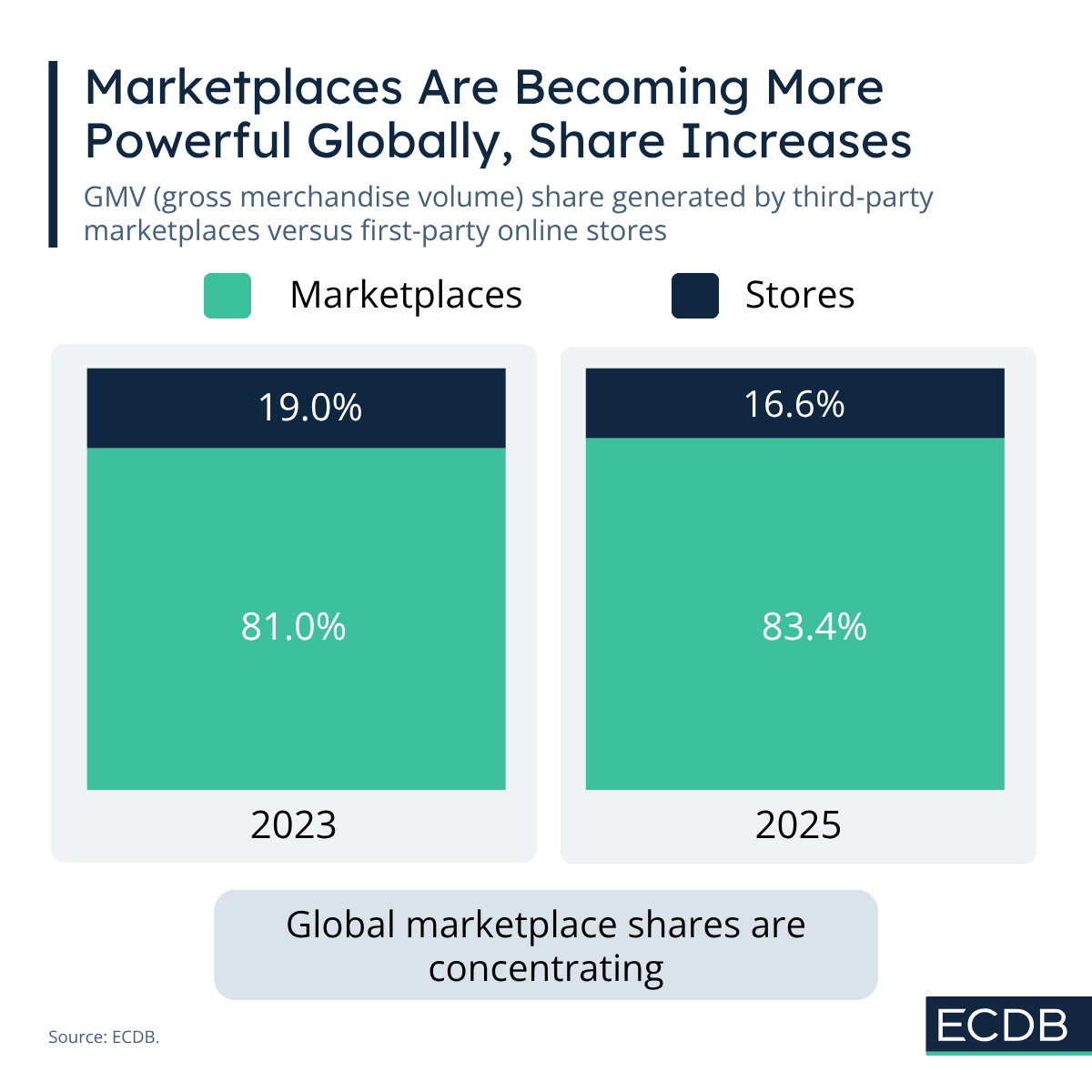
In 2023, 19.0% of global e-commerce revenues were made by 1P online stores. This share has shrunk to 16.6% by 2025. In turn, 3P revenues generated on global marketplaces grew from 81.0% to 83.4%. There is one region in particular that corresponds to this majority, even though 3P shares are increasing everywhere.
Asia Takes the Lead in Global 3P Shares
In Europe, where many heritage brands traditionally focus on direct-to-consumer sales or their own online stores, the share of GMV from third-party marketplaces is lower than in Asia. In 2025, 60.8% of European e-commerce revenue comes from marketplaces, up from 56.2% in 2023.
In the Americas, the picture is mixed. North American brands still rely heavily on their own online stores, while South American consumers favor large marketplaces such as MercadoLibre and Shopee. In many of the emerging markets, most GMV flows through these ecosystems.
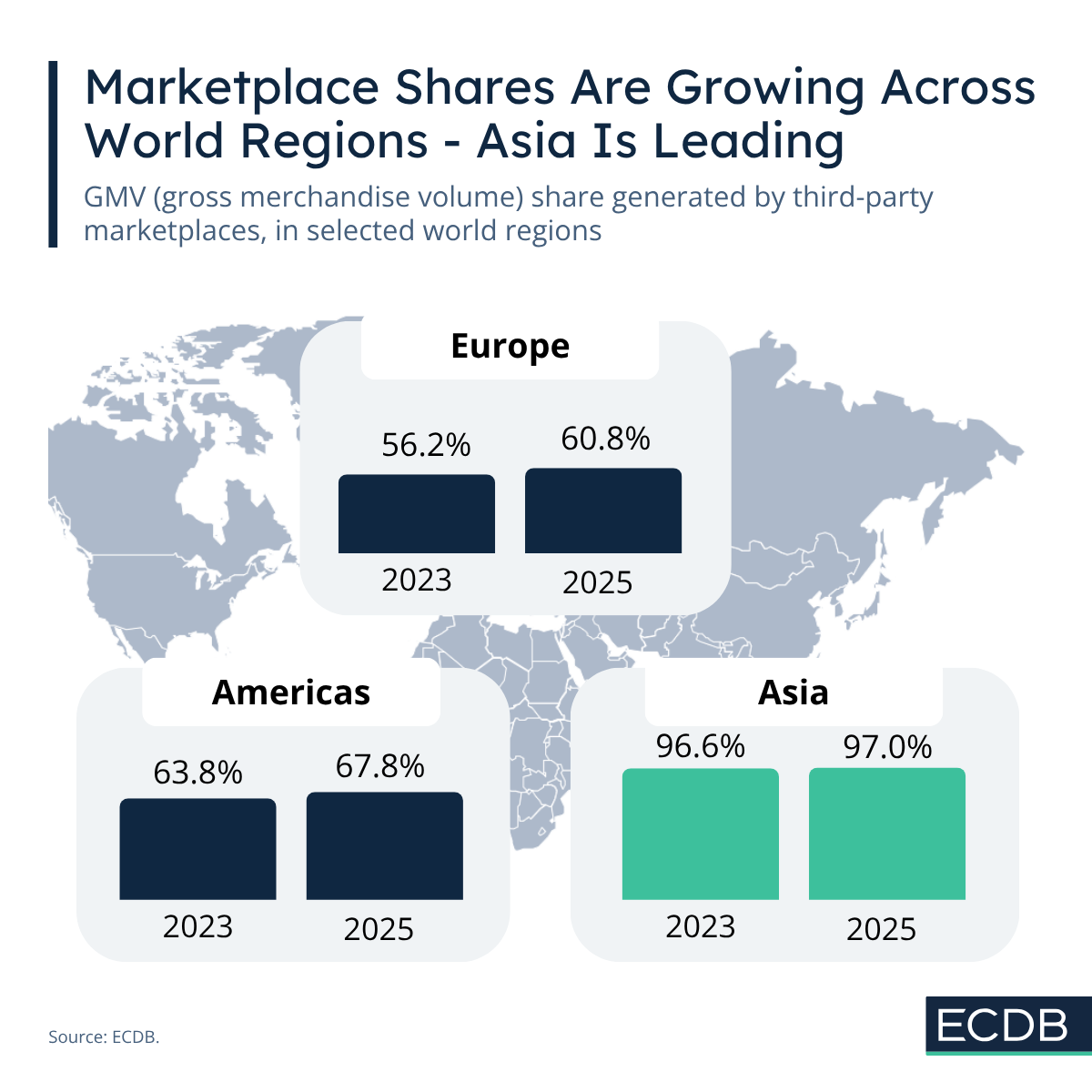
Asia stands apart with marketplace dominance. Since 2023, the marketplace share of Asian e-commerce revenues expanded even more to reach 97.0% in 2025. This is because major platforms played a central role in building e-commerce infrastructure in the region. Marketplaces created habits that continue to influence online shopping today.
Outlook: 3P Trend Expected to Continue
Marketplaces are becoming more influential everywhere but nowhere do they dominate as much as in Asia. Third-party platforms helped build e-commerce ecosystems in the region and are therefore now omnipresent. But the trend towards 3P-marketplaces is also visible in the Americas and Europe, where shares range between 60.0% and 70.0% in 2025. In the coming years, this trend is expected to lead to further concentration of top marketplaces.

Related Articles
All ArticlesReady to Unlock the Full Power of ECDB?
Book a demo to see how ECDB's market intelligence can support your business.