High Connectivity, Limited Size: The Reality of Nordic Online Retail
The Nordics belong to the most digitized regions worldwide, yet the size of the e-commerce market remains limited. Who dominates the region and why growth is constrained are both discussed in the following.

The Nordic region is often viewed as one of the most digitally advanced parts of Europe. Consumers are highly connected, online payments are widely adopted, and internet penetration exceeds 98% across Sweden, Norway, Denmark, and Finland.
Despite this promising foundation, the regions are well behind the rest of Europe in terms of e-commerce market size. What hinders e-commerce growth in the Nordics?
Sweden Is the Largest E-Commerce Market in the Nordics
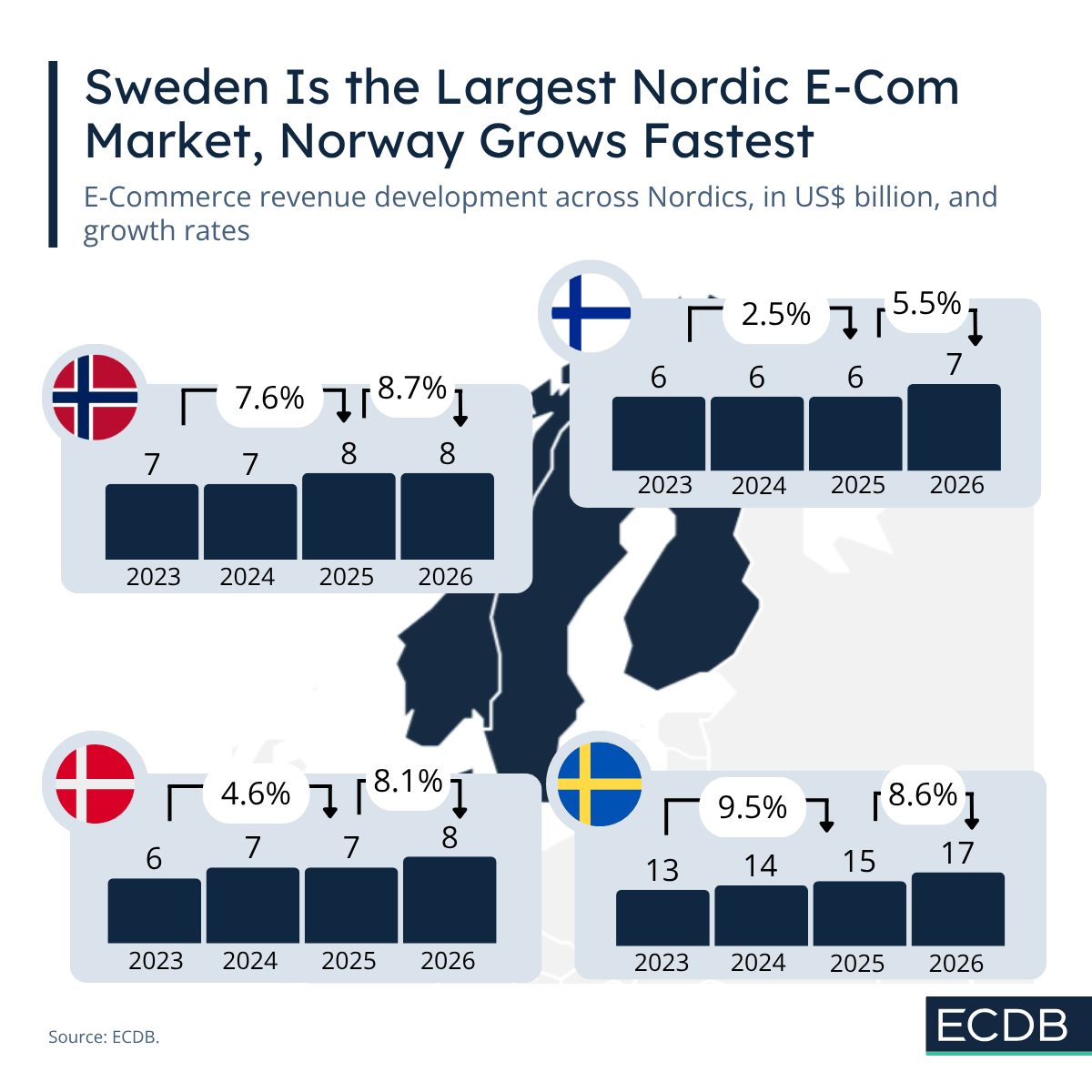
Sweden is the largest e-commerce market in the Nordics. Revenue is expected to grow from US$13 billion in 2023 to US$17 billion by 2026. This makes Sweden not only the biggest market in the region but also one of the fastest growing.
With a year-on-year growth rate pf 8.6% in 2026, Sweden sustains its leadership in the region.
Norway is significantly smaller in size and grows highest. Norway's e-commerce revenue is forecast to increase at a rate of 8.7% in 2026.
Denmark and Finland remain relatively close to one another in market size. Denmark is expected to grow from around US$6 billion in 2023 to approximately US$8 billion by 2026, while Finland is projected to reach around US$7 billion during the same period.
Sweden is ahead of the other markets in the region due to its larger population size and GDP, which places Sweden at a structural advantage over its neighbors in terms of e-commerce development. Despite its leading role in the Nordics, Sweden still ranks 26th among European e-commerce markets.
Given the region's wide digitization, what hinders e-commerce growth in the Nordics?
Structural Limitations to E-Commerce Growth in the Region
The Nordic countries are highly digitalized, wealthy, and technologically advanced, so at first glance it may seem surprising that their e-commerce markets are relatively small compared to many other European regions. The explanation largely comes down to structural limitations rather than a lack of digital maturity.
Population size
Even when combined, Sweden, Norway, Denmark, and Finland have a population of only around 28 million people. That is smaller than countries like Poland or Spain alone. Large e-commerce markets are typically driven by scale, and the Nordics simply have fewer consumers.
Geography
The Nordic region has low population density, long transport distances, and many rural or remote areas. This increases logistics costs and delivery complexity compared to densely populated markets such as Germany, the Netherlands, or the United Kingdom, where distribution networks are more efficient and cheaper to operate.
Strength of offline retail
Nordic consumers have historically had wide access to organized retail chains, shopping centers, and high quality physical stores. In some European countries, e-commerce expanded rapidly because traditional retail infrastructure was weaker or fragmented. In the Nordics, consumers already had efficient offline shopping experiences. This reduces the urgency of switching online.
Cross-border fragmentation
Although the Nordic countries are culturally similar, they still operate as separate markets with different languages, currencies, tax systems, and consumer preferences. This makes scaling e-commerce operations across the region more complicated than many outsiders assume.
High labor and operational costs
Warehousing, customer service, transportation, and last mile delivery are expensive compared to many parts of Europe. This can pressure margins and slow aggressive expansion strategies.
Nordic E-Commerce Wrap-Up
Internet penetration is among the highest in the world, digital payment adoption is advanced and consumer trust is high. The limitations are more structural and do not reflect a lack of adoption, but size.
This is why Sweden stands out within the region. It combines the same high digital maturity as its neighbors with a much larger population and economy, creating the conditions for a significantly larger e-commerce market.
Related Articles
All ArticlesReady to Unlock the Full Power of ECDB?
Book a demo to see how ECDB's market intelligence can support your business.