Online Grocery in Germany: REWE Leads, Picnic Is Closing the Gap
Picnic sits about €200 million behind REWE in German online grocery. Growth rates suggest the gap will keep closing in a market that is hard to enter and even harder to sustain.

Nadine Koutsou-Wehling
Data Journalist
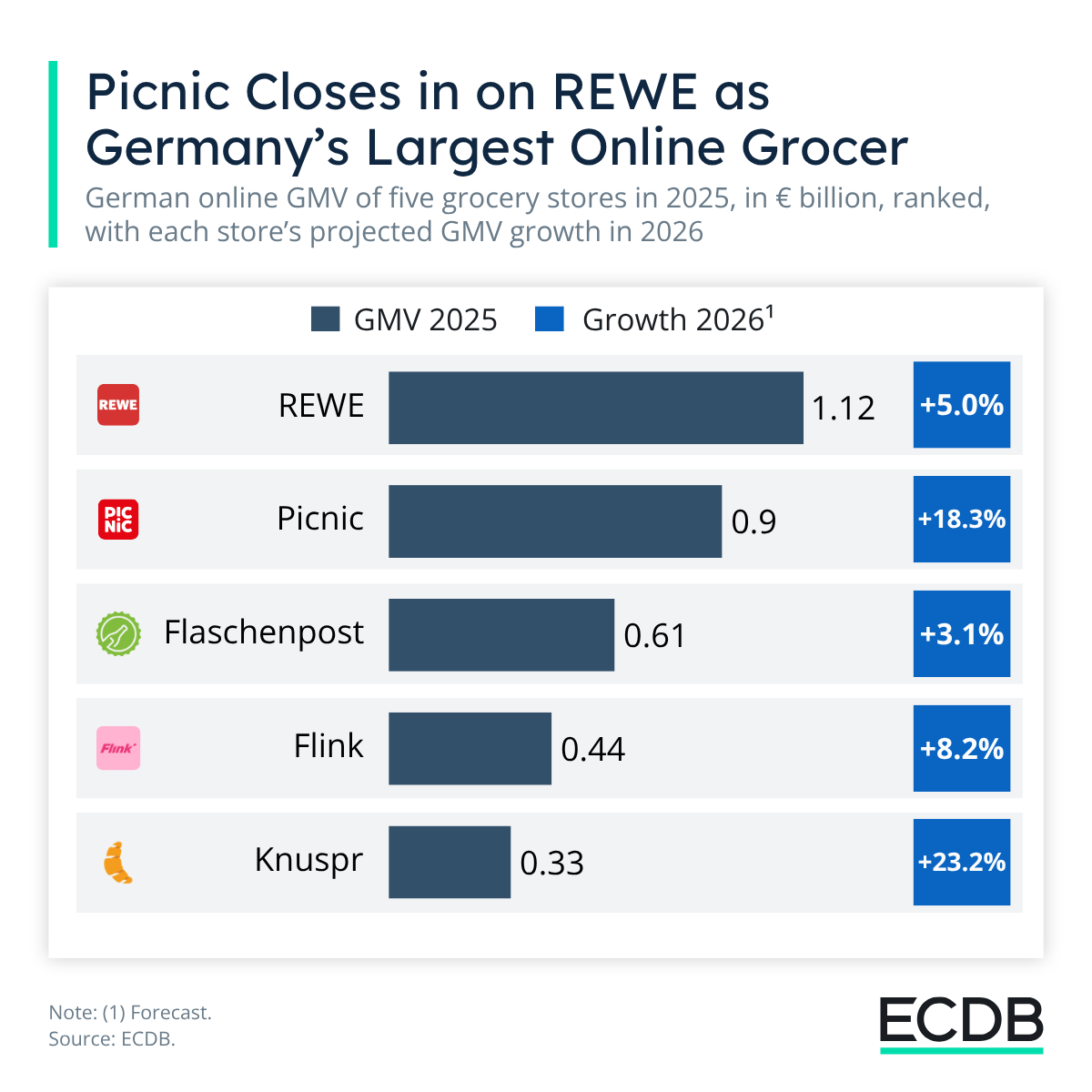
Germany's online grocery ranking has had the same leader for years. REWE holds first place, with €1.12 billion in GMV last year. Picnic now sits about €200 million behind it.
That gap is narrowing. Picnic is growing more than three times as fast as REWE, in a market where most households have yet to move their weekly shop online. Both facts leave room for the ranking to change.
Picnic Is Growing More Than Three Times as Fast as REWE
ECDB projects REWE to grow 5.0% in 2026. Picnic is expected to grow 18.3% across its markets.
REWE grows from a large base. It already serves a wide share of Germany's online grocery shoppers, so every additional percentage point takes more effort to win. Picnic starts smaller, and a smaller base makes double-digit growth easier to reach. The 18.3% also covers all of Picnic's markets, including the Netherlands, where the company started.
If that pace holds, the top of the ranking could look different within a few years.
Picnic Built Its Reputation Outside the Big Cities First
Picnic's playbook is simple. Reliable, scheduled grocery deliveries to German households. Customers pick a delivery window, and Picnic's electric vans run fixed routes through each neighborhood.
The company started in small and mid-sized cities. Online grocery competition was thinner there, and a dependable service could build word of mouth quickly. Once its reputation and funding were in place, Picnic moved into the big metros. There it now competes head-on with REWE's own delivery service.
Flink Holds Its Ground in Quick Commerce
Flink plays a different game. Quick commerce promised groceries at the door within minutes, and few of its players lasted in Germany. Gorillas and Getir have both left the market. Flink is one of the few apps still standing.
Its partnership with REWE explains much of that. REWE is also one of Flink's investors. The arrangement keeps Flink's costs down and gives the app a wide product range. REWE, in turn, gains a foothold in rapid delivery through a company it partly owns.
This year, Flink reported EBITDA profitability in Germany and the Netherlands. In a field shaped by failed ventures, that is a real milestone.
Flaschenpost Grows Its Beverage Service Into a Full Weekly Shop
Flaschenpost started in 2016 as a beverage delivery service. The Oetker Group took it over at the end of 2020. Groceries, household goods and drugstore items followed in the years after. With €613 million in GMV in 2025, it sits right behind Picnic, but growth is flat at a projected 3.1% in 2026.
Speed and convenience carry the model. Orders arrive within 120 minutes, and drivers take empty deposit bottles back at the door. In a country where returning deposit bottles is a weekly chore, that service gives shoppers a practical reason to order.
In November 2026, flaschenpost doubled its grocery range to 8,000 items, with Kaufland as a long-term supplier. Kaufland private labels such as K-Classic and K-Bio now sit in the shop. The deal puts a familiar retail name behind flaschenpost's groceries. Kaufland, in turn, gets a delivery channel it has not run itself since its Berlin pilot ended in 2017.
Knuspr Brings a Tested Model Over From Prague
Knuspr belongs to the Czech Rohlik Group, which also runs online supermarkets in the Czech Republic, Hungary, Austria and Romania. It entered Germany in 2021, starting in Munich. Two years later, it took over its competitor Bringmeister.
Growth has been fast since then. Knuspr.de's GMV rose 51.2% to €332 million in 2025. ECDB projects another 23.2% for 2026, which would take the shop to €409 million.
Rohlik's edge sits in its warehouses. The group builds its own automation platform, Veloq, most recently backed by a €30 million financing top-up from the European Investment Bank. Knuspr pairs that technology with a full grocery range and fresh products from regional farms, bakeries and dairies.
A sales channel is about to close. Since early 2025, Amazon customers could order Knuspr groceries directly on amazon.de. Amazon ends that integration on January 19, 2027. Knuspr now has to move those shoppers into its own app, and it is offering a free trial of its Xtra membership to do it.
Most German Households Still Buy Groceries in Person
Every one of these players competes in a tough market. Online grocery penetration in Germany is low. Most households still do their weekly shop at brick-and-mortar supermarkets.
For many Germans, a supermarket or discounter sits within easy reach, and in-store prices are low. That combination gives shoppers little reason to change a routine that already works for them.
The UK shows how far the habit can shift. Online grocery has long been part of the weekly routine there, with British supermarket chains running home delivery for years. In Germany, every online grocer still has to win each customer away from the store.
Wrap-Up: Trust Decides Who Wins the Weekly Shop
Trust wins the customer in Germany. REWE's place at the top of the ranking shows it. German online shoppers like to buy where they know they get good value for the price. As one of the leading brick-and-mortar supermarket chains, REWE is in a position to meet that expectation. Shoppers who know its stores already know what its deliveries will bring.
Picnic has earned trust through reliability, one scheduled delivery at a time. Flink and Flaschenpost borrow some of it from partners shoppers already know, REWE and Kaufland. Knuspr builds it through fresh, regional products. The race for first place will come down to one thing: who German shoppers trust with their weekly purchase.
Related Articles
All ArticlesReady to Unlock the Full Power of ECDB?
Book a demo to see how ECDB's market intelligence can support your business.