The Fastest Growing Marketplaces Worldwide Are Driven by Third-Party Sales
Of the 30 fastest growing marketplaces, 17 have a third-party share of over 80%. This hints at a future of platform ecosystems over inventory-led business models.

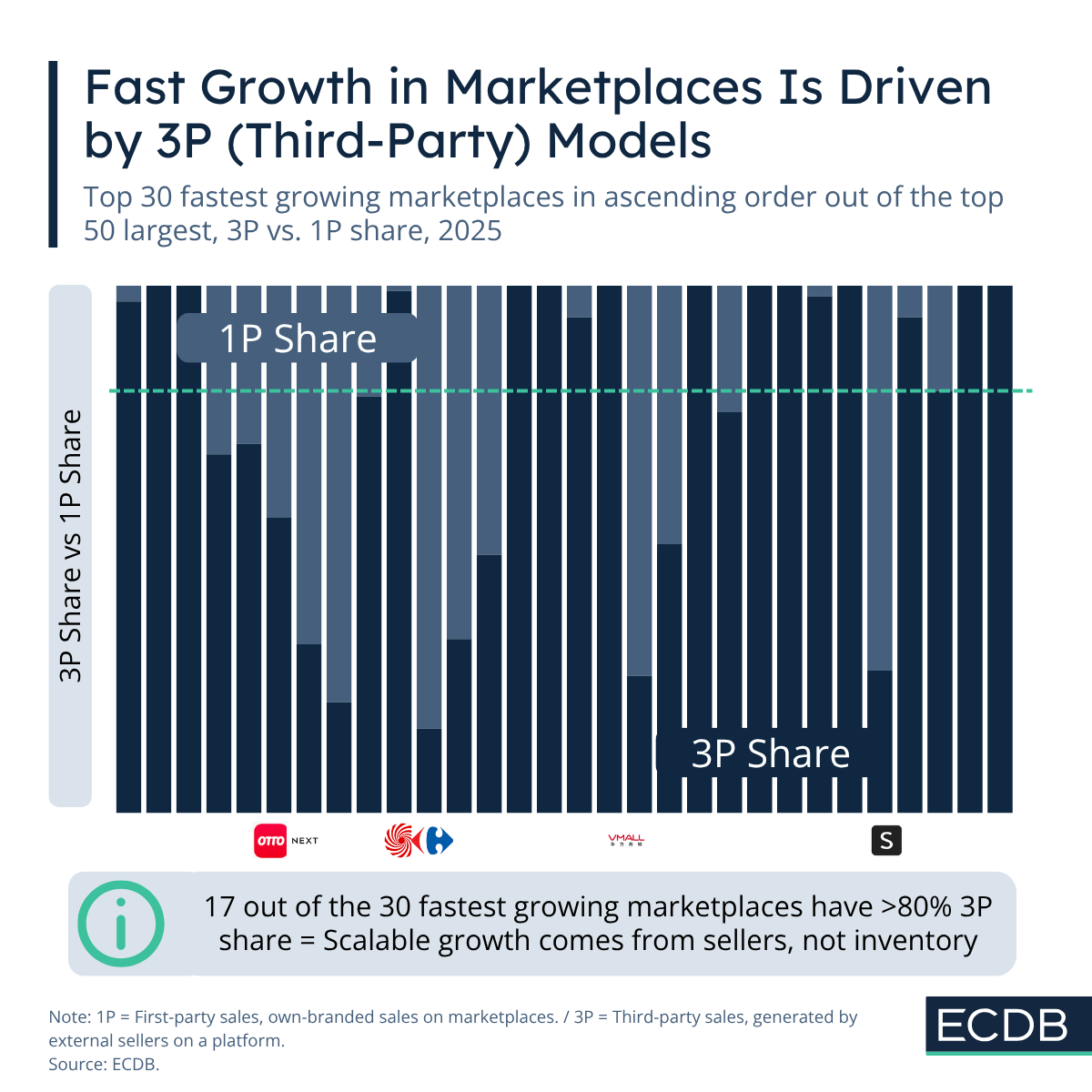
A clear pattern is emerging among the world’s fastest-growing platforms: they are increasingly powered by third-party sellers.
Looking at the 30 fastest-growing marketplaces globally, seventeen of them generate more than 80% of their revenue from third-party (3P) sellers. This is a signal of where the industry is heading.
The Shift Towards Ecosystems
Traditionally, marketplaces operated heavily on a first-party (1P) basis. They sourced products, managed inventory, handled logistics, and controlled nearly every step of the transaction. But this model comes with limits, especially when it comes to growth.
Today’s high-growth marketplaces are flipping that approach. Instead of owning inventory, they are building ecosystems.
External sellers now play a central role:
They bring in product variety
They respond quickly to trends
They increase supply without increasing platform risk
The 3P shift allows platforms to focus on what truly drives expansion: infrastructure, discovery, trust, and liquidity. The result is a more dynamic marketplace that grows faster and adapts better to demand.
The Exceptions That Prove the Rule
Not every marketplace follows this path. Some major players still operate with a more 1P-heavy model, which means they maintain significant control over inventory and supply.
1P models offer tighter control over quality, branding, and customer experience. But they often come with higher operational complexity and capital requirements. In contrast, 3P-driven platforms can grow faster by distributing those responsibilities across a network of sellers.
Among the top fastest growing marketplaces, 1P-dominant players are Otto, Next, MediaMarkt, Carrefour, VMALL and Shein. They do have a share of 3P sellers on the platform, but dominantly operate with first-party inventory.
What the 3P Shift Means for the Future
Marketplace growth is increasingly tied to how effectively a platform can attract, enable, and manage third-party sellers. The winners will be those that build strong ecosystems. This is where sellers thrive and customers trust the experience. The platform facilitates it all without becoming a bottleneck.
Ultimately, the best marketplaces may be the ones that connect the best via infrastructure, customer loyalty, and seamless operations.
Related Articles
All ArticlesReady to Unlock the Full Power of ECDB?
Book a demo to see how ECDB's market intelligence can support your business.