Three Marketplaces Models That Consistently Win in E-Commerce
Depending on two variables, share of main category and share of main country, ECDB identified three structurally resilient marketplace archetypes that convince global audiences with their strategies.

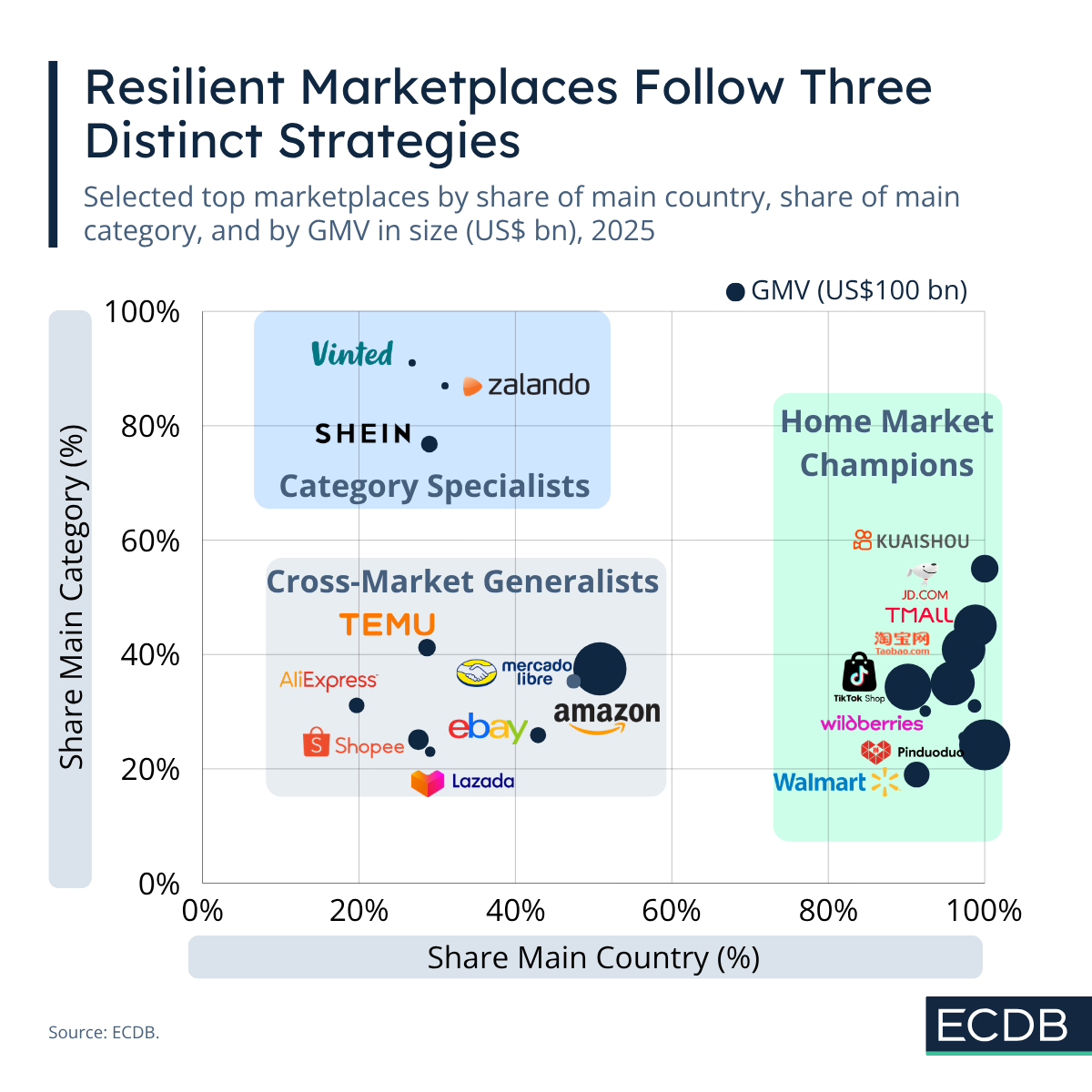
There’s no single formula for building a winning marketplace. But when you look at the world’s most successful platforms, clear patterns emerge. Despite operating in different regions and industries, they tend to converge around three dominant strategic models.
Each model takes a different path to growth, but all three consistently outperform when executed with focus and discipline.
1. Category Specialists
Some marketplaces win by doing one thing exceptionally well. Platforms like Vinted, Zalando, and Shein focus deeply on a single category, but grow across different markets. Their strength lies in precision and category competitiveness.
What sets them apart:
A tightly defined value proposition
Highly optimized user experience for one category
Brand clarity that reduces decision fatigue
Deep understanding of category-specific demand and supply dynamics
By narrowing their focus, they make buying simpler, faster, and more intuitive.
2. Cross-Market Generalists
At the other end of the spectrum are the global giants that scale through breadth rather than depth.
Marketplaces like Amazon, eBay, Shopee, Temu, and Mercado Libre don’t limit themselves to one category or one region. Instead, they aim for maximum coverage.
Their competitive advantage comes from:
A massive product variety that they deliver via advanced logistics and fulfillment infrastructure.
Network effects ensure low prices at a global or multi-regional reach.
These platforms win by becoming the default destination for almost anything. The broader the selection, the stronger the pull.
3. Home Market Champions
Dominating domestically, players like Coupang, Walmart, Wildberries, Tmall, Taobao, and JD.com build deep, localized ecosystems that are hard to replicate elsewhere.
Their edge comes from:
Deep integration with local logistics and payments.
Wide understanding of domestic consumer behavior.
Regulatory and operational alignment with their home market.
Highly optimized, country-specific user experiences.
Rather than spreading thin, they go deep. And in doing so, they often become unbeatable at home.
Three Structurally Resilient Marketplace Strategies
Despite their differences, all three models share clarity of strategy. Their consistency turns strategy into sustainable advantage.
In marketplaces, fragmentation is easy. It’s easy to add new categories, chase new geographies, or copy competitors’ features. What’s difficult is resisting that drift. The strongest players maintain a clear answer to a simple question: what are we optimizing for? And they keep returning to that answer, even as they grow and expand.

Related Articles
All ArticlesReady to Unlock the Full Power of ECDB?
Book a demo to see how ECDB's market intelligence can support your business.