Article in a Nutshell:
Global e-commerce revenue is projected to reach $7.38 trillion by 2030, growing at a steady 8% to 9% a year through the rest of the decade.
Everyday essentials are quietly building stickier shopping habits than the flashier corners of e-commerce ever did.
Borders, channels, and even the search bar are all starting to blur, cross-border shopping, mobile, and AI are turning from nice-to-haves into the actual dividing line between who pulls ahead and who falls behind.
Future trends in e-commerce show up first as a handful of companies making a specific bet, then the entire market following suit.
None of these six trends is a wild prediction. Each one is a direction already visible in the data, still early enough to plan around before it becomes the obvious story everyone else is telling.
1. E-Commerce Is Going to Hit the US$7 Trillion Threshold by 2030
Global e-commerce revenue is projected to climb from $5.36 trillion in 2026 to $7.38 trillion in 2030, growing at a remarkably steady 8% to 9% a year over that stretch. That steadiness is the more interesting part. After the volatility of the pandemic boom and the 2022 hangover that followed it, growth has settled into a predictable, compounding rate rather than another spike.
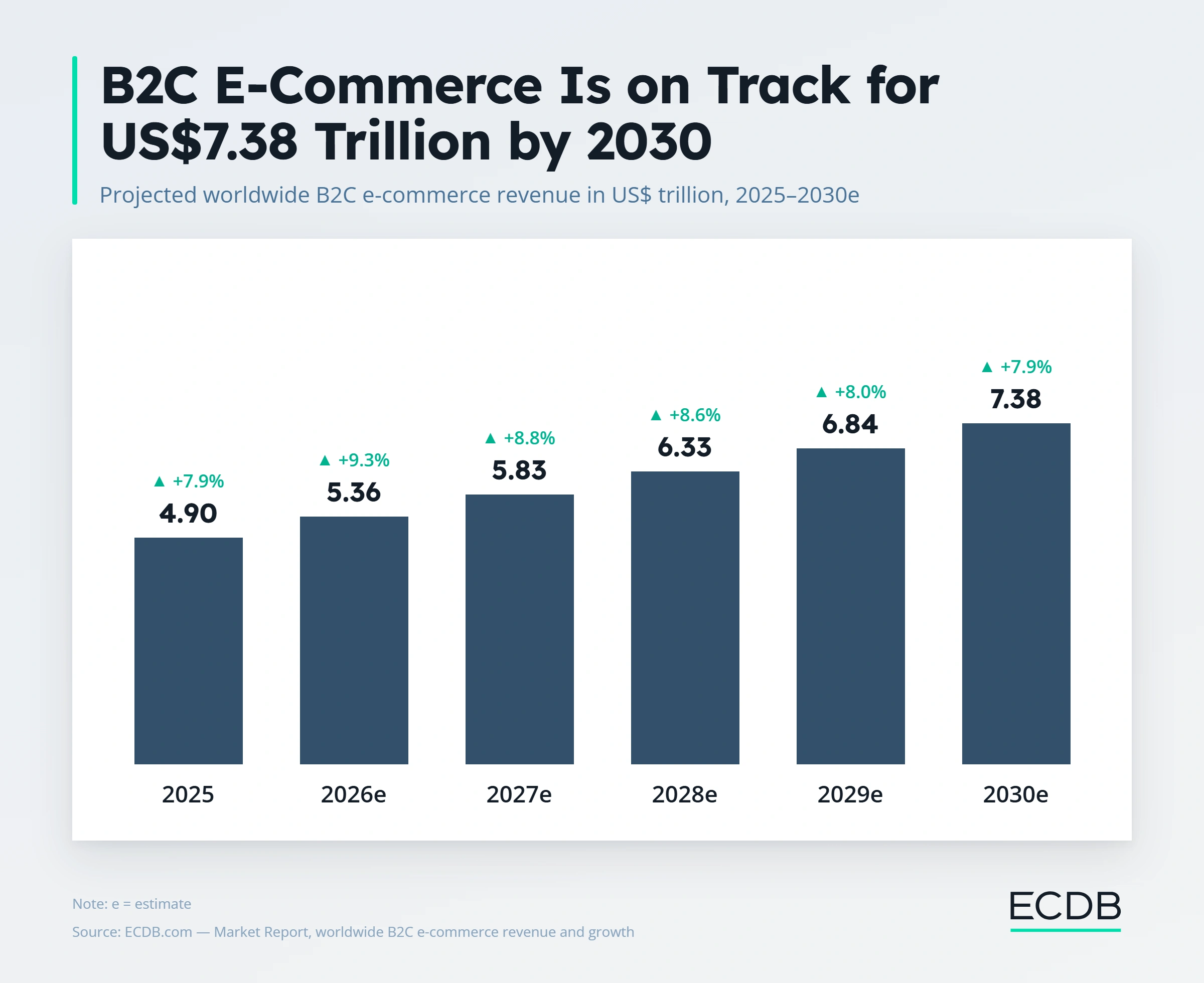
A market growing at a consistent 8% a year for five straight years behaves differently than one lurching between extremes. It rewards patience over timing. Businesses that build for a steady multi-year climb, rather than trying to catch the next sudden surge, are better positioned for a market that's stopped behaving like a boom and started behaving like an established, maturing industry.
2. Everyday Essential Goods Are Coming to the Forefront of E-Commerce
The categories pulling e-commerce forward right now are the ones people shop for out of routine. Grocery has grown between 12.9% and 15.2% every year since 2023. Health-related products grew as fast as 19.4% in a single year. Household basics have accelerated every year since 2023 too. Personal care and beauty, by comparison, a category people associate far more with online shopping, has grown at a comparatively modest 6% to 8% a year over the same period.
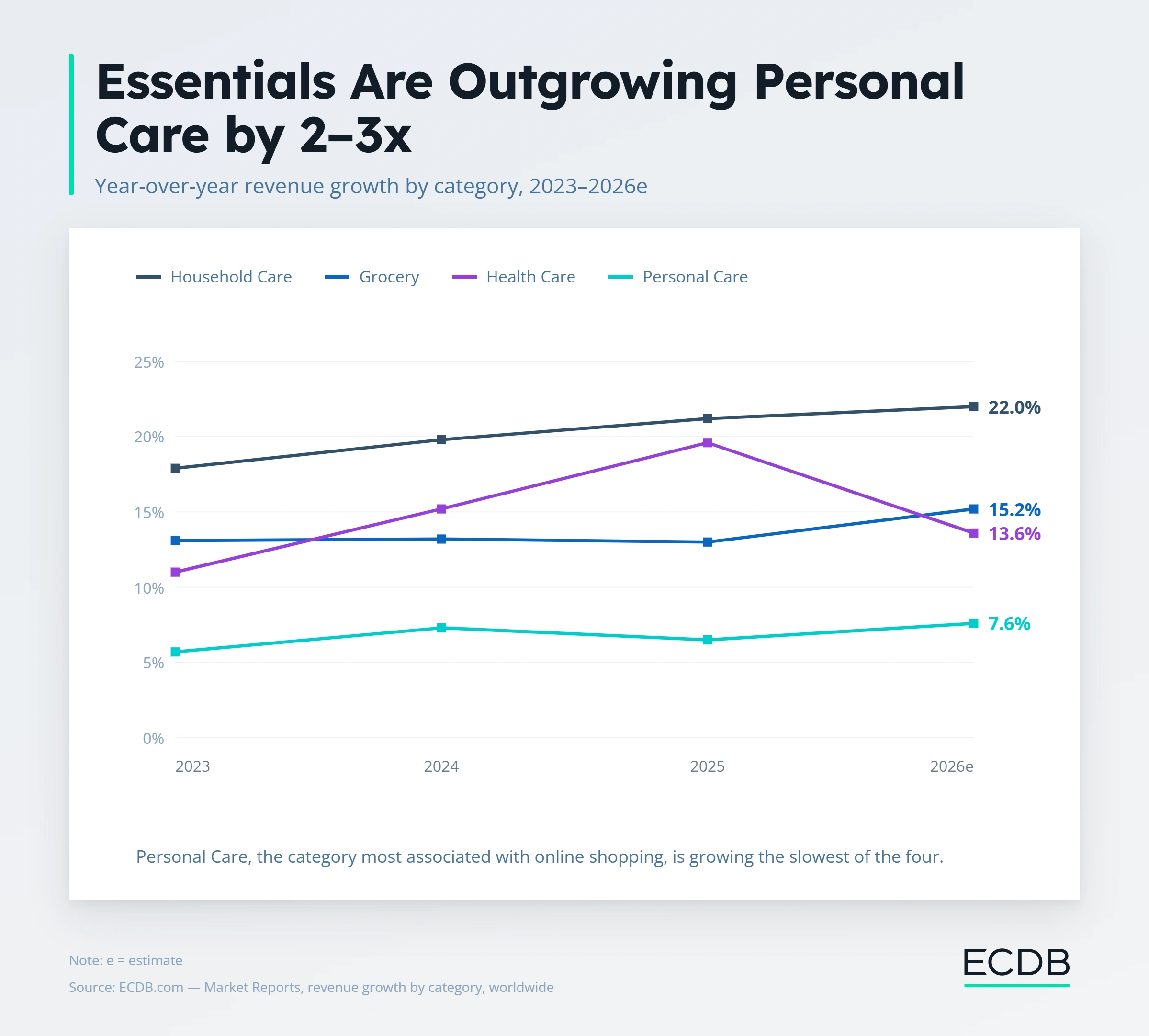
That gap says something about how online shopping habits have matured. Buying a skincare routine online was a genuine behavior shift a decade ago. Buying dish soap, vitamins, and pantry staples online is the behavior shift happening now, and it's a stickier one, since a household that starts restocking essentials online rarely goes back to doing it any other way.
These are the categories building the deepest, most habitual relationship between shoppers and online retail, and that's exactly why they're growing fastest.
3. Omnichannel Commerce Is Turning Into a Dividing Line, Not a Shared Advantage
Having a website and a store used to be enough to call a retailer omnichannel. That bar has moved. The retailers pulling ahead are the ones using physical locations as active infrastructure for online orders, fast pickup, local delivery, real-time stock visibility, while the ones treating stores and online as separate businesses are watching the gap between the two groups widen rather than close.
Mobile is what's accelerating that split. A phone is now the device most shoppers use to check whether a product is in stock nearby, to scan something in a store before buying it online, or to get notified the moment a pickup order is ready, all in the same few minutes.
That makes mobile the connective tissue of real omnichannel rather than just another sales channel to track. A retailer with a weak mobile experience loses the bridge between its stores and its online business, which is exactly where the compounding advantage described above actually comes from.
4. Personalization Moves From Category-Level to Shopper-Level
E-commerce has always adjusted itself at the category level, pricing, promotions, and marketing built around what an average buyer of a given category tends to do. That's no longer granular enough. The data increasingly available on individual shopper behavior, age, income, purchase history, browsing pattern, makes it possible to tailor an experience to a specific person rather than a category-wide average, and shoppers are starting to expect exactly that.
The businesses adapting fastest are treating personalization as a retention strategy, not just a marketing tactic. A shopper who consistently sees offers, recommendations, and pricing that reflect their own actual behavior has less reason to comparison shop elsewhere.
As that kind of shopper-level data becomes more accessible and easier to act on, the advantage shifts to whoever uses it to make the experience feel individually built, rather than whoever simply spends the most on category-wide advertising.
5. Cross-Border Commerce Keeps Internationalizing
Large economies still buy mostly domestic. Germany, the US, and the UK each import less than a tenth of their online purchases from abroad. Step down to a smaller economy and the picture flips: Austria already sources 40% of its e-commerce from outside its own borders, Belgium 24%, Switzerland 19%.
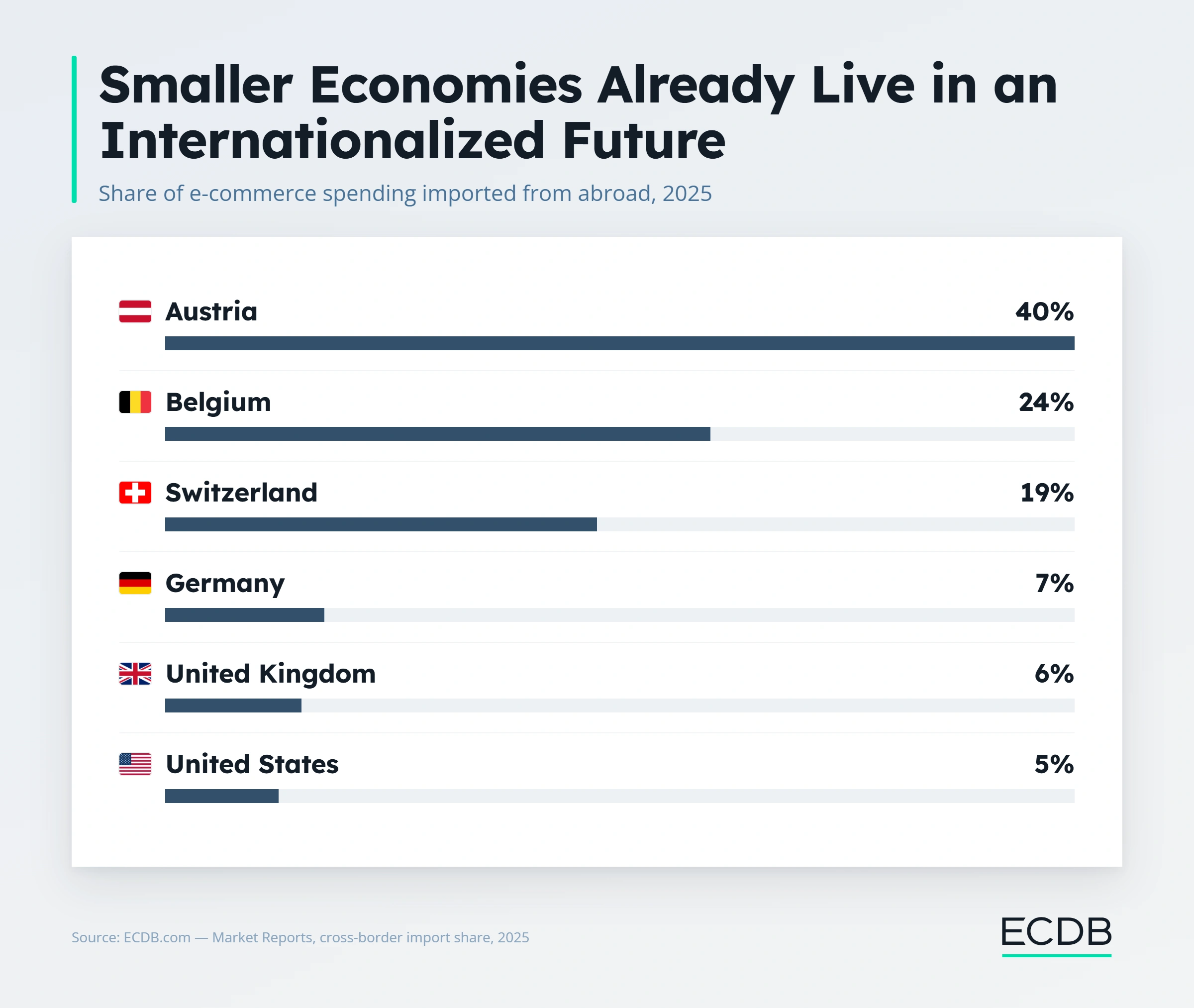
Smaller markets have effectively been living in an internationalized e-commerce future for years, out of necessity rather than choice.
That gap is likely to narrow as cross-border logistics, payments, and returns keep getting faster and cheaper, and larger economies won't stay as insulated as they are today. Platforms are already fighting each other directly across borders for the same shoppers in fast-growing regions, rather than each staying comfortably within their home market.
Internationalization in e-commerce is already the normal condition for a meaningful share of the world's online shoppers, not a future possibility, and it's spreading toward the markets that have so far been the exception.
6. AI Is Becoming the Default Shopping Interface
The next major interface shift in e-commerce is AI replacing the search bar and the dashboard as how people actually get to a decision, not a new app or channel. That shift is furthest along in B2B procurement right now, where AI assistants are already cutting negotiation cycle times by double digits, but the same underlying behavior, asking a system a direct question instead of filtering through menus, is showing up in consumer shopping too.
Being findable and well-represented inside an AI-mediated shopping flow is likely to matter as much over the next few years as SEO mattered for the last two decades. Most businesses haven't started treating it that way yet, which makes it one of the more underpriced shifts on this list, and one of the easiest to get ahead of simply by paying attention before it becomes standard practice.
Where This Leaves a Strategy Built Today
None of these six trends demands an overnight overhaul. They're reasons to check specific assumptions: whether a category written off as boring is actually where the real growth is hiding, whether an omnichannel strategy accounts for mobile as the connective layer rather than a separate channel, whether personalization is being treated as a retention tool or left as an afterthought, and whether a cross-border strategy is being built now or only once competitors force the question.
Trends like these show up in the data months before they show up in industry conversation. Checking a category, a channel, or a market against ECDB's data on a regular rhythm is how a strategy catches a shift while it's still a pattern worth acting on, not after it's already the story everyone else is telling.