Article in a Nutshell
Alibaba, Amazon, JD.com, and eBay show up twice: as the largest B2C platforms ECDB tracks, and as the named leaders of the global B2B e-commerce market, according to Mordor Intelligence's 2026 research.
Amazon Business, Amazon's dedicated B2B marketplace, generated $35 billion in 2025, according to Digital Commerce 360, a fraction of the $851.9 billion Amazon.com did in consumer GMV the same year, per ECDB.
Total B2B sales across US manufacturing and distribution grew just 0.4% in 2025, but B2B e-commerce specifically grew 13%, according to Digital Commerce 360. Digital is taking share inside a flat market, not riding a growing one.
What does the future of B2B e-commerce look like? Largely like B2C's recent past, run by the same handful of companies, built on the same marketplace architecture, several years behind on digitization but catching up fast.
The rest of this piece works through six numbered trends, each focusing on business-to-business (B2B) e-commerce and its projected future.
1. The Same Retailers Leading B2C Are Named the Leaders of B2B Too
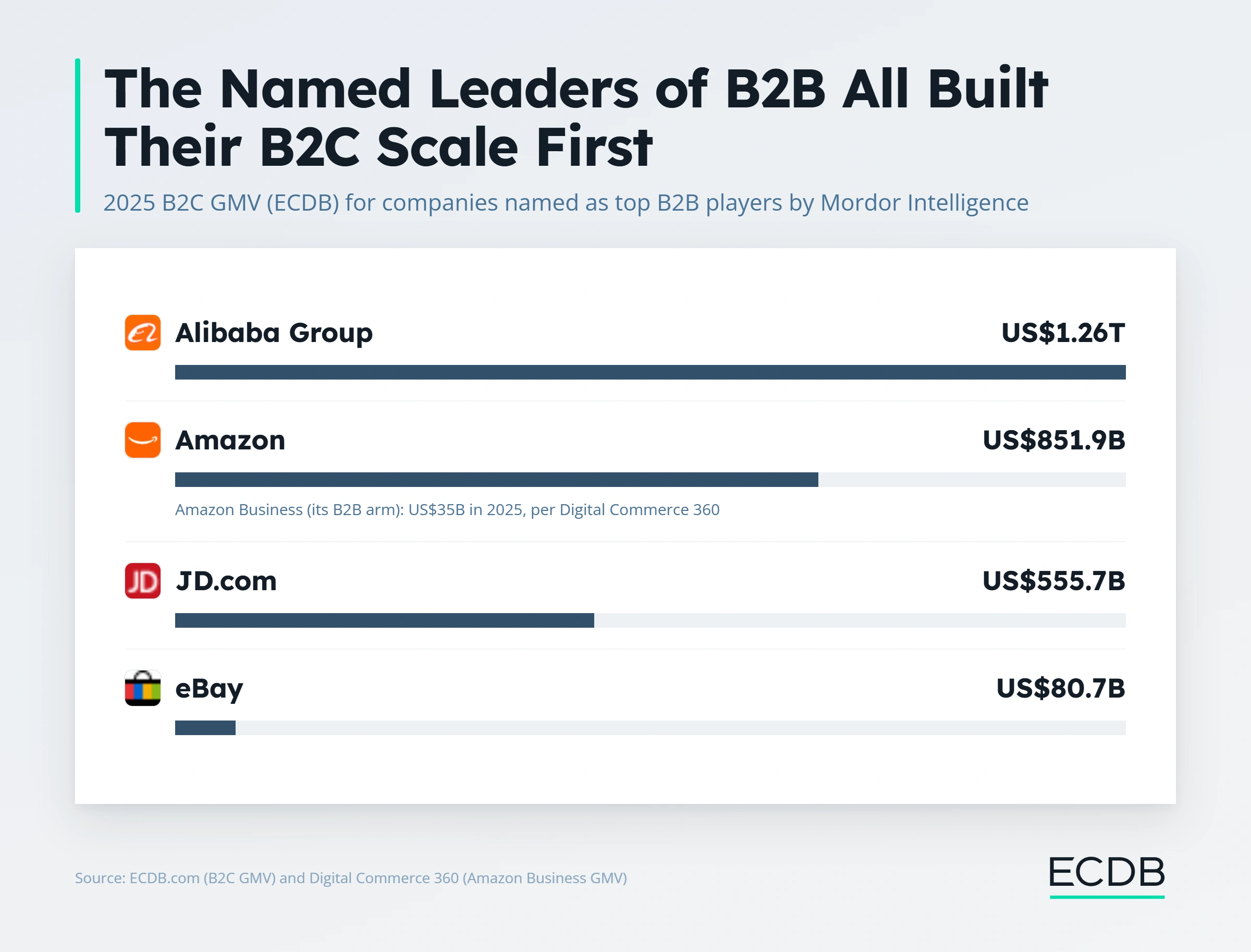
Alibaba Group, Amazon, and eBay top ECDB's B2C rankings, at US$1.26 trillion, US$851.9 billion, and US$80.7 billion in 2025 GMV respectively. The same three names, plus JD.com, appear on Mordor Intelligence's list of leading global B2B e-commerce players for 2026, alongside IndiaMART and Global Sources.
That overlap is structural. The infrastructure that makes a company good at consumer e-commerce, payments, logistics, supplier networks, cloud systems, transfers directly to business buying. Companies didn't need to start from scratch to enter B2B.
2. B2B Is Copying B2C's Marketplace Blueprint
Third-party (3P) sellers on marketplaces and first-party (1P) sellers who sell their own inventory define a split in e-commerce revenues. The same logic applies to B2B sales, too. Amazon Business runs on a hybrid logic: a mix of Amazon's own supply deals and third-party sellers, layered onto the marketplace model Amazon spent two decades refining for consumers.
The scale gap shows how early this still is. Amazon Business generated US$35 billion in 2025, according to Digital Commerce 360's tenth annual report on the marketplace. Amazon's consumer business did US$851.9 billion in GMV the same year. Amazon Business is worth roughly 4% of Amazon's own B2C GMV, on the same platform, after ten years of dedicated investment. The blueprint has been proven. Most of the building still hasn't happened.
3. B2B Buyers Are Behaving Like B2C Shoppers, and the Data Backs It Up
Most B2B buyers now say they'd rather not talk to a salesperson at all. Gartner's survey of 646 B2B buyers, conducted in late 2025, found 67% prefer a rep-free buying experience. Separately, Astute Analytica's 2025 analysis found 73% of B2B buyers prefer to purchase online, against just 18% who prefer buying in person.
That preference is the same one ECDB's B2C data shows driving consumer e-commerce: fast, self-directed, low-friction buying beats a slower, assisted process whenever the buyer already knows what they need. Amazon's consumer purchase frequency, 21.95 orders a year, is the kind of frictionless repeat buying B2B platforms are now trying to recreate for procurement teams.
4. Digital Share Is Growing Even Though the Market Itself Is Barely Moving
Total B2B sales across US manufacturing and distribution rose just 0.4% in 2025 as buyers delayed projects and scrutinized spending, according to Digital Commerce 360. B2B e-commerce specifically grew 13% that same year. The overall pie barely moved. The digital slice of it grew anyway, meaning the growth is coming from revenue shifting into digital channels, not from the underlying market expanding.
That 13% actually outpaces global B2C e-commerce growth, which our analysts put at 7.89% for 2025. B2B started years behind B2C on digitization, and it's now closing that gap faster than B2C itself is growing.
5. Manufacturers Are Borrowing DTC's Playbook, Direct From the Factory
In 2026, 79% of B2B companies report some form of direct selling to end consumers, according to Sana Commerce's annual B2B e-commerce trends research. That's the same direct-to-consumer logic covered elsewhere in this series. A brand or manufacturer sells straight to the buyer instead of routing through a distributor. The only difference is where it shows up: it used to be a D2C brand strategy, and now it's also a formal B2B trend.
The appeal is identical to why Nike, Gymshark, and Allbirds built direct channels in B2C: access to end-buyer data, more control over the experience, and revenue that skips the distribution margin. The challenge is the same too, supporting multiple customer types, pricing structures, and fulfillment workflows at once, without the years of B2C practice those brands already had.
6. AI Is Automating the Next Purchase the Way Recommendation Engines Did for B2C
SAP rolled out a generative AI assistant for its Ariba procurement suite in 2025 that studies historical spend to surface renegotiation opportunities, cutting cycle times by 30%, according to Mordor Intelligence. Coupa automated invoice matching the same year, cutting accounts-payable workloads nearly in half. Both are the B2B version of what recommendation engines and one-click reordering have done in B2C for years: remove friction from the next purchase before the buyer has to think about it.
The room to keep going is large. Only 17% of manufacturers currently use data to personalize the buyer journey, according to Sana Commerce, meaning most of B2B is still at the starting point B2C left behind roughly a decade ago.
The Future of B2B as per ECDB Prediction
Put the six trends together and a clear picture emerges. B2B e-commerce will keep consolidating around the same handful of companies that already won B2C, since the infrastructure advantage, payments, logistics, supplier networks, transfers directly from one to the other. It will keep adopting B2C's marketplace structure, direct sales sitting alongside third-party sellers, rather than inventing a new model from scratch.
That share will keep shifting into digital channels faster than the overall B2B market grows, since most of the current growth is budget moving online rather than new budget appearing. Manufacturers will keep opening direct channels to end buyers, borrowing the D2C playbook wholesale. AI will keep closing the gap between B2B procurement and the personalized, low-effort repeat buying B2C has run on for years.
All of that adds up to B2B finishing a catch-up phase that consumer e-commerce went through roughly a decade earlier, on the same rails, run largely by the same companies.
ECDB's part in tracking that shift sits on the consumer side of these same companies, the exact data used throughout this article to size Alibaba's, Amazon's, JD.com's, and eBay's overall scale. That precision on the B2C base is what makes it possible to measure how much room each company's B2B arm still has left to grow, and it's available through ECDB's Profiles and Rankings tools for any of them.