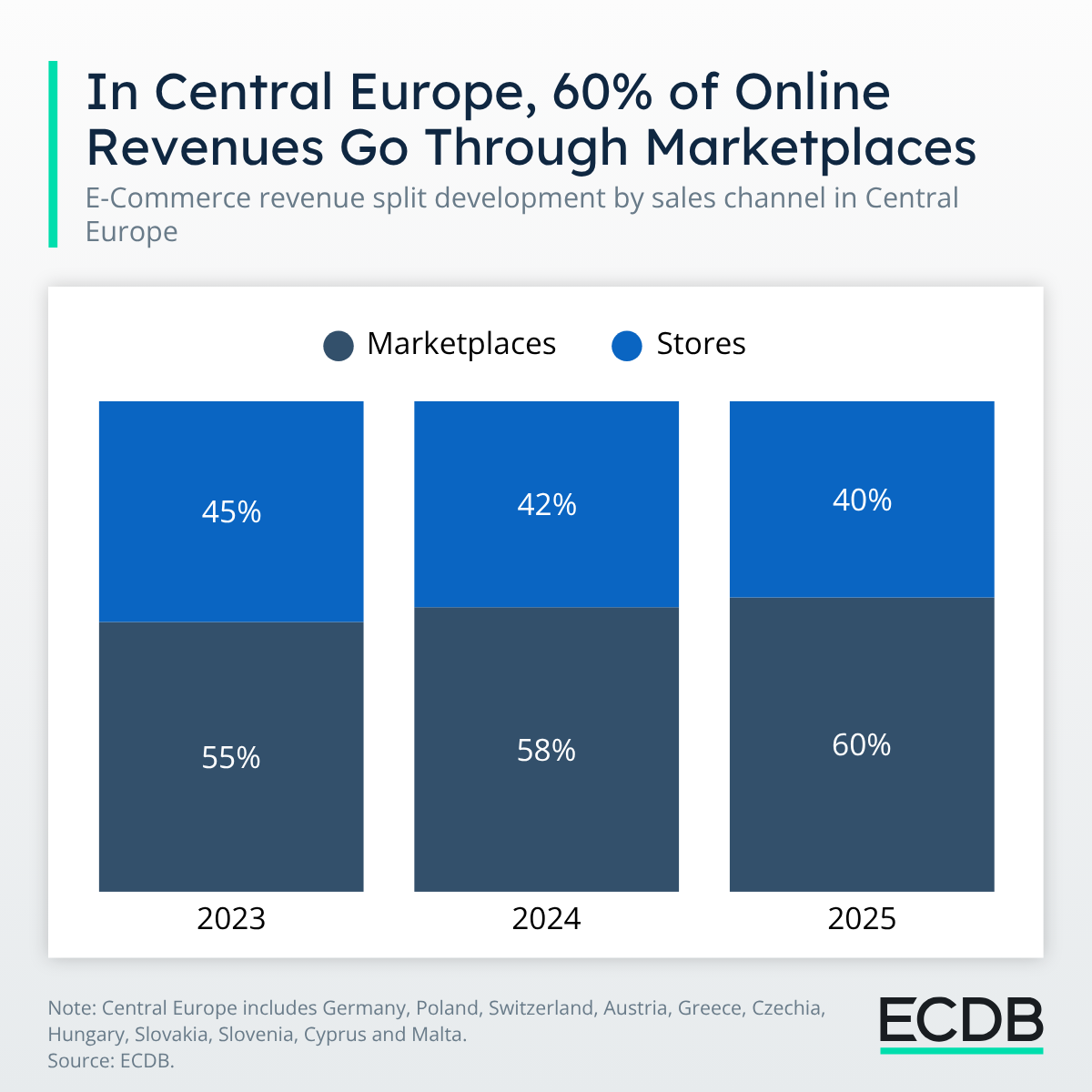
In Central Europe, 60% of e-commerce revenues are generated through marketplaces. Just two years ago, that figure was at 55%. This number follows a global trend, and is therefore highly likely to increase in the future.
Why Marketplaces Keep Gaining Ground
Marketplaces include benefits for all parties involved. For sellers, the platforms ensure they can reach a wider audience for their merchandise. Marketplace providers can offer more products at minimal held inventory and take fees for placement, while consumers get all merchandise they look for in one place.
But as with the development of increasing concentration of a few large players, these same names contribute to the dominion of marketplaces in global - and Central European - e-commerce. Amazon, eBay, Temu and AliExpress all rank among the top online retailers in the region, alongside homegrown platforms like Allegro or Zalando.
Where Europe Stands in the Global Comparison
Compared to Asia or the world average, Central European revenue splits are significantly behind the trend. Globally, 83.4% of revenues come from marketplaces and in Asia that share is even higher, at 97.0%. It is therefore no coincidence that as cross-border champions are taking hold, the entire structure of e-commerce skews towards world standards.
The gap has structural roots. Much of Asia's e-commerce grew up inside marketplace ecosystems from the start. Platforms like Alibaba's Taobao and Tmall, JD.com and Pinduoduo built the shopping habit itself, so a standalone brand website was never the default starting point for most sellers or shoppers in the region. Central Europe took a different path: retailers and brands built direct online stores early, and consumer habits followed.
That gap is closing. The same cross-border sellers reshaping the global picture, Temu and AliExpress among them, are exporting the marketplace-first model into markets that used to run mostly through direct retail. As these cross-border champions take hold in Central Europe, the region's revenue structure is shifting to look more like the world standard, not less. The rise from 55% to 60% in two years is Central Europe catching up to a dominant pattern.
But the Online Store Still Matters
The role of online stores is therefore shifting, albeit not becoming obsolete altogether. Next to marketplaces, the direct-to-consumer store remains the channel best suited to building loyalty and telling a brand's story on its own terms.
Online stores capture valuable customer data that a marketplace provider keeps under wraps, from purchase history to browsing behavior to direct contact details. That data is what makes retargeting, personalized offers and loyalty programs possible in the first place; a brand cannot build a membership tier or a points system on top of a sale it barely gets to see.
The buying experience differs just as much. A product listed on a marketplace often sits beside a competitor's version of the same item, sometimes losing the buy box to it outright. An online store removes that comparison entirely, so a repeat visit is driven by brand preference rather than by whichever seller undercuts the price that day.
Repeat business also costs less to earn on an owned store. Every marketplace sale, including the tenth from the same buyer, still carries a placement or referral fee. On a brand's own site, that cost drops sharply, which is a large part of why customer lifetime value compounds there rather than on the platform.
Finding Your Own Marketplace and Store Balance
Central Europe's 60/40 split is a regional average, and the real number for any single market, category, or competitor can look very different. That number matters more than the regional trend line, since it is the one that actually shapes where a channel strategy should focus next.
ECDB's Rankings tool makes that split visible at the level that counts. Retailers and markets can be filtered by business model, separating 1P revenue, sold directly by the retailer, from 3P revenue, sold through third-party sellers on a marketplace. That means a brand can see exactly how much of a market's, or a competitor's, GMV runs through each model, rather than assuming from a regional average that may not apply to its own category or country. For a brand weighing how much to invest in its own store versus a marketplace presence, that distinction turns a general trend into a decision it can actually act on.