Shopify Is the Most Used Shop Software Globally, But Magento Dominates in Europe
Shop software usage hinges on factors like usability, access, and cost. But regional preferences also play an important role.

Shop software providers make it easy for anyone to set up an online store. But there are many options to choose from, each with a different service. Some let you set up your store for free, while others charge for specific tools or features.
Two of the most commonly used shop software providers in the world are Shopify and Magento. Shopify powers 14.6% of online stores worldwide and Magento is used by 9.1%. On a global scale, the prevalence of each solution is strongly linked to regional preferences.
Magento Is Most Prevalent in European Countries
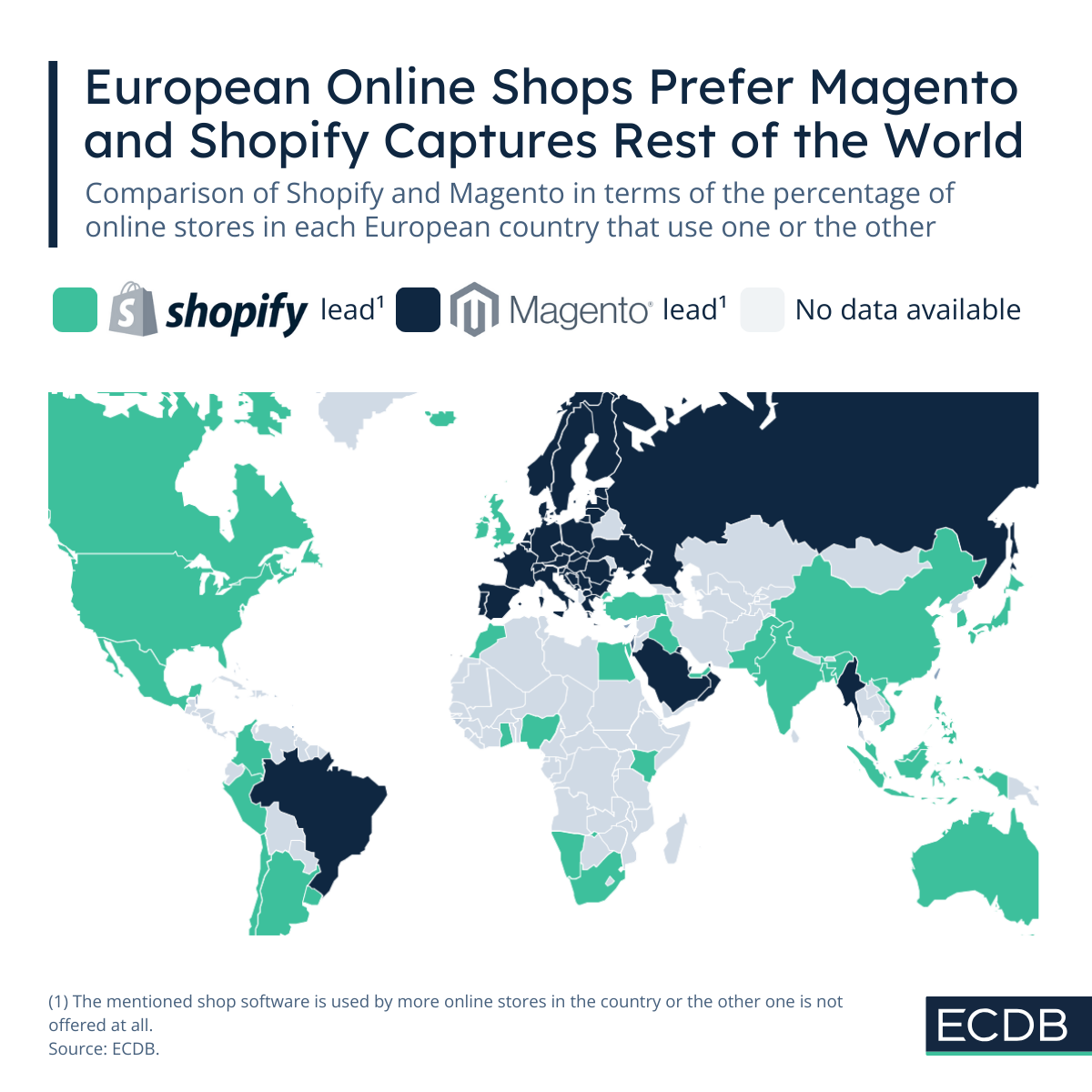
At ECDB, our extensive information on online stores from around the world also includes the use of shop software. In a head-to-head comparison between the two largest providers, Shopify and Magento, neither takes a clear lead over the other – it rather depends on the region.
Magento is more widely used in Europe. With the exception of Latvia, the UK, Ireland and Türkiye, Magento has a clear lead in the number of online stores in the European countries for which information on shop software usage is available.
The gap between Magento and Shopify usage tends to be large in most cases. In Germany, 10.1% of online stores use Magento over Shopify (6.8%), and in France the difference is over 5 percentage points for Magento (12.5%) versus Shopify (7.2%). Shopify is barely used in Poland (0.8%), while Magento fares better, with 6.7% of online stores using it. The list goes on, except for a few outliers where Shopify dominates.
These include the UK and Ireland. Both providers are common in the UK, Shopify with 22.3% of online stores and Magento with 15.7%. In Ireland, 24.4% of online stores use Shopify, while the share for Magento is 12.6%.
Shopify’s lead in these markets aligns with the trend of its higher adoption in English-speaking countries, including North America and Australia.
Shopify Usage Extends Over Americas to Asia
Of the two shop software services, Shopify is considered the easier software to use, but with higher fees for additional features. It is the most widely used shop software in the world, but there is a regional concentration of its preferred markets, nonetheless.
North America is one of them: In the U.S., Shopify’s lead over Magento is significant. Shopify is used by 38.0% of online stores in the United States, while Magento captures only 7.9%. Canada is very similar: Shopify reaches exactly one third of online stores (33.0%) and Magento 9.1%.
Moving down to Latin America, among the countries where information on shop software usage is available, Brazil is the only one where Magento takes the lead over Shopify. But the difference is not as clear as in the other markets: Magento is used by 9.7% of online stores, while Shopify is used by 3.9%.
On the other side of the globe, Shopify usage is also more common in Asian countries. This is true for Pakistan, India, Bangladesh and China, as well as South Korea, the Philippines, Singapore and Indonesia. Outliers in the region include Thailand, where Magento is used by 7.4% of online stores, compared to 2.8% for Shopify. Saudi Arabia also stands out with 12.3% of online stores using Magento, compared to 6.0% for Shopify.

Related Articles
All ArticlesReady to Unlock the Full Power of ECDB?
Book a demo to see how ECDB's market intelligence can support your business.