Mobile Commerce: Types, Strategies and Trends
Mobile commerce stacks at least six different channels on top of each other. Most strategies only optimize for one or two of them at a time.
Benchmarking Strategy in E-Commerce
Knowing where you stand takes a sequence of questions: who you're actually competing with, how you perform against them, and why. That sequence is what makes benchmarking so valuable in e-commerce. Here is how to actually run it.

Nadine Koutsou-Wehling
Data Journalist
September 11, 2026
Other
Article in a Nutshell:
Real benchmarking starts with identifying genuine competitors. Comparing against the wrong peer group makes every number after it meaningless.
Once the right competitors are identified, the real value comes from checking several metrics side by side. A lead in one number can hide a weakness in another that only shows up when they're compared together.
The full picture takes more than one tool: finding the right competitors, comparing them, sizing the category, and understanding the shopper behind the numbers all answer different parts of the same question.
E-commerce benchmarking is the practice of measuring a business's performance against real competitors. A retailer that only tracks its own growth quarter over quarter can look healthy for a long time. That can hold right up until a competitor pulls ahead on the one metric that actually decides who wins a category. Benchmarking catches that shift while there's still time to respond to it.
Benchmarking is a recurring sequence instead of a single lookup. Each step below answers a specific question on how to act next. Taking Casper, the mattress retailer, as an example, this article shows how benchmarking is done properly to yield tangible results.
Before comparing anything, the more basic question is who actually counts as competition. Weighting matters here. Leaning into Category Match specifically is what delivers a genuine peer group instead of just a similarly sized name.
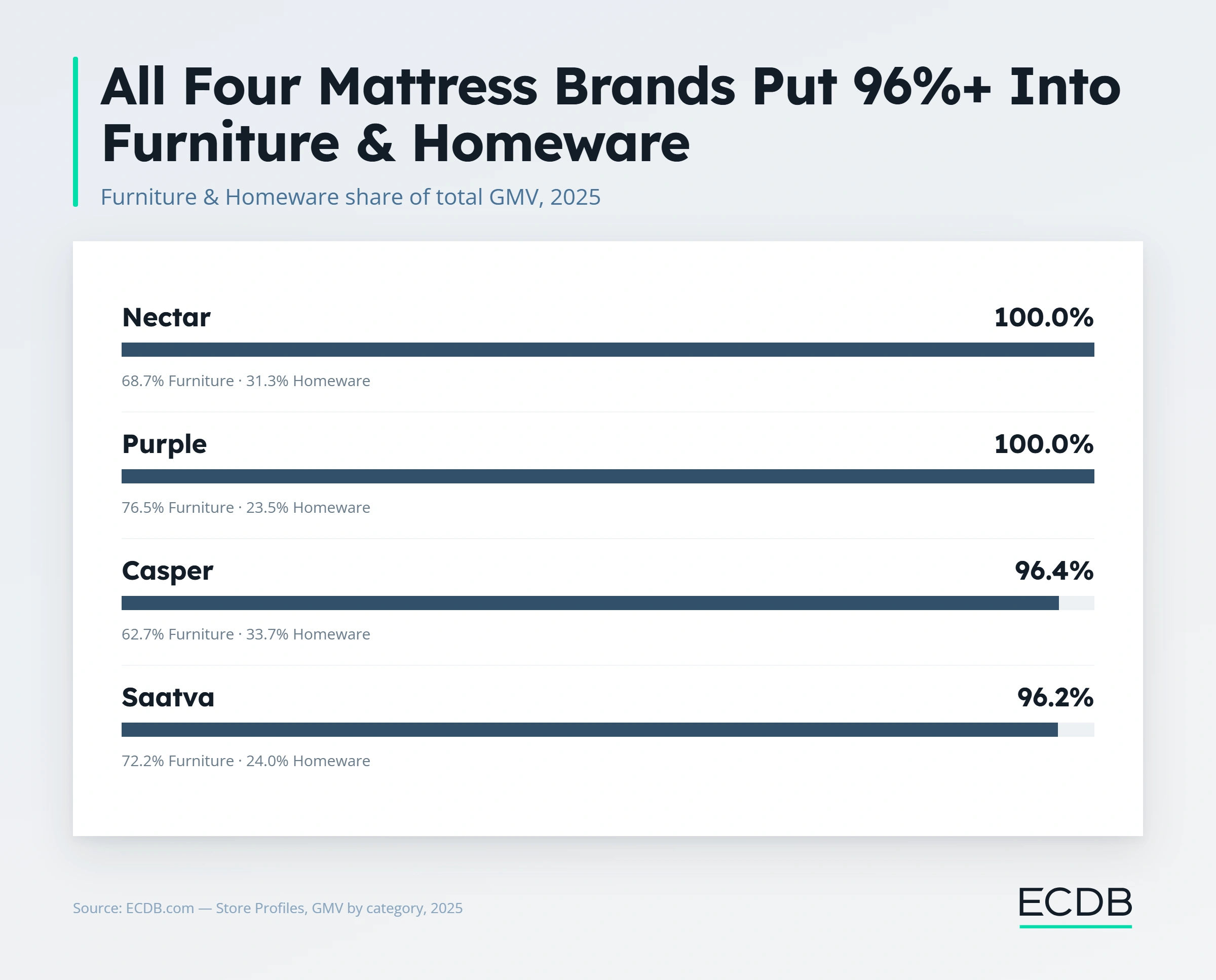
For Casper, the match list comes back with Nectar, Saatva, and Purple. All four put 96% to 100% of their revenue into Furniture & Homeware, mattresses specifically. Finding out a retailer's match specifically has become much easier with ECDB's Competitor Finder.
The problem with internal reporting is that it is not always accessible to anyone and the methods can differ. Finding out real performance, a benchmarking strategy needs to compare metrics like revenue, growth, AOV, and purchase frequency together to see who comes out where.
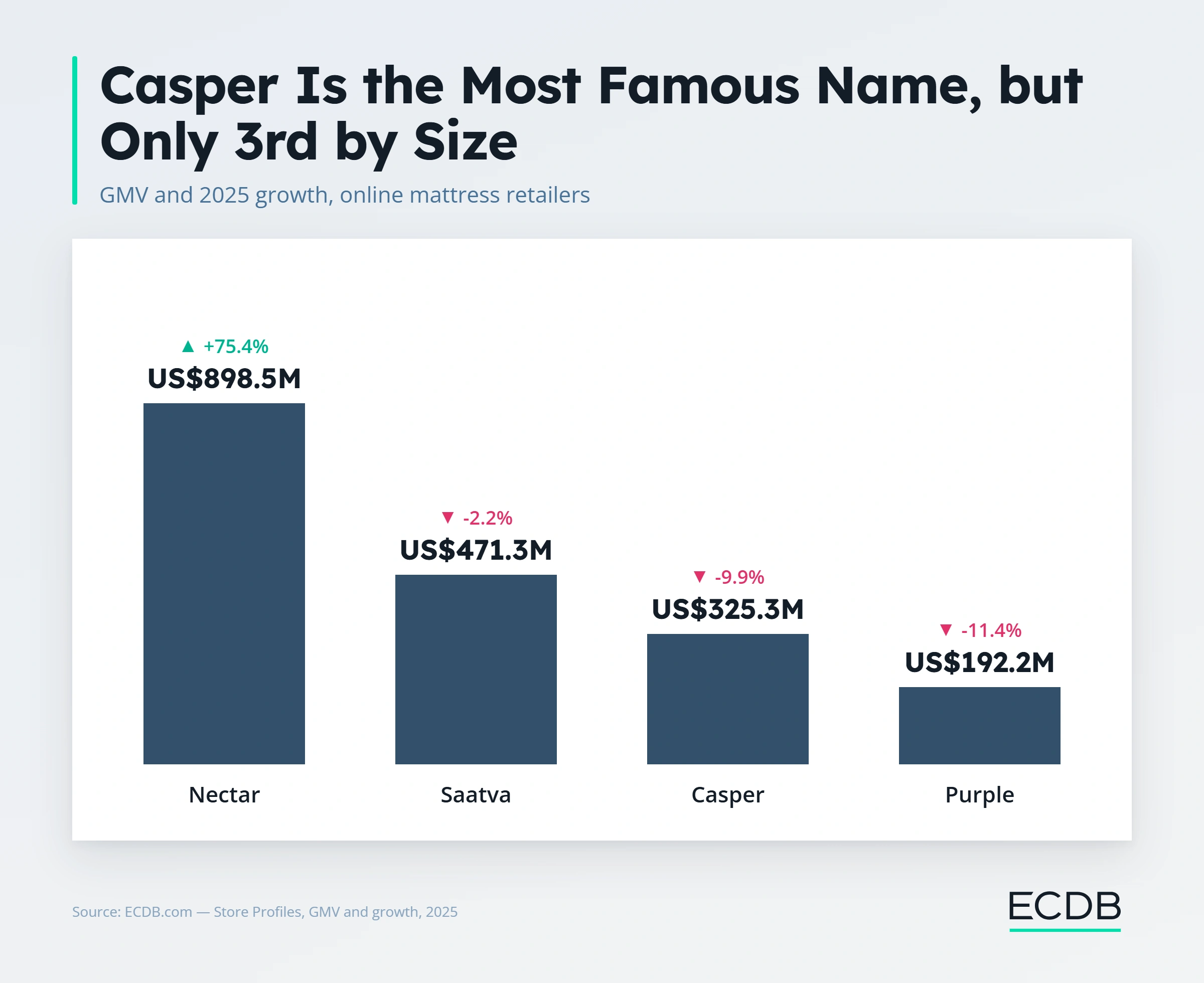
Analyze & Compare is built for exactly that kind of side-by-side view, with up to four stores at a time and the setup saved for the next review. Nectar's 2025 GMV is US$898.5 million, against US$471.3 million for Saatva, US$325.3 million for Casper, and US$192.2 million for Purple. Casper, one of the most recognizable names in the category, actually sits third by size.
Growth splits the group even further apart. Nectar grew 75.38% in 2025. Casper fell 9.87%, Saatva fell 2.25%, and Purple fell 11.36%. Three of the four established names are shrinking while the fourth is growing by three-quarters in a single year.
A shrinking retailer could mean the whole category is struggling. Or it could mean one retailer specifically is losing ground in a category that's still healthy. For a proper benchmarking strategy, you need to map out the underlying context to put performance into perspective.
In our case, US furniture grew 5.6% in 2025, a modest but real increase. Set next to that, Casper's, Saatva's, and Purple's declines aren't a category problem. All three are shrinking inside a category that's growing. Nectar isn't just outperforming a soft market either. It's growing more than thirteen times faster than the category average. Something specific to each of these four companies is driving the gap, not the market they're all selling into.
Knowing where the gap is isn't the same as knowing why it exists. Getting to why means looking at several things together for one retailer at a time: revenue, conversion, purchase frequency, AOV, and customer demographics. ECDB Profiles is built to hold all of that in one place.
For Casper and Nectar, the obvious explanations don't hold up. Conversion rates sit within a fifth of a point of each other, 2.44% for Casper against 2.32% for Nectar. Purchase frequency is nearly identical too, 1.76 against 1.59, both consistent with how rarely anyone buys a mattress. AOV doesn't explain it either. Nectar's is higher than Casper's, but Saatva's is higher still, and Saatva is shrinking.
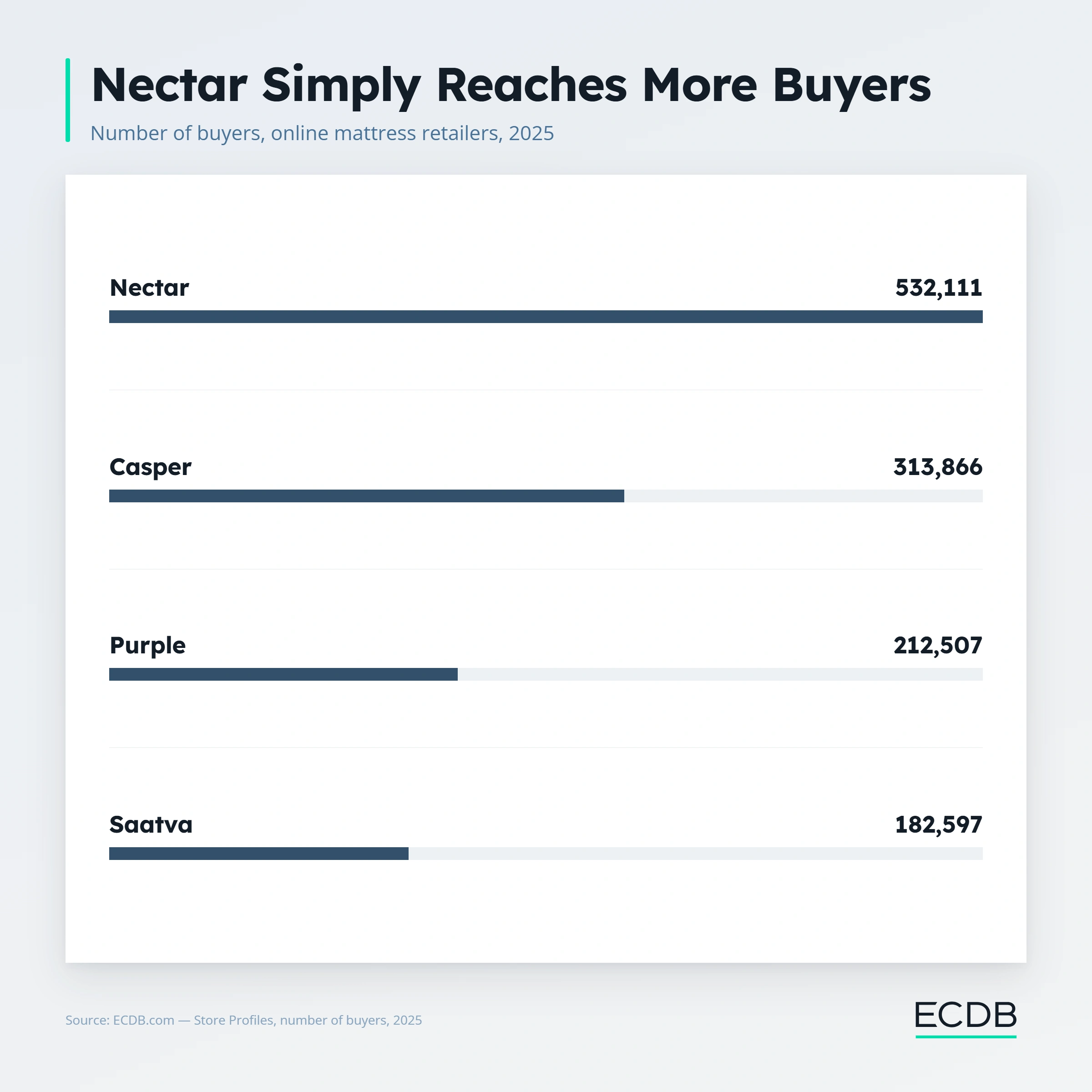
Looking deeper, we find that the buyer number is highest at Nectar, which explains its leading position. Nectar reached 532,111 buyers in 2025, against 313,866 for Casper, 212,507 for Purple, and 182,597 for Saatva. For Casper, the mission becomes clear: get more buyers.
Every step so far looks at retailers. The shoppers behind them matter just as much. We want not only to understand how many customers buy, but also how they interact between stores to see if maybe some competitor is taking away from our existing shopper base or vice versa.
Specifically, whether Nectar's growth is coming from Casper's own customers switching over, or from an entirely different pool of buyers. That distinction changes the response. If Nectar is pulling Casper's own customers away, the right move is retention, offers and messaging aimed squarely at the shoppers most likely to switch.
If Nectar's growth is coming from buyers new to the category entirely, the opportunity is acquisition instead. That means matching whatever is drawing those new buyers in, rather than defending a base that was never at risk. All this research is best conducted using Shopper Analytics, which tracks how shoppers move between stores across five European markets, turning that retention-or-acquisition question into an answer backed by real behavior
Two more questions round out a full benchmarking practice. A huge share of category volume often sits outside a brand's own site entirely, on Amazon specifically. The same benchmarking logic needs to extend to marketplace-specific performance too.
Amazon Analytics is built for exactly that analysis. It shows who's actually selling a given brand's products across 12 Amazon marketplaces, and at what volume. It also breaks down how much of that revenue runs through authorized channels versus resellers the brand may not even be tracking.
For Casper, that means checking whether unauthorized sellers are undercutting its official Amazon listings. It also means comparing that same picture against how Nectar's products are being sold and resold on Amazon. That's a second, marketplace-specific read on the competitive gap, one a brand's own website numbers alone would miss entirely.
A benchmark built once and never rechecked goes stale the moment a competitor's numbers move. The API and MCP Server keep the picture current. MCP (ECDB AI Connector) connects the same underlying data directly into tools like Claude. That means plain-language questions get sourced, traceable answers, without rebuilding a comparison from scratch every time something needs confirming.
For a retailer in Casper's position, that means checking three things on a rhythm. Is Nectar's growth rate holding or cooling off? Are Saatva's and Purple's declines stabilizing? Has a new specialist entered the category match list?
A retailer that runs through every step here and still can't point to a decision hasn't done the job right.
With that picture in hand, Casper's next moves are about reach:
Shift marketing budget toward broad, top-of-funnel acquisition rather than site or loyalty improvements.
Hold pricing steady rather than discount. AOV already sits in line with the category, and a price cut would address a problem Casper doesn't actually have.
Treat Saatva's and Purple's declines as part of the same shift Casper may be facing.
Build the budget shift around the channels where Nectar is clearly winning attention over Casper.
These are actionable steps a retailer like Casper can surmise from using these tools shown above. ECDB brings every one of these steps into one place, on the same underlying data, so a retailer never has to switch tools or guess at a competitor's numbers to get there. That's what turns benchmarking into a decision a business can actually act on

Related Articles
Mobile commerce stacks at least six different channels on top of each other. Most strategies only optimize for one or two of them at a time.
Revenue in e-commerce comes down to a simple multiplication: the number of people buying, how often each one buys, and how much they spend per order. Here are the ways how to increase each component.
An e-commerce strategy is a plan for growing online sales with intention. Using ECDB, this article runs an illustrative analysis to show how that plan comes together.

Click here for
more relevant insights from
our partner Mastercard.
Book a demo to see how ECDB's market intelligence can support your business.