How to Conduct Proper E-Commerce Benchmarking to Know Where You Stand
E-commerce benchmarking is the sequence of questions a business asks to know where it stands. This article shows how to run that sequence, using a real-world example.
Types of E-Commerce
Mobile commerce stacks at least six different channels on top of each other. Most strategies only optimize for one or two of them at a time.

Nadine Koutsou-Wehling
Data Journalist
August 14, 2026
Other
Article in a Nutshell:
Globally, 11.18% of online visitors add something to their cart, but only 2.68% complete a purchase, a gap that mobile's smaller screens and slower checkout flows tend to widen rather than close.
Cart abandonment already runs from 66.7% to 83.8% depending on the category, and the categories that involve the most comparison shopping, like Furniture & Homeware, are exactly the ones where a cramped mobile screen makes that comparison harder to do.
Mobile-native platforms like Douyin and Kuaishou's Kwaixiaodian have built some of the largest social commerce businesses in the world without ever needing a desktop version at all.
Mobile commerce covers any purchase that starts or finishes on a phone, and that definition stretches across more formats than most strategies account for.
Getting it right means treating each type as its own channel with its own friction points, rather than assuming a mobile-responsive website covers the whole picture.
Mobile commerce splits into several distinct formats, each with a different relationship between browsing and buying:
Mobile web commerce: shopping through a browser on a phone, usually the first mobile experience a new customer has with a store, and often the least optimized.
Native app commerce: a dedicated shopping app, typically reserved for a retailer's most frequent customers, since downloading an app is a bigger commitment than opening a browser tab.
Social and in-app commerce: purchases made without leaving a social platform, from a shoppable post or a live-stream sale, built entirely around mobile from the ground up.
Mobile wallets and one-tap payment: Apple Pay, Google Pay, and stored-card checkout that removes manual card entry, the single biggest friction point on a small screen.
QR and scan-to-buy: a bridge between a physical store and a mobile purchase, scanning a product in an aisle to check stock, reviews, or a better price before buying on the spot.
Push and SMS-driven commerce: purchases triggered by a notification rather than a search, cart recovery reminders, restock alerts, and flash sale pushes.
Each type solves a different problem, and a mobile strategy built only around a responsive website is only covering the first one on this list.
Globally, 11.18% of online visitors add a product to their cart, but only 2.68% complete a purchase. That gap between browsing and buying is where most mobile revenue disappears, and mobile's format makes the gap worse rather than better: a longer checkout form, a card number that needs to be typed manually, or a comparison across multiple tabs are all harder on a five-inch screen than a desktop monitor.
Cart abandonment rates already vary by category, from 66.7% in Bullion & Precious Metal up to 83.8% in Furniture & Homeware, and that variation tracks how much comparison shopping a category involves before checkout.
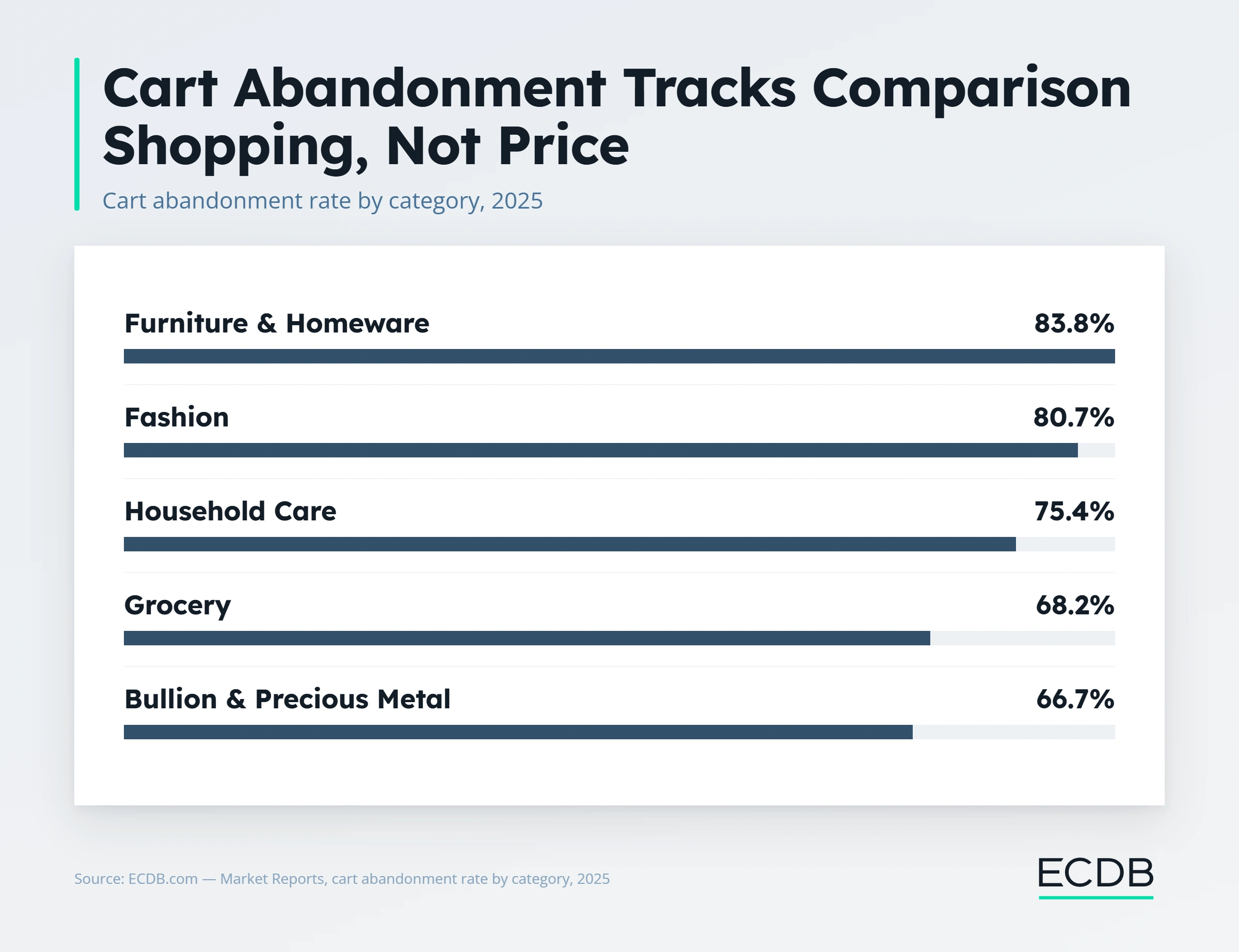
A category that already asks a shopper to compare several retailers before deciding is exactly the category where a cramped mobile interface adds friction on top of a decision that was already going to take a while.
The strategies that work address a specific type of mobile commerce and a specific point of friction, rather than trying to fix mobile as one generic problem:
Simplify checkout to the fewest possible steps, and default to one-tap payment options wherever the platform supports them, since manual entry is the single biggest source of mobile-specific abandonment.
Reserve app-exclusive perks, early access, loyalty points, or member pricing, for the native app specifically, since that's what gives a customer a reason to install it rather than just using the mobile site.
Treat push notifications as a tool for categories that already run on repeat purchases, restock reminders for household essentials or groceries convert far better than generic promotional pushes, because they're solving a problem the shopper already has.
Use QR and scan-to-buy as the connective layer between physical stores and mobile checkout, letting a shopper start a decision in-store and finish it on their phone without losing the momentum of that decision.
Social commerce has moved well past being an experimental add-on to mobile shopping. It's already a primary channel in its own right. Douyin and Kuaishou's Kwaixiaodian have built e-commerce businesses at massive scale entirely inside a mobile, video-first experience, with no desktop equivalent driving that growth.
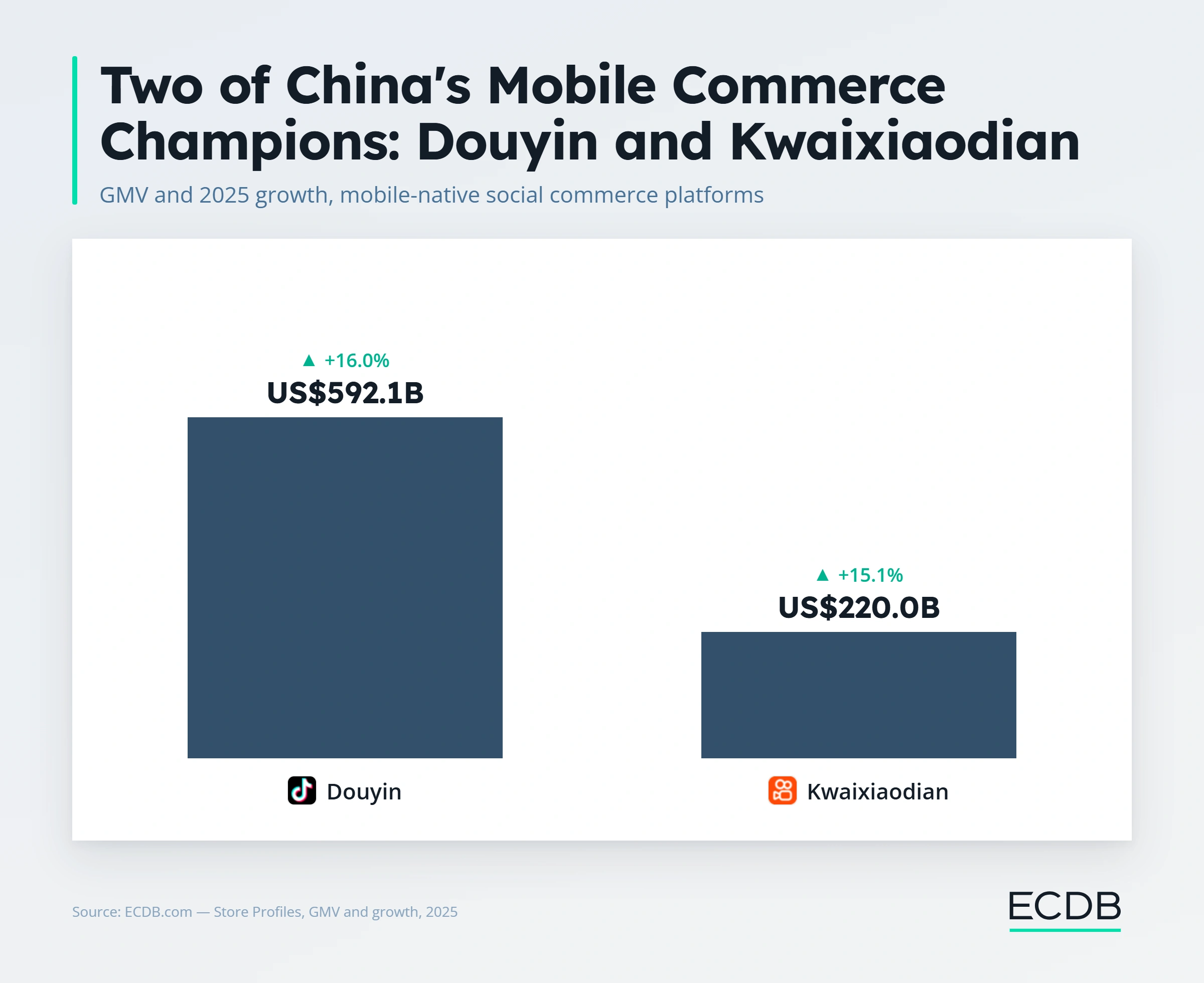
That model is spreading well beyond the platforms that pioneered it, and it points toward more purchases happening inside the app someone is already using to be entertained, rather than a separate shopping destination.
Douyin proves this with US$592.1 billion GMV generated, excluding the GMV made by its sister platform, TikTok Shop. Kwaixiaodian by Kuaishou is based in China entirely, but likewise generates hundreds of billions in GMV in a year.
AI is layering on top of that shift. A mobile shopping assistant that can answer a direct question about a product, or handle a return without a menu tree, fits naturally into a format that was never built around a full desktop-style interface to begin with.
Expect the next wave of mobile commerce strategy to spend less time perfecting a checkout flow and more time making sure a purchase can happen through a conversation, a video, or a single tap, however few traditional steps that leaves in between.
A mobile strategy ultimately has to move the same outcomes any commerce strategy does: more visitors converting, fewer carts abandoned, and more frequent repeat purchases.
ECDB tracks exactly those outcomes, conversion rate, cart abandonment, purchase frequency, and AOV, at the category and store level across thousands of retailers, which is the benchmark a mobile initiative should actually be measured against.

Related Articles
E-commerce benchmarking is the sequence of questions a business asks to know where it stands. This article shows how to run that sequence, using a real-world example.
Revenue in e-commerce comes down to a simple multiplication: the number of people buying, how often each one buys, and how much they spend per order. Here are the ways how to increase each component.
An e-commerce strategy is a plan for growing online sales with intention. Using ECDB, this article runs an illustrative analysis to show how that plan comes together.

Click here for
more relevant insights from
our partner Mastercard.
Book a demo to see how ECDB's market intelligence can support your business.