How to Conduct Proper E-Commerce Benchmarking to Know Where You Stand
E-commerce benchmarking is the sequence of questions a business asks to know where it stands. This article shows how to run that sequence, using a real-world example.
E-Commerce Strategy
An e-commerce strategy is a plan for growing online sales with intention. Using ECDB, this article runs an illustrative analysis to show how that plan comes together.

Nadine Koutsou-Wehling
Data Journalist
July 30, 2026
Other
Article in a Nutshell:
A successful e-commerce strategy runs one goal through a repeatable loop, sizing the category, mapping the competition, and understanding the shoppers behind it, rather than treating a single report as the finished plan.
Each step of that loop surfaces a different layer of information: how big and healthy the category actually is, who genuinely competes for the same shopper, how those rivals perform side by side on the metrics that matter, and what's actually driving their numbers versus your own.
Run together, on data that stays current through the API and MCP Server, these tools turn a broad ambition into a specific, defensible goal, backed by concrete measures instead of guesswork.
An e-commerce strategy is a plan to sell products online successfully, built on evidence instead of instinct. Its purpose is simple: make the biggest decisions deliberate instead of reactive. Which category to enter. How to price. Who the real competitors are.
Get those decisions right early, and budget goes toward a category that's genuinely worth entering, not just one that looks exciting from the outside.
The rest of this guide walks through how to build an e-commerce strategy, step by step, using ECDB's tools and Douglas as a running example.
An e-commerce strategy is a plan for where to compete and how to win there, built on evidence instead of instinct. It only works with a fixed goal behind it, something specific enough to measure progress against, not a vague direction like "grow the business." You can either start with a specific goal in mind or scout your position in order to formulate something realistic, based in real-life market data.
A fixed goal you choose might be closing the gap with the fastest-growing competitor in your category, lifting repeat purchase rate by a set amount, or taking a defined share of a category you're already in.
Let's say we conduct a strategy for douglas.de, one of the leading personal care retailers in Germany. We see where we stand first before we formulate a realistic direction. Every tool in this guide gets used in service of that, starting with the state of our main category.
Before anything else, check whether the category itself can carry growth. Category Explorer covers more than 18,000 categories across seven hierarchy levels and 149 countries, with data back to 2017 and forecasts out to 2030, built for exactly this question.
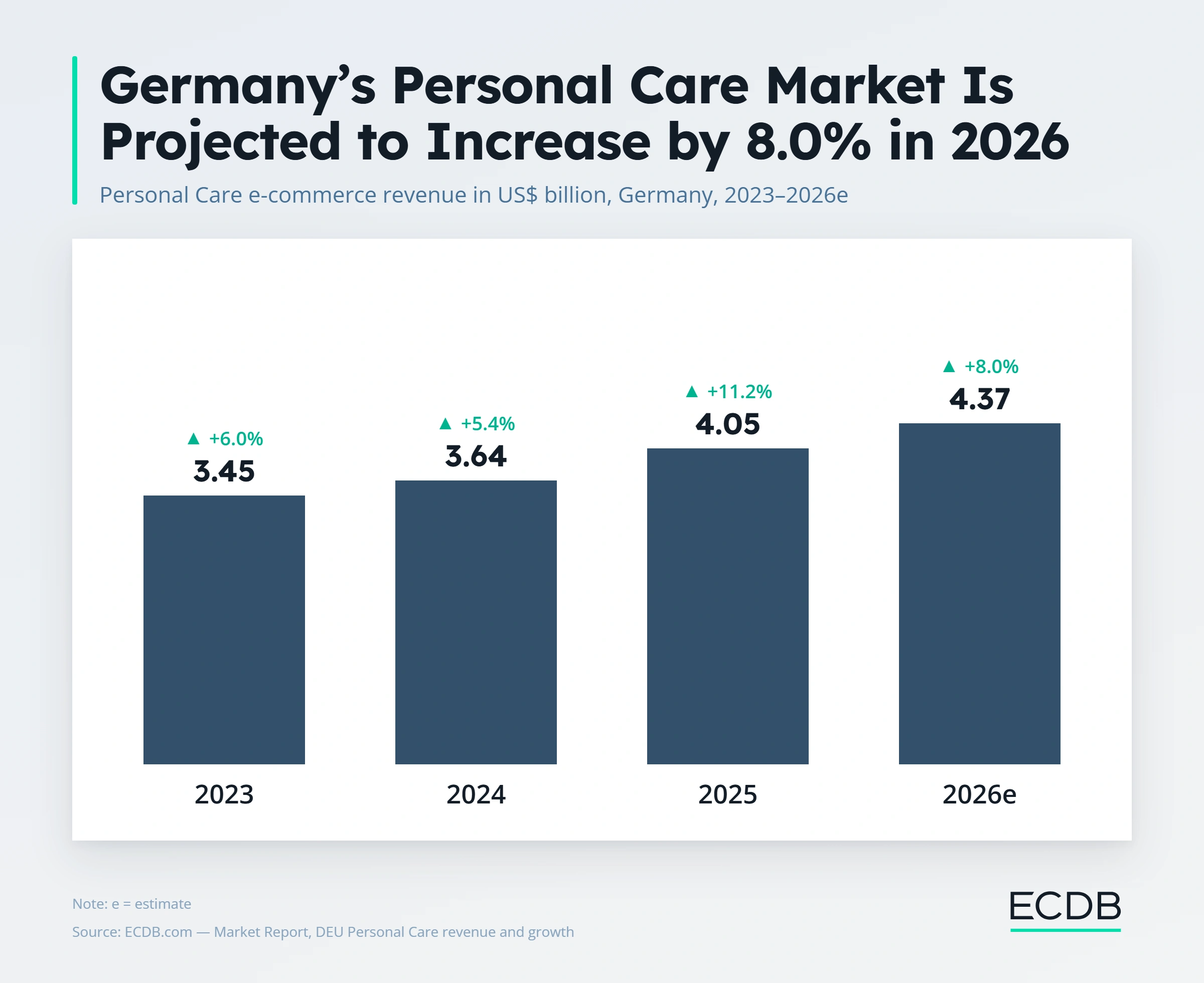
Personal Care in Germany is worth US$4.05 billion in 2025, up 11.19% on the year, with US$4.37 billion projected for 2026. That's a healthy category.
Let's see where we stand more specifically within it by digging deeper.
Once the category's own growth is on the table, the next question is where we actually sit in it. Rankings filters and ranks retailers by GMV, comparable across business models, so every player in a category lines up on the same scale regardless of size or setup.
In Germany's Personal Care category, Amazon.de ranks first, we rank second, and Flaconi.de ranks third. Temu, Zalando, and AliExpress round out the top six, all generalists. That tells us exactly where the pressure on our online business comes from both directions: Amazon above us on scale, and Flaconi below us as the specialist actually gaining ground.
Rankings names the field. Competitor Finder tells us who in it is a real competitor rather than just a bigger name. Feed in our own store, and it scores every other retailer in the database on a Match Score built from criteria like Country Match, Category Match, Category Concentration Match, and 1P/3P Match, weighted however matters most.
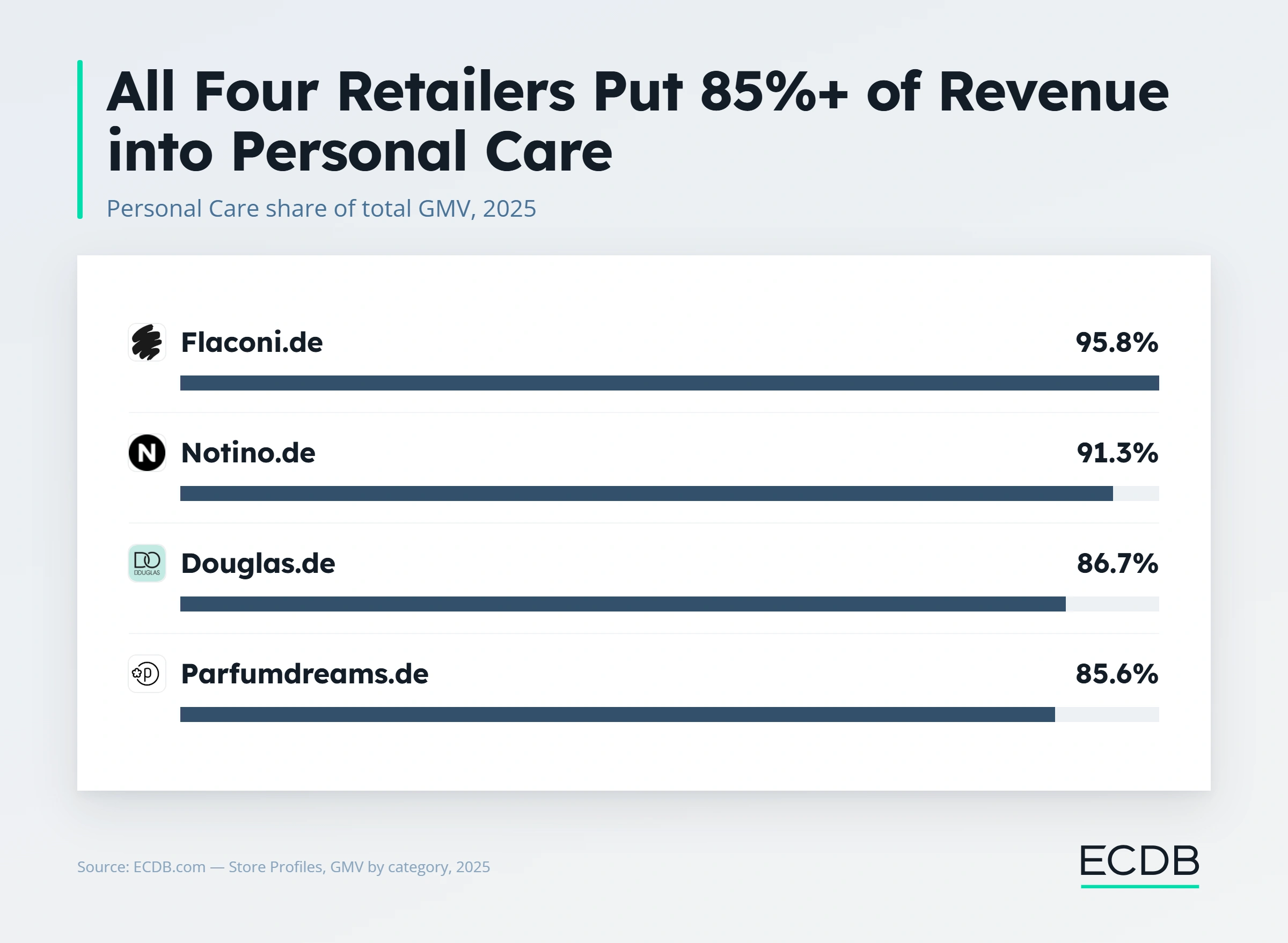
For us, that surfaces Flaconi.de, Notino.de, and Parfumdreams.de, three stores that put 93% to 96% of their revenue into Personal Care, close to our own 86.67%.
Amazon and Zalando never make this list. They may outrank us on Rankings' raw GMV, but they're not selling against us the way these three specialists are, and our goal needs to be measured against the competitors actually in our lane.
With the real competitive set identified, Analyze & Compare puts up to four stores side by side across whatever metrics matter, revenue, growth, AOV, conversion, purchase frequency, over time, with the setup saved for the next review instead of rebuilt from scratch.
This is where our goal takes shape. Flaconi grew 16.47% last year and Notino grew 20.13%, both more than double our own 7.95%. Parfumdreams is the exception, down 0.44%.
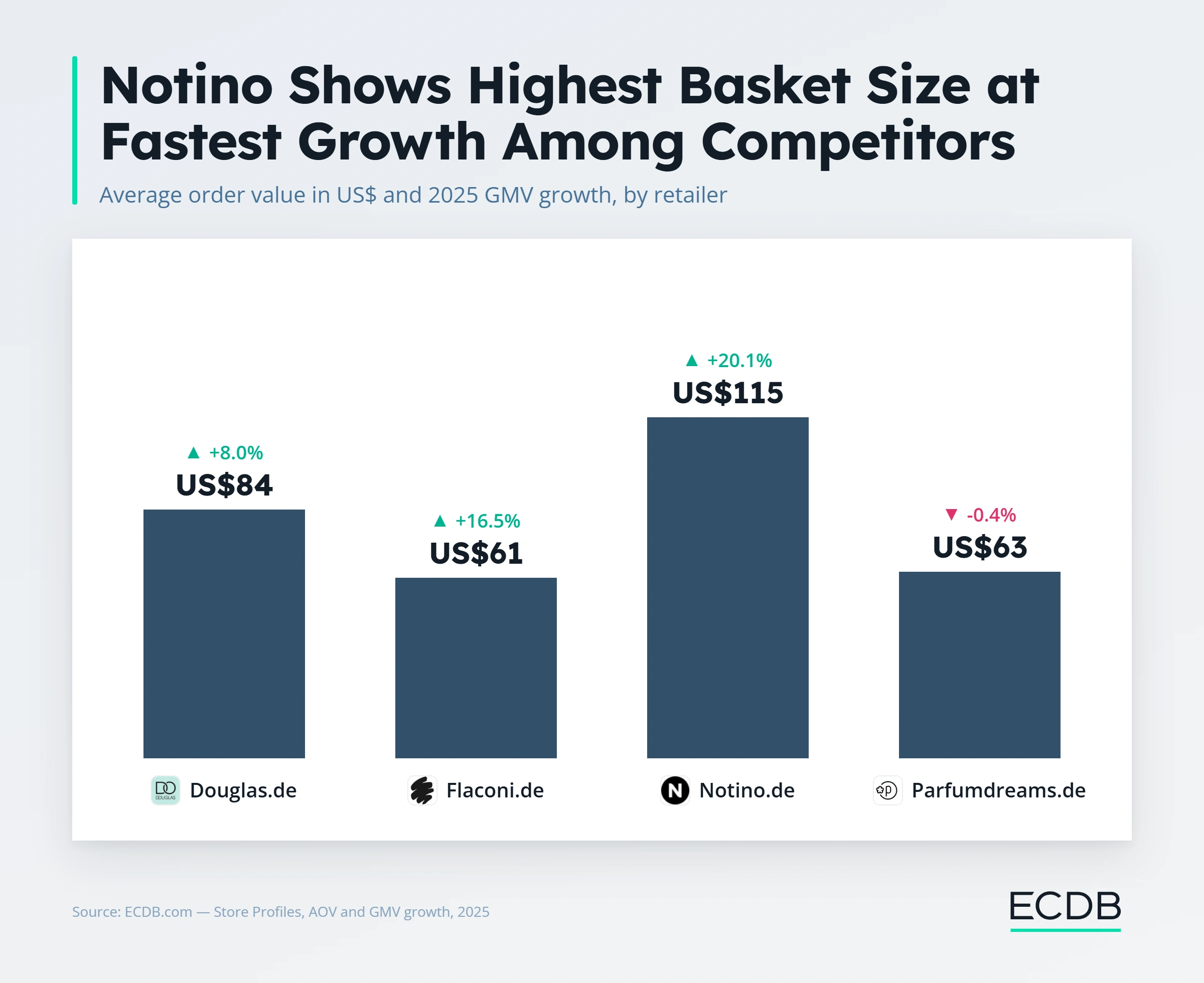
On AOV we sit in the middle at US$84.00, behind Notino's US$114.60 but ahead of Flaconi's US$61.20 and Parfumdreams' US$63.40. We do lead the group on purchase frequency, 2.32 orders a year against 1.85 to 2.26 for the other three.
None of that closes a growth gap this size on its own. Outpacing the others is our business aim, and we now can formulate exactly where we stand.
Every step so far looks at retailers. Shopper Analytics looks at the shoppers themselves, modeled behavior across stores in five European markets, covering shopper profile, spending behavior, shopping pattern, and loyalty.
For a growth gap like the one against Flaconi and Notino, this is where the real cause shows up.
Shopper Analytics' Cross-Shopping view would tell us whether their growth is coming from our own customers switching over, or from shoppers new to the category entirely. All three of us have a similar age and income mix, younger and middle-income-skewed, within a few points of each other across every bracket.
Whatever was driving Flaconi's and Notino's faster growth, it wasn't a fundamentally different customer base sitting right there in the data. Running Cross-Shopping settled the rest of it: Notino overlaps with our own shopper base far more than Flaconi does. Notino's growth is substantially our own customers buying there too. Flaconi's is coming from a slightly different pool of shoppers.
A quarterly goal isn't something to check once and revisit at quarter's end. ECDB's API and MCP Server keep the picture current throughout: MCP connects the same underlying data directly into tools like ChatGPT and Claude, so plain-language questions get sourced, traceable answers without rebuilding a ranking or comparison from scratch every time.
For us, that means tracking week to week whether GMV and online share are actually on pace, whether Flaconi's or Notino's growth is accelerating or cooling, and whether Parfumdreams' decline is turning into an opportunity to take its share directly. A goal this size doesn't survive being checked only once a quarter.
Running the analysis refined our goal to something realistic and grounded in real market data. From an unspecified number we arrived at 16% GMV growth over the next four quarters, with an interim goal of capturing two percentage points of category share from Parfumdreams within the next two.
Sixteen percent sits close to Notino's own pace rather than an arbitrary estimation, and Parfumdreams is the one competitor already losing ground, which makes it the nearest realistic source of share.
That goal comes with measures, not just a new number:
Launch acquisition campaigns aimed specifically at Parfumdreams' customer base, in the categories where its decline is sharpest.
Build a retention play aimed squarely at customers also shopping Notino, loyalty perks, personalized offers, faster delivery, since that overlap means every point of Notino's growth is a point we're actively handing over.
Put fresh acquisition budget where Flaconi is winning shoppers we don't currently reach, rather than treating it as the same problem as Notino.
Protect our purchase frequency lead, currently the best in the group at 2.32 orders a year, with a loyalty or subscription mechanic, since it's a strength competitors could still erode.
Track GMV and category share monthly through the MCP Server against both the 16% full-year target and the two-point interim goal on Parfumdreams, adjusting spend each quarter based on which competitor is gaining or losing ground.
Every step of this came from the same six tools, run in sequence rather than checked in isolation. Category Explorer confirmed whether the category could carry a stretch goal in the first place. Rankings placed us in the field. Competitor Finder narrowed that field down to the three retailers actually competing for our shopper, not just the biggest names nearby. Analyze & Compare showed exactly where we lead and where we don't. Shopper Analytics pointed at the real cause behind a competitor's growth instead of stopping at the size of it. The API and MCP Server keep all of it current instead of frozen at the moment this analysis was run.
None of those six steps produces a final answer by itself. Run together, they turned an untested assumption into a goal we can actually defend, with specific measures attached to it instead of hope. That's what conducting an e-commerce strategy with ECDB looks like in practice: not a single report filed away after one good quarter, but a loop that gets rerun every time the category, the competition, or our own numbers move, so the plan stays built on what's actually happening rather than what looked right three months earlier.
Related Articles
E-commerce benchmarking is the sequence of questions a business asks to know where it stands. This article shows how to run that sequence, using a real-world example.
Mobile commerce stacks at least six different channels on top of each other. Most strategies only optimize for one or two of them at a time.
Revenue in e-commerce comes down to a simple multiplication: the number of people buying, how often each one buys, and how much they spend per order. Here are the ways how to increase each component.

Click here for
more relevant insights from
our partner Mastercard.
Book a demo to see how ECDB's market intelligence can support your business.