The State of JD.com's Acquisition of MediaMarkt-Saturn and What It Means for European E-Commerce
JD.com acquired a majority stake in the German electronics retailer Ceconomy, parent company of MediaMarkt-Saturn. But that is not all. The move positions JD to become an indirect minority stake owner of Fnac Darty, French electronics chain with a presence across Europe. What this means for the broader European e-commerce sector and its current state is discussed in the following.

Article in a Nutshell
JD.com has locked in majority control of Ceconomy, becoming the largest shareholder in one of Europe’s biggest electronics retail groups.
Formal closing still hinges on the European Commission, which is investigating whether Chinese state subsidies distorted the bid. Brussels must rule by October 2, 2026, and JD.com filed remedies in August to address the concerns.
Through its acquisition, JD will gain indirect influence over Fnac Darty, which gives JD a foothold in the French consumer electronics market.
This will result in an overall expanded reach across Europe, with access to key markets including Germany, Belgium, Switzerland, France, the Netherlands, Italy, Austria, Portugal, and Spain.
JD.com now has the potential to rise among the top electronics e-tailers, possibly becoming the second-largest player in several countries.
This development could reshape Europe's competitive landscape by introducing a well-funded, cross-border entrant capable of integrating online and offline operations.
Since 2025, JD has moved to acquire European electronics company Ceconomy, parent of MediaMarkt and Saturn. Both retailers do not only have much influence offline and online in their home market Germany, but expand across Europe to serve a variety of cross-border markets. One of which is France, enabled through the minority stake of Ceconomy in Fnac Darty, the country's leading electronics and media retailer.
ECDB set out to measure what this combination adds up to: how far JD.com's reach would extend across European electronics e-commerce, and where it could land among the region's biggest online retailers.
JD.com's bid is not settled yet. The European Commission is investigating whether Chinese state subsidies shaped the offer, and Beijing has pushed back, calling the review unlawful. More on the current state of the deal below.
The Ceconomy Deal Extends JD's Influence Far Beyond MediaMarkt and Saturn
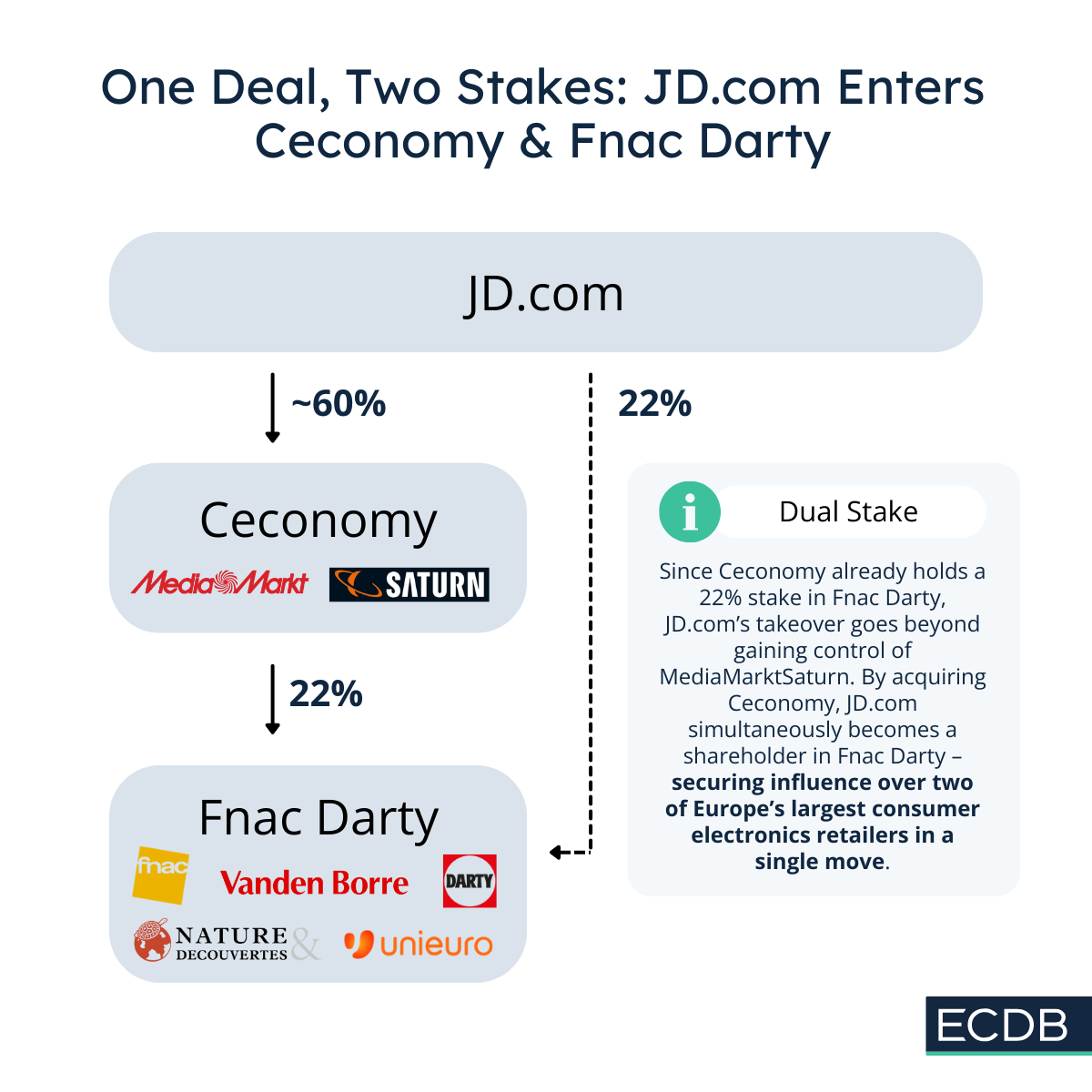
Towards the end of 2025, Chinese e-commerce giant JD.com secured a controlling stake in Ceconomy. By acquiring about 59.8% of its shares through a voluntary takeover offer, JD.com now controls roughly 85% of the company combined with its partner Convergenta's retained stake.
This makes JD the largest shareholder in one of Europe’s biggest consumer electronics retail groups. But that is not all.
As part of Ceconomy’s existing investments, the group holds a significant minority stake in French retailer Fnac Darty (around ~21-22 %). JD.com will indirectly gain influence over that share once the Ceconomy deal is completed.
In light of these developments, ECDB is interested in the tangible influence this will have on European electronics e-commerce.
JD Expands Its Reach Across European Electronics Online Markets
Taking into account all European markets in which Ceconomy and Fnac Darty operate through their various subsidiaries, JD.com’s controlling stake in Ceconomy and indirect minority influence in Fnac Darty would grant it access to these markets as well. Aggregating the current GMVs of all domains held by Ceconomy and Fnac Darty yields the following market shares:
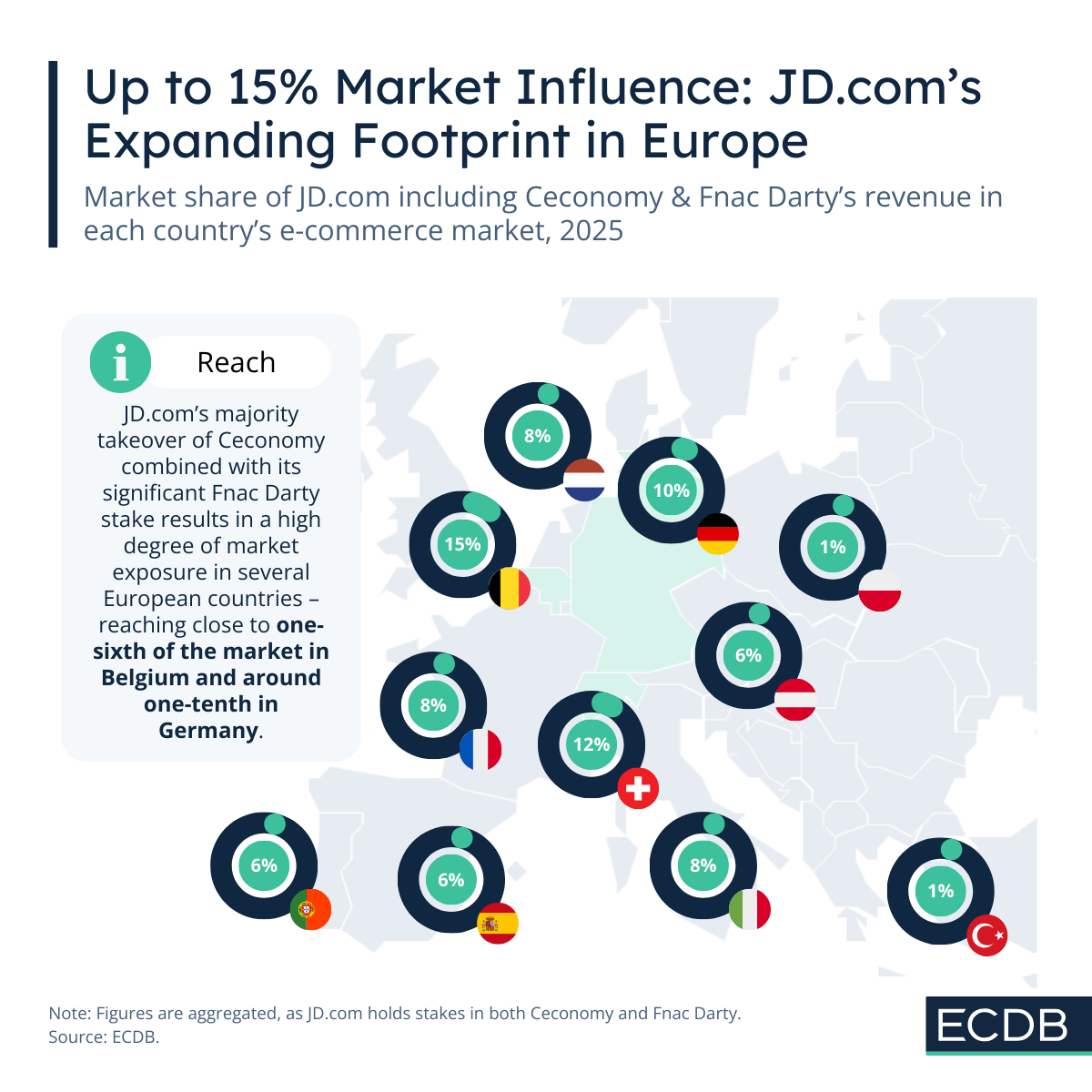
Top markets are Belgium (15%), Switzerland (12%) and Germany (10%).
At 8% market shares are the Netherlands, France, and Italy.
Combined GMV Could Propel JD to a Top-Tier Position in European Electronics
In consequence, the combination of group GMV would lead JD.com to become the up to second-largest electronics e-commerce retailer in the respective European markets.
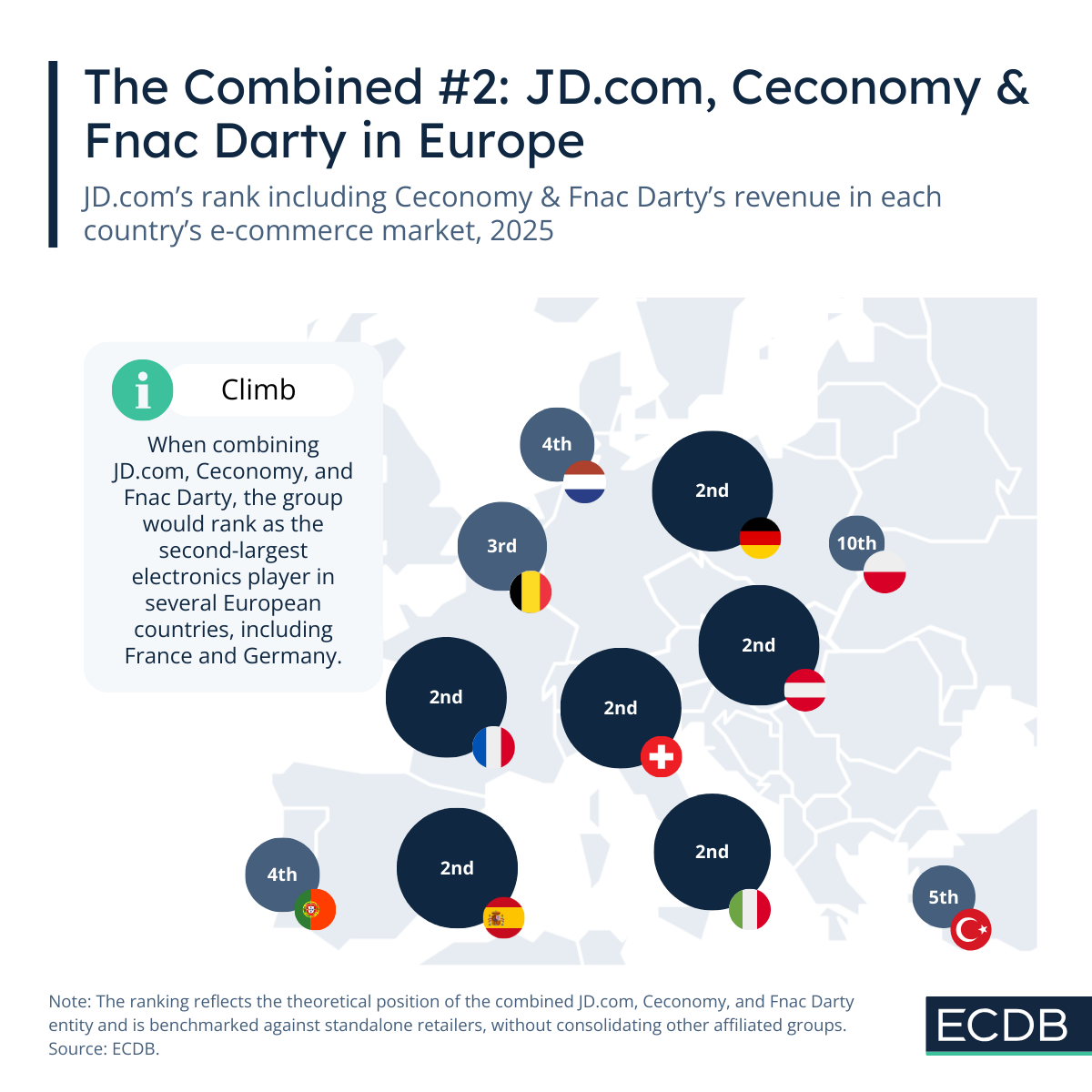
This reflects the sheer scale of its reach through both direct control of Ceconomy and indirect influence over Fnac Darty, potentially reshaping competitive dynamics and market share distribution across the region.
Why the Acquisition Stalls: Current State of the Affair
In short: Europe is blocking the deal. JD.com already controls roughly 85% of Ceconomy's shares. Germany's competition authority cleared the deal back in 2025, and Germany's investment-screening body, along with regulators in France and Italy, have since signed off too. The holdup sits in Brussels.
The European Commission opened an in-depth investigation in May 2026 under its Foreign Subsidies Regulation, questioning whether preferential financing, tax breaks, or grants tied to the Chinese state let JD.com outbid rivals for Ceconomy.
A formal Statement of Objections followed in July. JD.com filed remedies with the Commission in August to address the concerns, and Beijing responded by instructing Chinese entities not to cooperate with the probe, calling it unlawful.
That friction has not moved the timeline: the Commission still has to rule by October 2, 2026. Until then, Ceconomy's ownership stays in limbo, majority secured but not yet finalized.
JD’s Expansion Positions It Alongside Europe’s Top Retailers
JD.com’s acquisition of Ceconomy, combined with its indirect influence over Fnac Darty, marks a major strategic move into European e-commerce. By leveraging both direct control and minority stakes, JD.com gains access to multiple national markets. Direct control of one retail group and a minority stake in another give it access to multiple national markets at once. That combination alone could put JD.com among the continent's top electronics e-tailers.
Beyond boosting its market share, this move could change the competitive landscape, as European retailers may now face a well-funded newcomer capable of combining online and in-store operations across countries. JD.com is no longer a foreign investor in that way, but could become a major player in the region alongside other household names. This is why the move is being heavily scrutinized.
None of this is settled yet. The European Commission is still weighing whether Chinese state subsidies shaped the bid, with a ruling due October 2, 2026. Beijing has called the investigation unlawful and told Chinese entities not to cooperate with it. Until Brussels decides, JD.com's new position in European retail stays provisional.
Related Articles
All ArticlesReady to Unlock the Full Power of ECDB?
Book a demo to see how ECDB's market intelligence can support your business.