China Is the Number One E-Commerce Exporter in 88% of World Markets, Other Exporters Far Behind
China is the leading export power in the e-commerce world, while the United States, United Kingdom and Germany follow at a distance.

Cross-border e-commerce reached US$1.14 trillion in e-commerce revenues in 2025, testament to its global significance in online trade. Among the biggest cross-border markets in e-commerce, one stands out: Greater China.
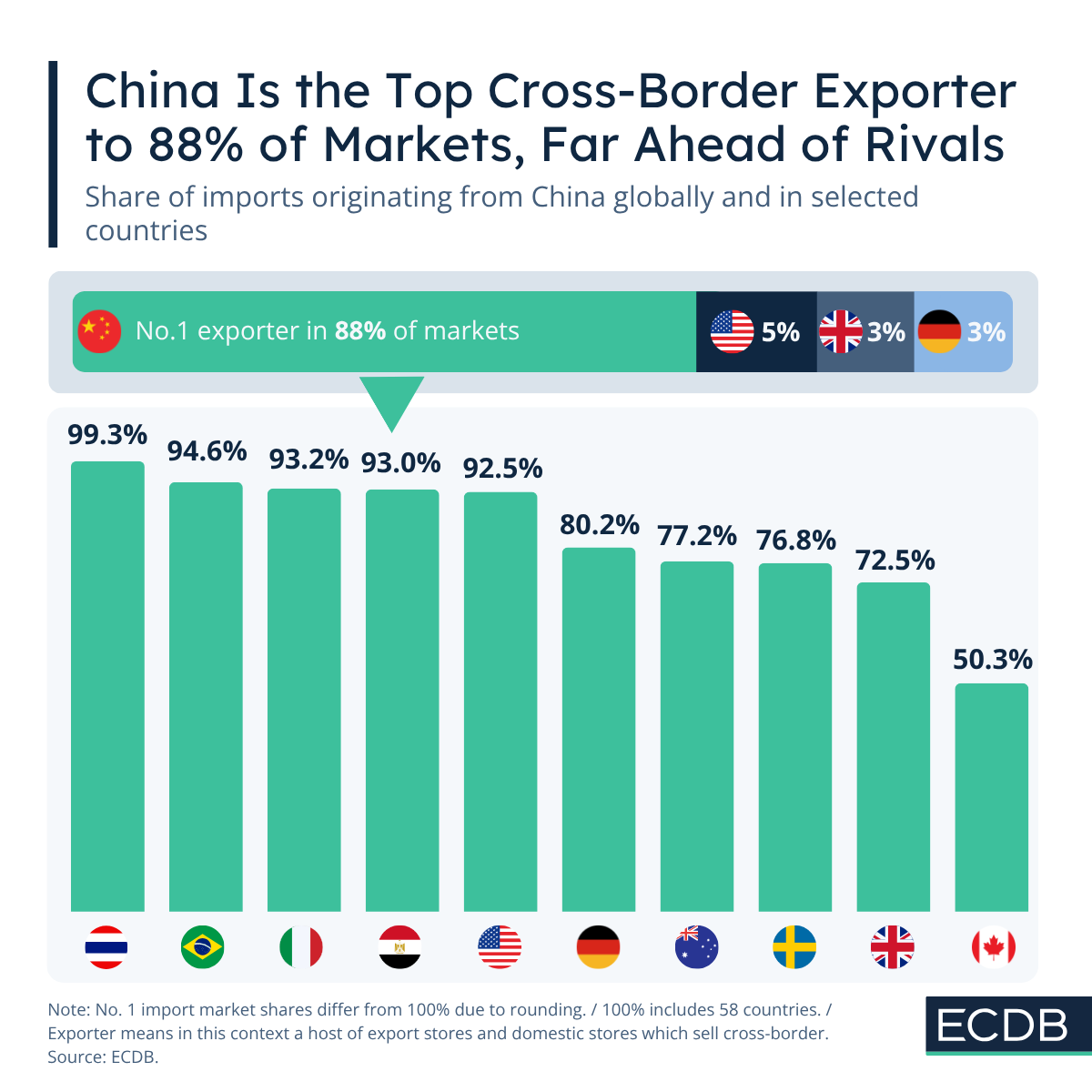
ECDB now illustrates cross-border sales in each Market Profile. A closer examination of the data shows that China clearly leads as an e-commerce exporter. China ranks as the number one source of imports in 88% of world markets ¹.
What Counts as Cross-Border E-Commerce?
Cross-border e-commerce refers to the import of goods in online trade, where products are purchased by customers in one country from stores located in another country. On each ECDB Market Page, you can explore the balance between domestic and import revenue and see which countries contribute most to its imports.
Find out which other countries rank first and which factors account for these patterns.
China Ranks as the Number One Cross-Border Partner
China is known for its export strength. In a previous post, its comparatively low share of imports was highlighted alongside its export value. Indeed, imports account for less than 0.5% of China’s market revenue. It is China’s export value that is notable.
Its strength in this regard is not to be underestimated. China ranks as the biggest source of imports in a majority of e-commerce markets, sometimes with cross-border shares of over 90%.
In comparison, the United States ranks first in only 5% of markets. It is followed by the United Kingdom (3%) and Germany (3%).
Global Significance of China’s Cross-Border Lead
The markets in which China ranks number one in cross-border e-commerce span the globe. These markets are found on all continents and are the norm rather than the exception. In some countries, China accounts for nearly all of the online cross-border import share.
These countries include, but are not limited to, Thailand (where China accounts for 99.3% of imports), Brazil (94.6%), Italy (93.2%), Egypt (93.0%), and the United States (92.5%). Germany, as a top exporter in Europe, sources many of its imports from China, at a rate of 80.2%.
In other markets where other dominant import partners prevail, China holds a smaller share of cross-border eCommerce sales despite ranking first. One such case is Sweden, where China accounts for 76.8% of imports, followed by the United States (10.4%) and the United Kingdom (5.6%).
In the United Kingdom itself, China also is the number one source of imports, accounting for 72.5% of them.
In Canada, the race between China and the US is particularly tight: China accounts for 50.3% of e-commerce imports, while the US accounts for 48.4%. The remaining imports come from many smaller sources, including the UK, France, and Brazil.
C2M Business Model Plays a Major Role in China’s Lead
First, the underlying business model plays a role. Chinese retailers typically source products directly from domestic manufacturers due to China’s extensive and technologically advanced production network.
Amazon, by contrast, primarily serves as a platform that supports local manufacturers and international sellers. Amazon's focus on building national domain hubs rather than operating a C2M (consumer-to-manufacturer, or reverse manufacturing) model means that most Amazon country domains (amazon.de, amazon.co.uk, amazon.it) are classified as domestic e-commerce rather than imports.
In contrast, platforms such as Temu, Shein, and AliExpress are categorized as imports from China in the respective markets because their vertically integrated production models rely heavily on Chinese factories.
Shein, Temu and AliExpress Dominate Import Values With GMV Into the US$ Billions
Based on the above definition, the largest retailers with import values in the billions are predominantly Chinese-based. This explains why China consistently ranks as the leading import partner across many markets.
Therefore, the impact of the United States is predominantly determined by amazon.com's cross-border sales to Latin America, Europe, and Asia. Amazon's many country-specific domains are not counted as cross-border sales if online purchases stay within borders.
Europe: A Hub for Cross-Border eCommerce Exchange
Cross-border sales tend to stay within reach, which is why neighboring countries have the greatest impact, apart from China's significant global influence. Germany and the United Kingdom are evident examples of this due to their intricate involvement in European e-commerce.
European e-commerce includes many countries connected via cross-border e-commerce. This is due to the continent's geographical proximity and cultural alliances, which benefit cross-border sales via platforms.
The UK is the top import partner in three percent of world markets, including Ireland, which speaks to the proximity factor. The same goes for Germany, which is tied to Austria and Switzerland in the DACH region.
Cross-Border Sales Dominance: US More Significant Than Low Share Would Suggest
China’s position as the top cross-border e-commerce partner reflects the reach of its retail platforms, the efficiency of its production networks, and the scale of its global demand.
The United States' impact differs from that of C2M platforms like Temu, Shein, and AliExpress in China. Amazon establishes national fulfillment hubs, meaning that many of its sales occur domestically.
While regional e-commerce exchange remains significant, as is evident in Europe, China’s Silk Road is on its way to encompassing the entire world of e-commerce.

(1) The calculation includes 58 markets for which cross-border data is available and known.
Related Articles
All ArticlesReady to Unlock the Full Power of ECDB?
Book a demo to see how ECDB's market intelligence can support your business.