BRICS and NAFTA Generate 74% of eCommerce Revenues, EU-27 Risks Slipping Below ASEAN
How the political regions contribute to world eCommerce revenues differs. Some are more clearly ahead than others.

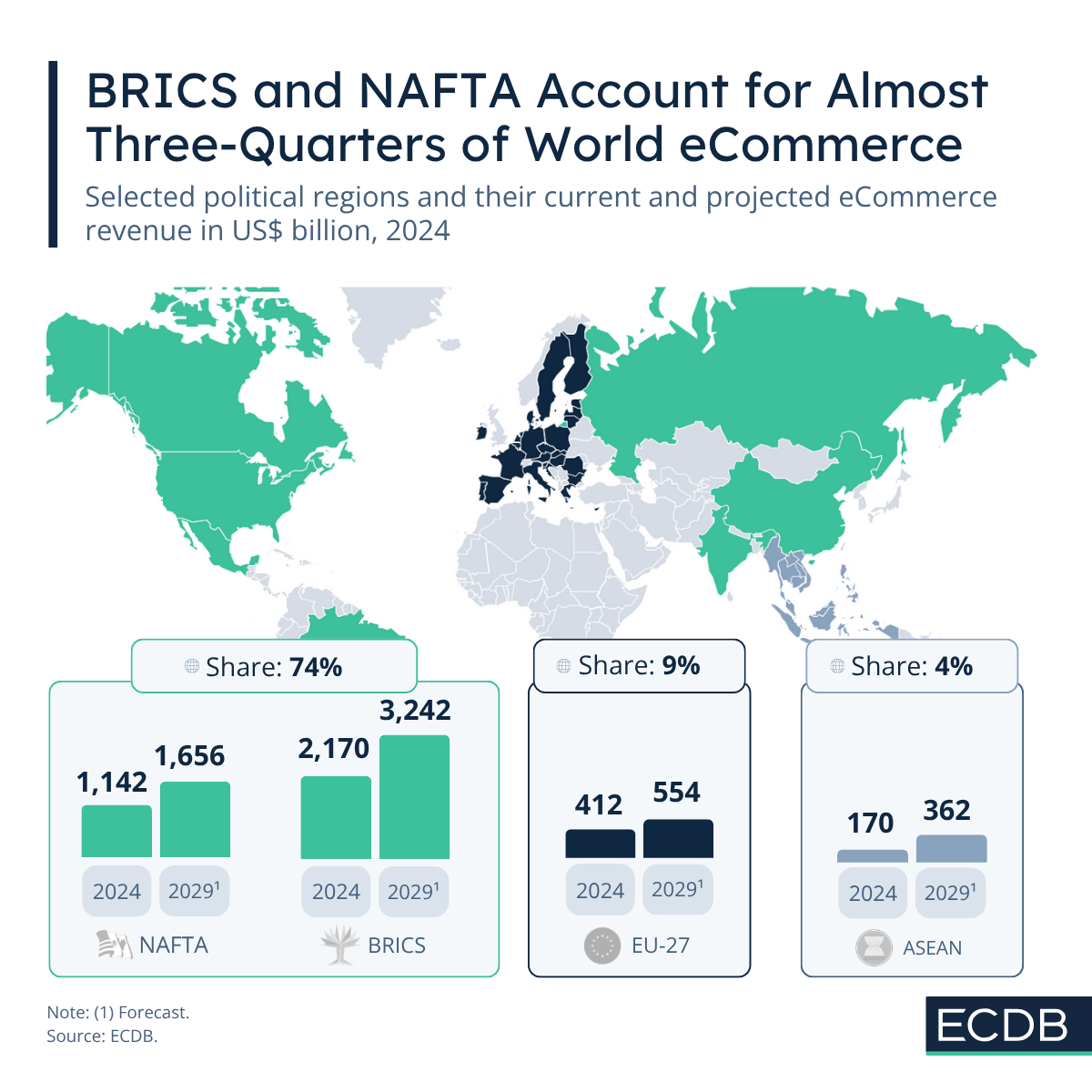
Current trade discussions are making global headlines and putting political regions at the forefront of eCommerce conversations. U.S. tariffs on BRICS regions, NAFTA collaboration with the EU and the rapid ascent of ASEAN compel us to examine how these regions and their market shares compare in eCommerce.
The new ECDB Countries & Regions feature takes your analysis to the next level. The Markets view now includes continents, geographical regions, and political regions at the supranational level.
In this analysis, we take a look at four political regions spanning the globe. How do they compare? Who’s on top and who has the highest potential?
BRICS and NAFTA Generate Trillions of Dollars in eCommerce Revenue
The NAFTA – BRICS rivalry precedes eCommerce; the latter is merely one link in a series of interdependencies and areas of contention. In terms of eCommerce metrics, comparing revenue and CAGR (2024-2029), BRICS outperforms NAFTA.
Both generate revenues in the trillions of dollars, but BRICS has a much larger market share in world eCommerce. BRICS leads with US$2.2 trillion in 2024 revenue, while NAFTA follows with US$1.1 trillion.
Located at a little over half of BRICS’ eCommerce market share of 48.3%, NAFTA has 25.4%. Nonetheless, NAFTA grows more slowly. BRICS compares with a CAGR of 7% to NAFTA, which has a CAGR of 6%.
The size and developmental phase of both regions account for their respective performance.
BRICS: High Population Count Meets Large Potential
NAFTA includes three countries, while the BRICS group has five members that are more dispersed around the world. All BRICS members are highly populous, two of them with the highest population counts in the world (India and China).
Within NAFTA, the United States and Mexico have high population counts, but they don't reach the billions of inhabitants in China and India. This first aspect renders BRICS the top political region on this list. Taken together, BRICS and NAFTA account for 74% of world eCommerce revenues.
A second aspect that contributes significantly to their top positions is the expected trajectory of their eCommerce development. Despite its size, BRICS is ahead of NAFTA. This is due to the participating BRICS countries' larger growth potential.
Although the region already has a high online share of 25.3% (compared to 25.5% in NAFTA), BRICS has a large rural and remote population whose inclusion will lead to further growth in the future.
Mexico is one of the stated growth champions in NAFTA. The U.S. and Canadian markets are more saturated. This is why BRICS is set to surpass US$3 trillion in eCommerce revenues by 2029, while NAFTA hasn't reached US$2 trillion yet.
EU-27 Currently Ahead of ASEAN, But For How Long?
The remaining regions in our selection differ in maturity level but are similar in size. Therefore, ASEAN has a much higher expected trajectory ahead of it than the EU-27. Again, size is playing a role in this relationship. The EU-27 countries collectively account for 9% of world eCommerce revenues. ASEAN is still small, at a share of almost 4%.
Their growth corresponds to their relative size. ASEAN has a CAGR (2024-2029) of 13%, compared with the EU-27’s CAGR of 5%. But their difference is surmountable: if the current growth trend continues, ASEAN will outpace the EU-27 within the next few decades. The EU-27's revenue is projected to reach US$554 billion by 2029, while ASEAN's is expected to reach US$362 billion.
Associated Marketplaces Reflect Trajectories
The top-ranked marketplaces in these regions reflect their respective growth outlooks. Amazon leads part of Europe and all of NAFTA, while Shopee leads ASEAN.
Because the BRICS countries are geographically dispersed, no single marketplace covers a large part of them. Pinduoduo is number one in China, Flipkart in India, Ozon in Russia, MercadoLibre in Brazil, and Takealot in South Africa.
These marketplaces represent different market dynamics and regional preferences. Amazon caters to many different tastes in North America and Western Europe. That story looks different in Europe’s East though.
It goes to show that since Amazon is currently being overhauled by its Chinese competitors in a majority of product categories, its relevance is further on the decline considering the future trajectory of the political regions it is serving.
In contrast, Pinduoduo, Shopee, MercadoLibre and Takealot are at a path of expansion that is fueled by the markets in which they primarily operate.

Related Articles
All ArticlesReady to Unlock the Full Power of ECDB?
Book a demo to see how ECDB's market intelligence can support your business.