June 2026 E-Commerce Recap: US$436.8 Billion in Global Revenue
The start of summer brought positive developments in June, with US$436.8 billion in global e-commerce revenues and a 9.5% year-on-year increase. Read on for the details here.
Types of E-Commerce
B2B and B2C are split by who's buying. DTC is a different question entirely: who's selling, and how directly. And that's still not the whole list, C2C, C2B, and government transactions all count too. See where each one actually sits.

Nadine Koutsou-Wehling
Data Journalist
July 15, 2026
Market Trends
Article in a Nutshell:
Every e-commerce transaction sorts by who's buying and who's selling, and that pairing produces at least seven real categories: B2B, B2C, DTC, C2C, C2B, B2A/B2G, and C2A/C2G.
DTC lives inside B2C. It still means selling to a private consumer, just directly from the brand's own site instead of through a retailer or wholesaler.
Nike, Gymshark, Allbirds, SKIMS, Liquid Death, Brooklinen, Glossier, Best Buy, IKEA, and Sephora are all "1P only" stores in ECDB's data, meaning 100% of what they sell online is direct-to-consumer, with no third-party marketplace layer involved.
E-commerce gets sorted into a handful of labels that get used almost interchangeably, and they're not all answering the same question. B2B and B2C describe who's on the other end of the transaction. DTC describes how the seller reaches that buyer.
C2C, C2B, and anything involving a government body (B2A and C2A) cover pairings that don't fit either of those molds. Mixing them up leads to bad comparisons.
A single-brand DTC site ends up judged by the same yardstick as a full retail marketplace, even though the two aren't playing the same game. Or a B2C platform gets assumed to be selling direct, when it's actually a mix of the brand's own stock and other sellers' listings.
Here is how these different types of e-commerce differ and what ECDB measures.
The split comes down to the buyer, not the product or the platform. A transaction is B2B when a business is buying from another business, usually in bulk, on negotiated pricing, often on invoice or payment terms rather than a card swipe at checkout.
A transaction is B2C when a private individual is buying for their own use, one unit at a time, paid upfront. ECDB tracks the development of B2C physical goods e-commerce specifically, across its categories and the retailers competing in each one.
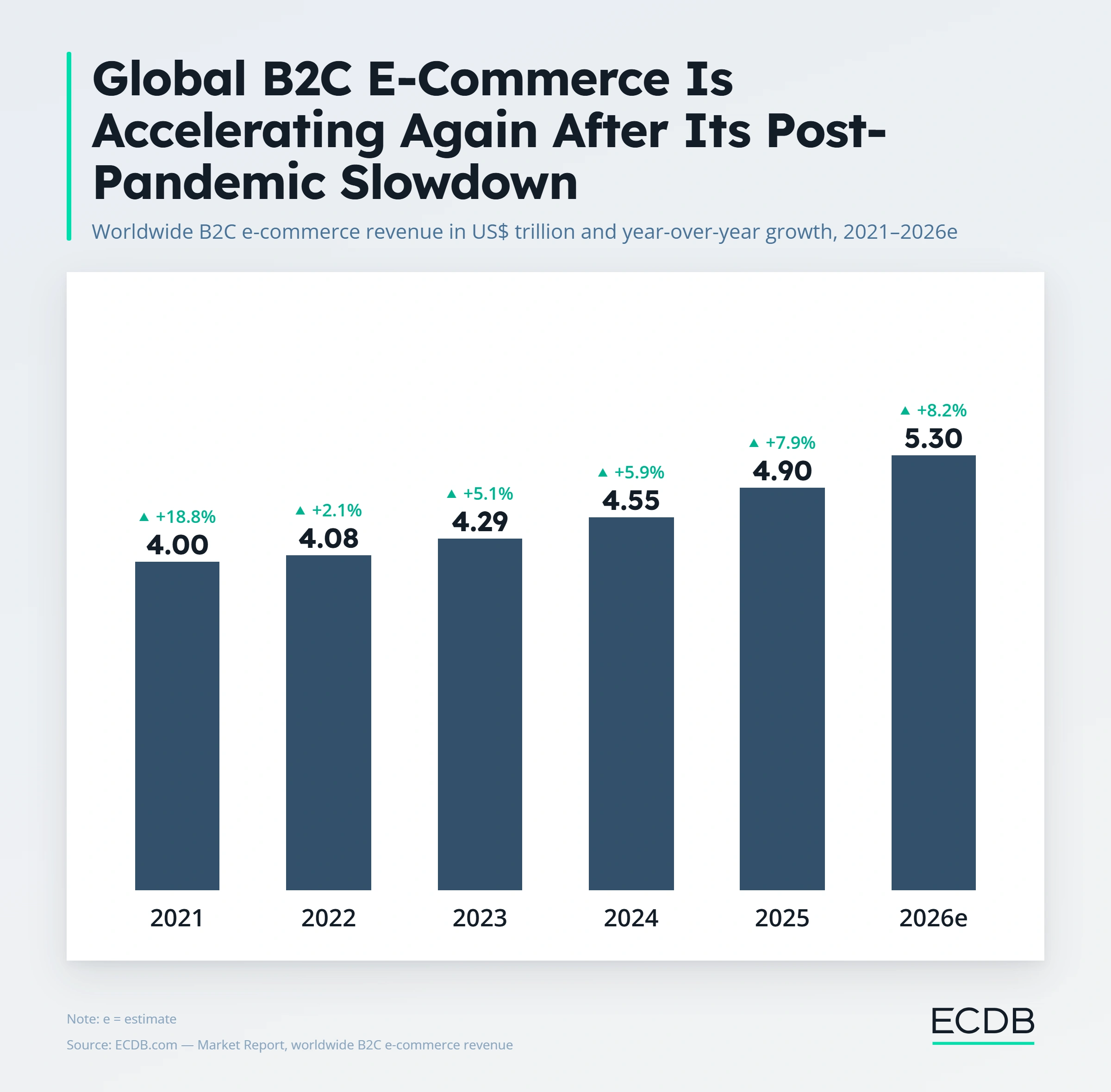
The sector as a whole is growing, and that growth has been accelerating since the post-pandemic slowdown in 2022. Projections for 2026 put the market past US$5 trillion for the first time.
The same parent company can run both B2C and B2B at once. Alibaba Group operates Alibaba.com, a B2B platform connecting manufacturers with business buyers placing bulk orders, alongside Tmall and Taobao, B2C marketplaces selling to individual shoppers in China.
Same company, two different businesses, sorted by who's on the other side of the sale.
DTC always sells to a private consumer, which makes it B2C by definition. What makes it DTC specifically is that the brand is selling on its own site, with no retailer or wholesaler standing between the brand and the buyer.
Nike, Gymshark, Allbirds, SKIMS, Liquid Death, Brooklinen, Glossier, and IKEA all carry that label. Every dollar of GMV on those sites is the brand selling directly to a consumer, which is what DTC actually means in practice.
Compare that to Walmart.com and Target.com, both marked "Hybrid." They sell to consumers too, so they're B2C, but they're not a single brand's direct channel. A hybrid store mixes its own retail inventory with other brands' listings and third-party marketplace sellers. Same buyer type as a DTC brand, a completely different seller structure.
B2B, B2C, and DTC aren't the only combinations of buyer and seller, just the ones that show up in most e-commerce data, including ECDB's. A few others worth naming:
C2C (consumer-to-consumer): one private individual sells to another, and the platform provides the infrastructure rather than making the sale itself. eBay's individual sellers, Vinted, Poshmark, and Facebook Marketplace all run on this model.
C2B (consumer-to-business): the reverse direction, an individual provides something a business pays for. A freelancer selling services to a company, a creator licensing content, or a trade-in program where a company buys back a consumer's used device all count.
B2A/B2G and C2A/C2G (to administration or government): a business or an individual transacting with a government body. Public contract bids and business tax filings sit on one side, tax payments and license renewals on the other.
None of these appear in ECDB's data, for the same reason B2B doesn't: the dataset is scoped to B2C. C2C carries one extra wrinkle worth flagging. A marketplace like eBay mixes individual sellers with registered businesses on the same platform, and ECDB's store type field tracks the store's overall structure, not whether any single listing behind it came from a private seller or a business.
Real C2C activity happening on a tracked 3P marketplace still counts toward that store's GMV, just folded in rather than broken out on its own.
Treating B2B, B2C, and DTC as interchangeable leads to comparisons that don't hold up. A DTC brand's purchase frequency, 1.79 to 3.53 orders a year across the mentioned single-brand stores above, looks like a failure next to a hybrid retailer like Amazon at 21.95.
That reading misses the more basic fact: this is the realistic ceiling for a single-category brand selling direct, since there's no second or third category pulling the same customer back for an unrelated reason.
The comparison only becomes useful once it's DTC against DTC, or hybrid retailer against hybrid retailer. Sorting stores by these categories first is what makes any benchmark afterward mean something.
ECDB tracks B2C exclusively, consumer purchases from online stores. B2B wholesale transactions, C2C resale between individuals, C2B arrangements, and anything involving a government body aren't part of the dataset, since each of those is a fundamentally different market with its own pricing and buying patterns.
DTC isn't tracked as its own labeled category at ECDB. However, filtering for "1P only" stores narrows the field to brands and retailers that aren't running a marketplace, but that still mixes true DTC brands in with retailers like Best Buy and Sephora that sell other companies' products as their own stock. Getting to genuine DTC from there means checking whether the name on the site matches the brand on the product, the way it does for Nike or Gymshark and doesn't for a retailer reselling other brands.
That gives customers a way to benchmark a DTC brand against other DTC brands instead of against a full retail platform. They can check how much of a category's online sales run through brand-direct sites versus big retailers. And they can catch single-brand stores that look like a straightforward DTC operation but are quietly running a hybrid or marketplace model behind the scenes.
That data is available through ECDB's Profiles and Rankings tools, filterable by store type for any category or market.
Related Articles
The start of summer brought positive developments in June, with US$436.8 billion in global e-commerce revenues and a 9.5% year-on-year increase. Read on for the details here.
Central Europe is dominated by one market in particular: Germany. The others follow at a far distance. They include Poland, Austria, Switzerland, and Greece. Here is how they compare.
In Italy, 66% of the top 250 online store's net sales are generated by the top 5. This makes it the most concentrated market among the EU-Big Five. What does that mean for e-commerce? Find it out here.

Click here for
more relevant insights from
our partner Mastercard.
Book a demo to see how ECDB's market intelligence can support your business.