How to Conduct Proper E-Commerce Benchmarking to Know Where You Stand
E-commerce benchmarking is the sequence of questions a business asks to know where it stands. This article shows how to run that sequence, using a real-world example.
Agentic Commerce
Most consumers in Central Europe are neutral about AI shopping assistants. This majority tracks closely with where mainstream development currently sits across markets.

Nadine Koutsou-Wehling
Data Journalist
July 28, 2026
Other
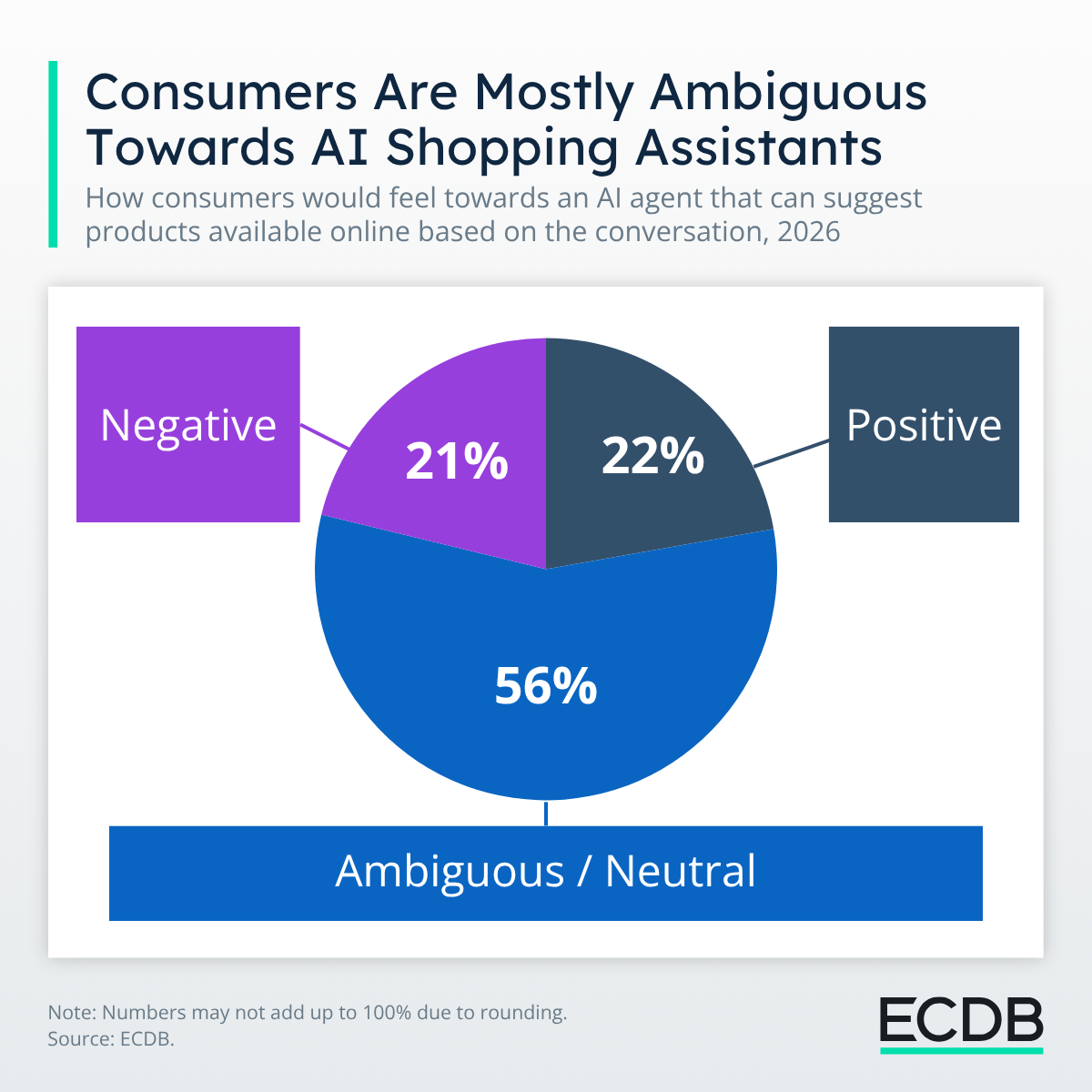
The biggest barrier to agentic commerce is consumer trust. In Central Europe, 56% of survey respondents are neutral or undecided about AI shopping assistants. Only 22% view them positively. 21% view them negatively.
In most emerging technology categories, opinion splits fairly quickly into clear camps of adopters and skeptics. Here, the largest group by far has not made up its mind at all. Adoption goes along with moving that undecided middle toward comfort.
The undecided middle is not unique to Central Europe. Global research shows a similar pattern, even if the exact numbers differ.
Most consumers across surveys were undecided or neutral about AI shopping assistants. Central Europe's 56% undecided share runs notably wider than global benchmarks. That points to a market still forming its opinion of AI shopping assistants.
Adoption depends on trust, transparency, and consumer control. This differs widely across categories. Consumers report higher willingness to use AI agents in clothing, electronics, and groceries. Categories that require research, comparison, and information processing can become more accessible through AI agents, which help consumers evaluate alternatives and feel more confident in their choice.
This category pattern lines up with what agents already do well. Comparing spec sheets, prices, and reviews suits automation, and consumers appear to recognize that. Research and comparison heavy categories are exactly where willingness runs highest. This runs similar to the average market adoption in Central Europe, where the research phase is the most commonly entered phase right now. Consumer willingness to adopt and market realities therefore seem deeply intertwined.
The picture shifts for higher stakes or more personal purchases. Global research backs this up too. Handing over a full purchase decision on a large or personal item asks for a different level of comfort, one that takes longer to build.
At the same time, enthusiasm is tempered by concerns over privacy, data security, and loss of control over purchasing decisions. Many consumers remain hesitant to let AI complete transactions on their behalf, particularly for higher value or more personal purchases.
Verification behavior tells a similar story. One 2026 industry study found that among shoppers who used AI for product research, the large majority still verified the AI's recommendation through another source before buying. Very few trusted the recommendation outright. Consumers are comfortable using AI as a starting point for research. Handing it the final purchase decision is a much bigger ask.
This trust gap connects directly to why adoption in Central Europe stalls before the Buy stage. Research, where an agent only searches, compares, and recommends, asks little of the consumer beyond curiosity. Buy, where an agent completes payment and checkout on its own, asks for something much bigger: letting go of the final check-in.
Central Europe's wide majority sitting at the Research stage explains much of the comfort seen in the data. Most consumers have only interacted with agents that search, compare, and recommend. That is the extent of what most markets currently offer, and it is also the stage where trust runs highest. Comfort has grown alongside exposure, not ahead of it.
This suggests the 56% undecided share will not close through messaging or reassurance alone. It will close as Buy and Advanced Buy capabilities become more widely available across mainstream providers. Consumer attitude is tracking market maturity closely. As the market moves further along the six stages, comfort with checkout automation should follow the same path trust in research and recommendation already has.
Related Articles
E-commerce benchmarking is the sequence of questions a business asks to know where it stands. This article shows how to run that sequence, using a real-world example.
Mobile commerce stacks at least six different channels on top of each other. Most strategies only optimize for one or two of them at a time.
Revenue in e-commerce comes down to a simple multiplication: the number of people buying, how often each one buys, and how much they spend per order. Here are the ways how to increase each component.

Click here for
more relevant insights from
our partner Mastercard.
Book a demo to see how ECDB's market intelligence can support your business.