Younger US Shoppers Are the Harshest Critics of AI Shopping Assistants
Online stores lift conversion by offering features that push users to make sales. But most US users find many of these features more annoying than helpful. One exception are AI assistants, which are rated more helpful, particularly by older users.

Article in a Nutshell:
Online stores add many features to lift conversions. Most of them annoy US consumers.
AI shopping assistants draw the least annoyance of these features. 36.8% of US users find them annoying, and 25.2% find them helpful.
Shoppers over 45 rate AI assistants as helpful as often as annoying. Younger shoppers are far more critical, with 44% finding them annoying.
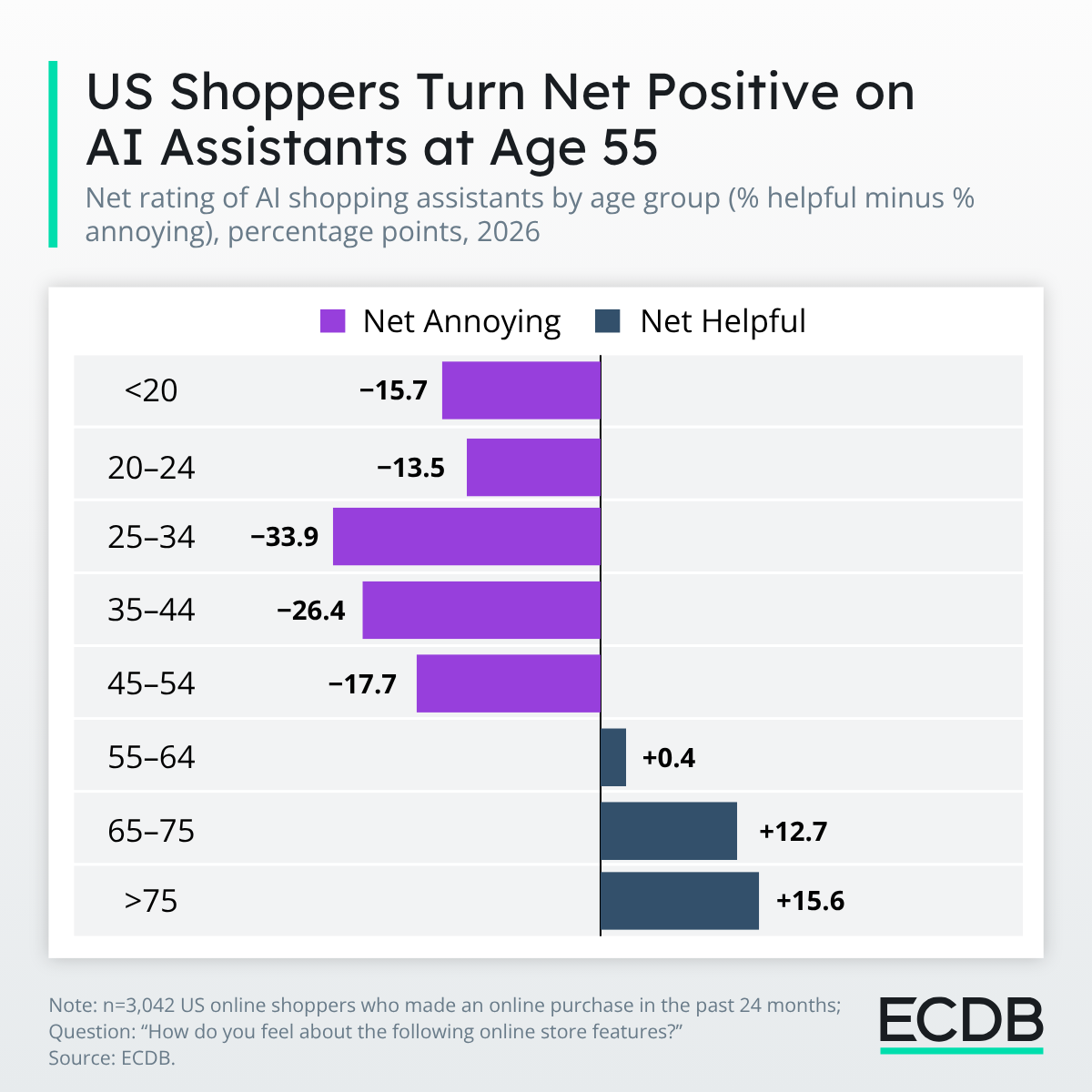
At 55, consumers turn net positive on AI assistants again.
Younger shoppers want speed and a bot that holds up against ChatGPT, Gemini or Claude. Older shoppers want a patient guide.
Chat widgets, pop-ups and product recommendations all promise higher conversion rates. US shoppers see most of them distinctly. The majority of shoppers rate these features as annoying rather than helpful, and AI shopping assistants are no exception. They do fare better than the rest, though. And the verdict depends heavily on who is shopping.
AI Assistants Are Rated as Most Helpful by US Shoppers
AI assistants collect the fewest complaints among the conversion features US stores are using. Of all shoppers, 36.8% of US users find them annoying. 25.2% find them helpful.
Compared to the other features websites use to drive conversion, AI assistants are rated as most helpful, however. The annoyance rates are much higher for the rest:
Stock availability displays have an annoyance rate of 64.3%,
limited-time offers annoy 55.8% of users,
personalized recommendations annoy 54.3%,
product bundles or sets annoy 55.4%,
discount campaigns indicate an annoyance rate of 65.6%.
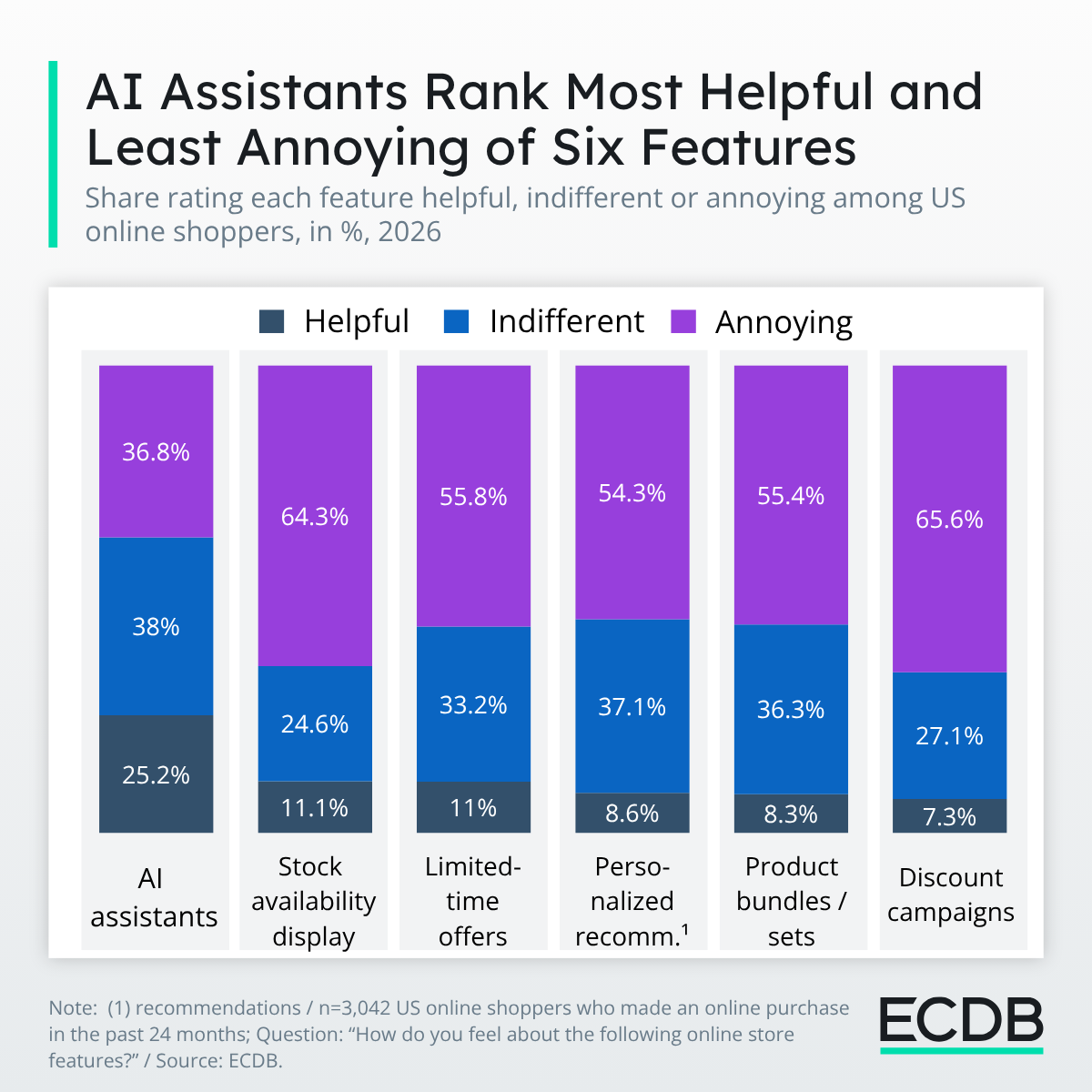
Most of these features have a pushy nature, distracting shoppers with pop-ups and notifications. AI assistants help navigate the shopping experience, which is why they might score higher on the helpfulness scale.
Age shifts that picture considerably. The split between annoyed and helped looks very different once the numbers are broken down age group.
Younger Shoppers Are the Toughest Critics
Shoppers under 45 judge AI assistants most harshly. 44% of them find the feature annoying, well above the US average of 36.8%. Three habits explain the gap.
Younger users are fast, confident navigators. Search bars, filters and reviews already get them where they want to go. An assistant adds a step to a path they have mastered, and that step rarely feels necessary.
They also bring a benchmark. Many use ChatGPT, Gemini or Claude for everyday tasks. Next to those general-purpose tools, a store's narrower bot looks weak by comparison. It knows one catalog and answers a limited range of questions.
Then there is the sales angle. Younger shoppers are more alert to being sold to. An assistant that steers every answer toward the store's own products starts to feel like a salesperson in disguise, and trust drops with it.
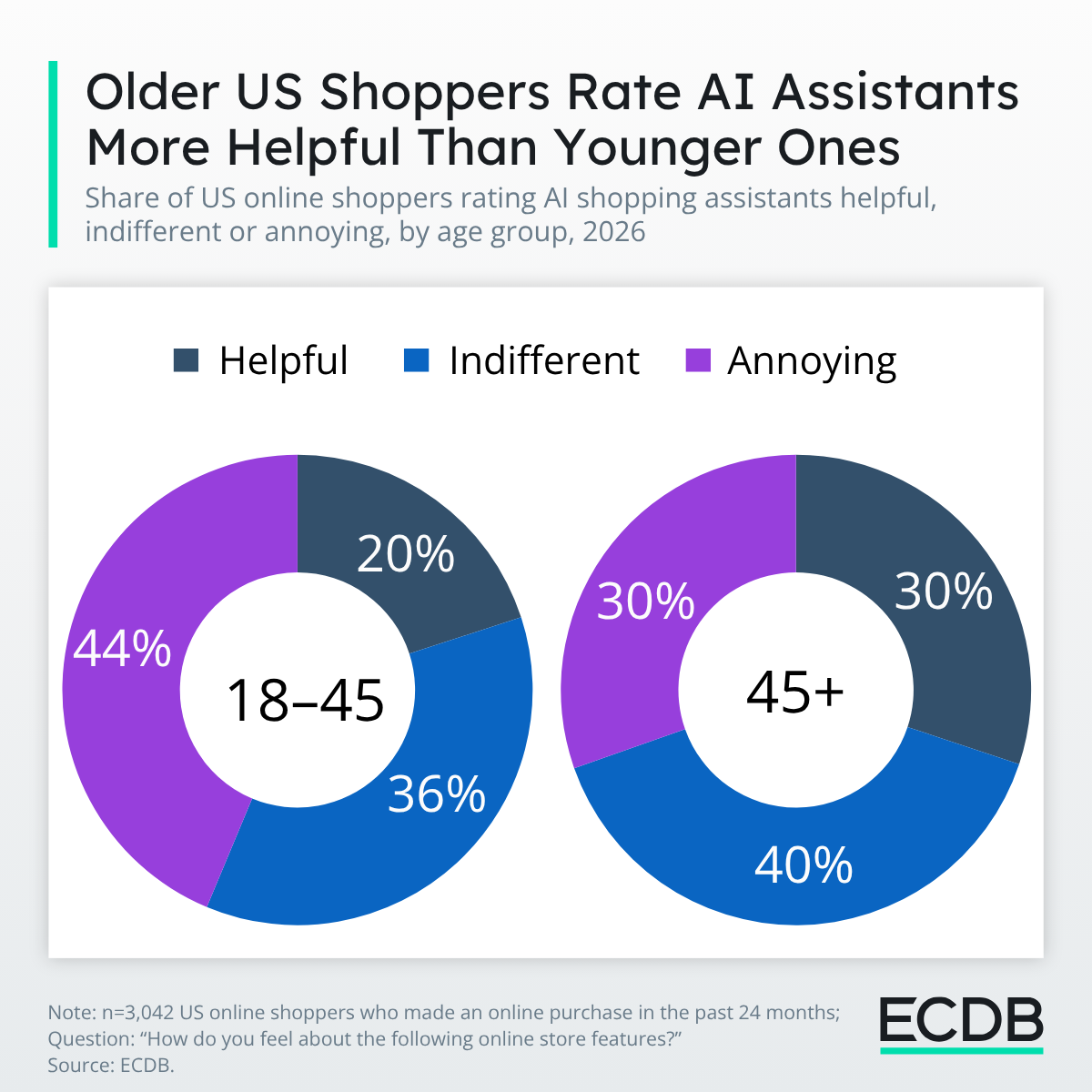
Past 45, the verdict evens out. Shoppers in this age group rate AI assistants as helpful as often as annoying. But a breakdown by age shows that actually the shoppers finding AI most helpful skew older than that.
Shoppers Over 55 Years Turn Net Positive on Their Attitude Towards AI Assistants
A more detailed breakdown pinpoints the age at which attitudes towards AI turn. Precisely, at 55 years the opinion of AI shopping assistants becomes more positive than negative, but still at a close rate.
It is at the age bracket of 65 to 75 where most consumers rate AI assistants as markedly more helpful than annoying. The reasons are various:
Effort counts. Complex store layouts, deep category trees and long filter menus cost older shoppers more time. Guidance through that maze carries real value for them.
Familiarity matters too. An AI assistant mirrors the in-store associate this generation is used to asking for help. Typing a question into a chat window feels close to walking up to the counter.
Expectations also sit lower. Older consumers have less exposure to general-purpose AI tools, so a store's bot has less to compete with. Less daily AI use also means less AI fatigue.
What younger shoppers experience as an extra step, older shoppers experience as service.
Wrap-Up: Different Generations Rate AI Assistants in Their Own Way
Younger users prefer speed and a bot that holds up against AI tools they already use daily. Older shoppers want a patient guide that takes effort off their hands, much like a good store associate.
No single assistant design serves both groups equally well. The age profile of a store's customers decides which version is worth building, and how much it has to do before shoppers stop seeing it as an obstacle.

Related Articles
All ArticlesReady to Unlock the Full Power of ECDB?
Book a demo to see how ECDB's market intelligence can support your business.