The Biggest Online Beauty Retailer Doesn't Win on Every KPI
Sephora is the biggest online beauty retailer by GMV, but that doesn't mean it wins on every other KPI. Here is why it still emerges on top.
Branding Strategies in E-Commerce
Some brands have it, while others don't: How to build a successful brand strategy in e-commerce, exemplified by emerging D2C online brands.

Nadine Koutsou-Wehling
Data Journalist
July 15, 2026
Retailers
Article in a Nutshell
Gymshark and SKIMS are growing at 12.51% and 7.29% in 2025, while Allbirds, one of the original D2C breakout brands, is shrinking by 10.23%, even after adding a second product line.
None of these brands survive on repeat purchases the way a marketplace does. Customers buy from Gymshark just 2.19 times a year and from Allbirds 2.17 times, far below a generalist like Amazon.
Liquid Death earns 20% of its revenue from merchandise, not water. Its brand identity has become a second product line in its own right.
Building a brand in e-commerce is a sequence of decisions. The data shows which decisions compound and which don't save a brand on their own.
In this article, we discuss five decisions that separate the D2C brands still accelerating from the ones losing ground. Each step is grounded in what these brands actually sell, at what price, and how often customers come back.
Every brand here began with a single, specific product. Allbirds launched on one wool sneaker and is still 87.8% footwear today. Liquid Death launched on one thing, canned water in a metal-scene wrapper, and is still 80% beverages.
A single, recognizable product is what makes a new brand easy to describe, easy to gift, and easy to remember before it has any reputation to lean on.
The lesson for a new brand: pick the one product that can define the company before worrying about the rest of the catalog. Everything else gets built around that anchor, not alongside it.
Average order value is grounded in a decision about who the brand is for and how it gets bought.
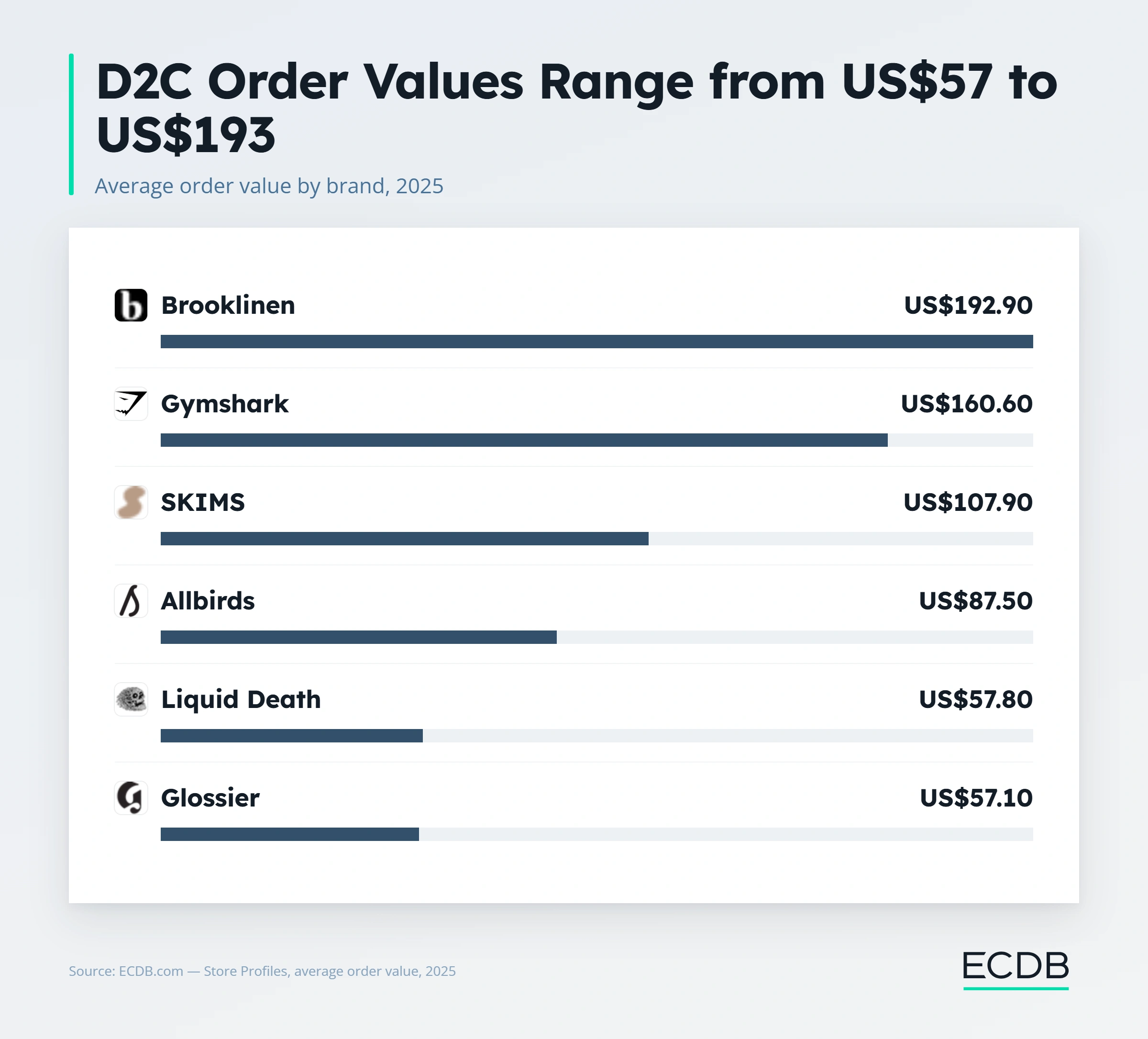
Brooklinen sells bedding at a $192.90 AOV, a considered, occasional purchase.
Gymshark sells performance apparel at $160.60.
SKIMS sits at $107.90.
Allbirds at $87.50.
Liquid Death, a grocery-aisle impulse buy, sits at $57.80, almost identical to
Glossier's $57.10 for beauty basics.
Each reflects how that product actually gets chosen, a bedding brand priced like fast fashion would confuse buyers, and a canned water priced like skincare would kill the impulse purchase that makes it work.
The lesson for a new brand: before launch, a brand needs to decide what it is building. A considered purchase shoppers plan for, or an impulse buy they grab without thinking.
None of these brands come close to a marketplace's purchase frequency, and that is the reality of selling one type of product instead of everything.
Customers buy from Brooklinen just 1.79 times a year, from Allbirds 2.17 times, from Gymshark 2.19, from Glossier 2.29, from SKIMS 2.37, and from Liquid Death 3.53.
A generalist marketplace with dozens of categories can see a customer twenty times a year. A single-category D2C brand realistically can't, there simply aren't twenty different reasons to buy wool sneakers or bed sheets in a year.
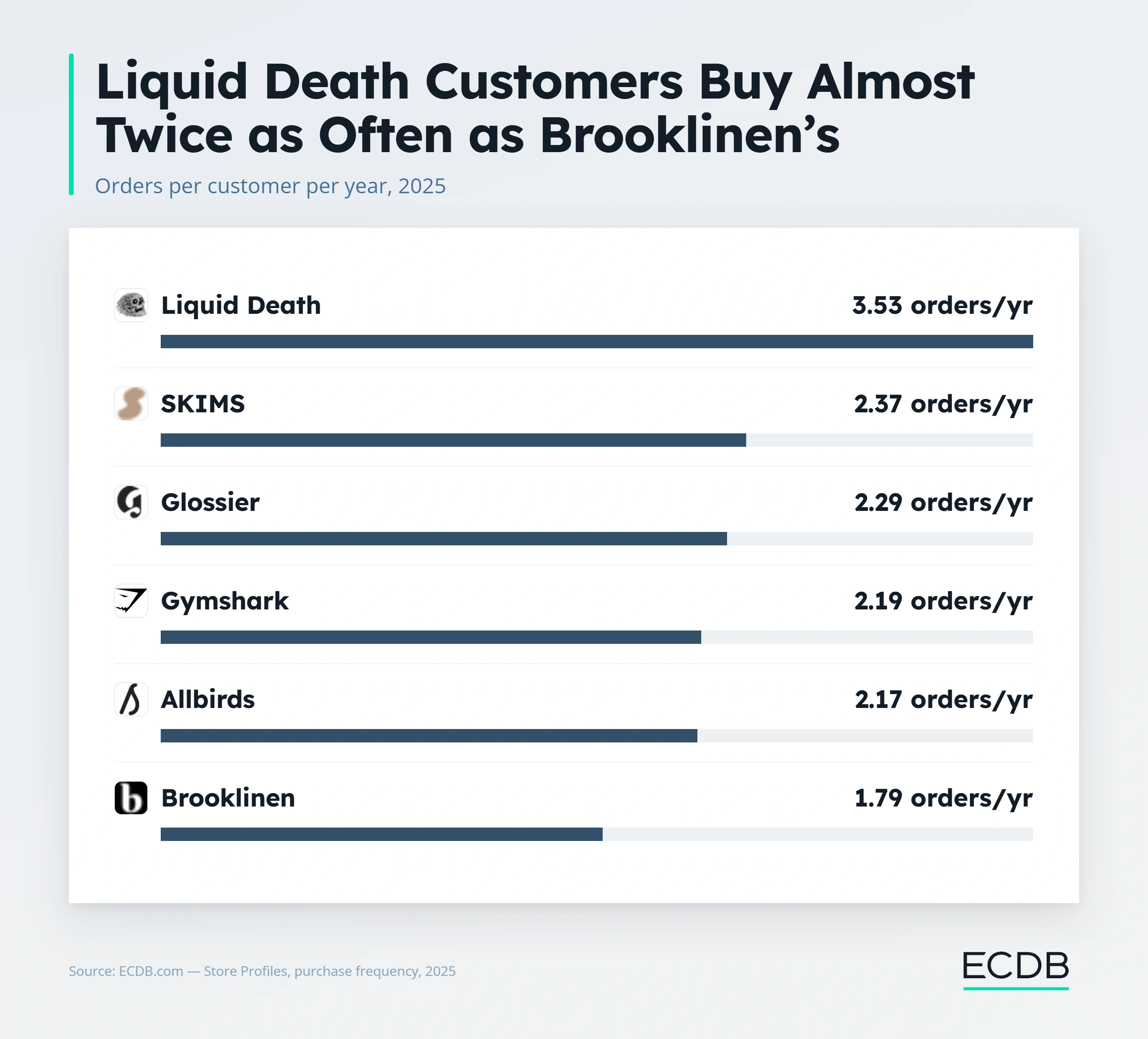
That means a D2C brand's growth math has to come from somewhere other than repeat frequency, mainly new customer acquisition and the price point set in step two.
The lesson for a new brand: Building a strategy around "customers will come back constantly" sets a single-category brand up to miss its own numbers. Building around competitive, well-priced first and second purchases is the realistic target.
The most popular brands are selling an identity people want to display, and that identity can turn into real revenue on its own.
Liquid Death is the clearest case: 20% of its total revenue comes from apparel and accessories, not the canned water it was built on. The brand became something people wear, not just drink. That's a genuine second revenue line, not a marketing expense.
The lesson for a new brand: Ask early whether its identity is strong enough that people would buy a piece of it even without the core product, and if the answer is yes, that merchandise line deserves real investment, not an afterthought in the online store's footer menu.
Expansion works when the new category is a natural extension of what the brand already stands for, and it doesn't automatically rescue a brand whose core product is losing ground.
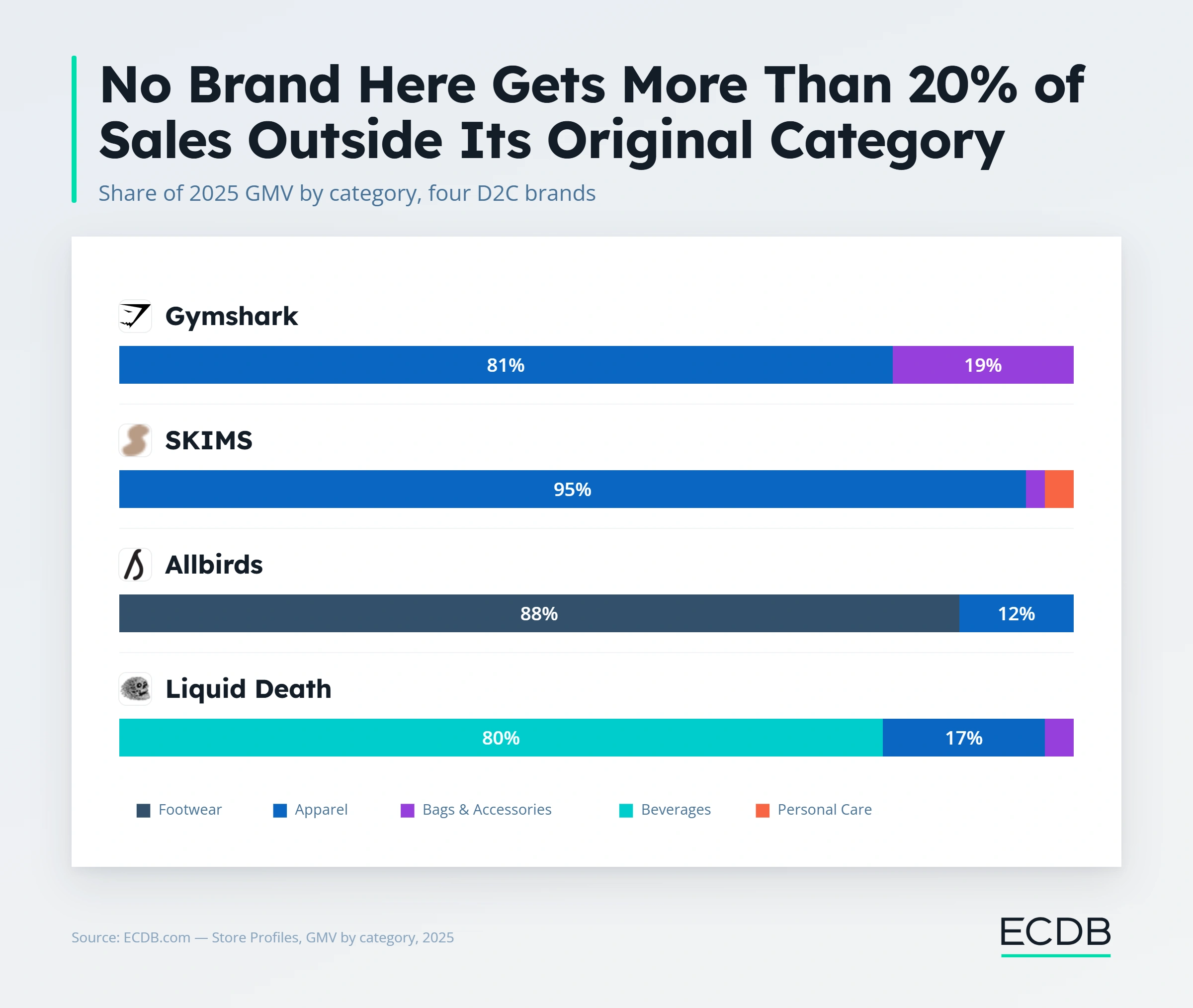
Gymshark expanded from apparel into bags and accessories, now 19.2% of its revenue, while growing 12.51%.
SKIMS added personal care, a modest 3.1% of revenue so far, while growing 7.29%.
Both expansions sit close to the brand's original identity.
Allbirds is the case that keeps this honest. It expanded from footwear into apparel, now 12.2% of its revenue, and its overall business still shrank by 10.23%. Adding a second category didn't offset softening demand for the shoes the brand was built on.
The lesson for a new brand: Expansion is a genuine tool, but only once the core product is still working. It isn't a substitute for fixing a core that isn't.
A new e-commerce brand needs to make the same five decisions deliberately: one sharp product to start, a price point chosen on purpose, a repeat-purchase expectation grounded in reality, a brand identity worth selling on its own, and expansion that stays close to what earned it customers in the first place.
Every figure behind these five decisions, AOV, purchase frequency, growth, and category mix, comes from data ECDB tracks for any brand it covers.
That turns brand strategy from a guess into something checkable: instead of assuming a price point or a merch line will work because it worked for Liquid Death, a brand can check it against real competitors in its own category first.
Before launch, that means pulling AOV and purchase frequency for a handful of direct competitors to set pricing and repeat-purchase expectations realistically. Once live, it means tracking growth and category mix over time, the same view that shows Allbirds' expansion and its decline side by side, to catch early whether a strategy is actually working or just adding categories without fixing the core.

Related Articles
Sephora is the biggest online beauty retailer by GMV, but that doesn't mean it wins on every other KPI. Here is why it still emerges on top.
Market concentration is a law of retail. On Amazon, this becomes particularly evident. Four in five dollars land in just five countries, the US on top.
Alibaba is the largest e-commerce company in the world, bigger than Amazon and Walmart's online businesses combined. Its steady increase in GMV keeps Alibaba at the top of the list.

Click here for
more relevant insights from
our partner Mastercard.
Book a demo to see how ECDB's market intelligence can support your business.