Shein and Temu: The Markets Both Platforms Can't Afford to Lose
Many wonder whether Temu and Shein are the same company. They are not, but their markets of operation overlap far more than their branding suggests.

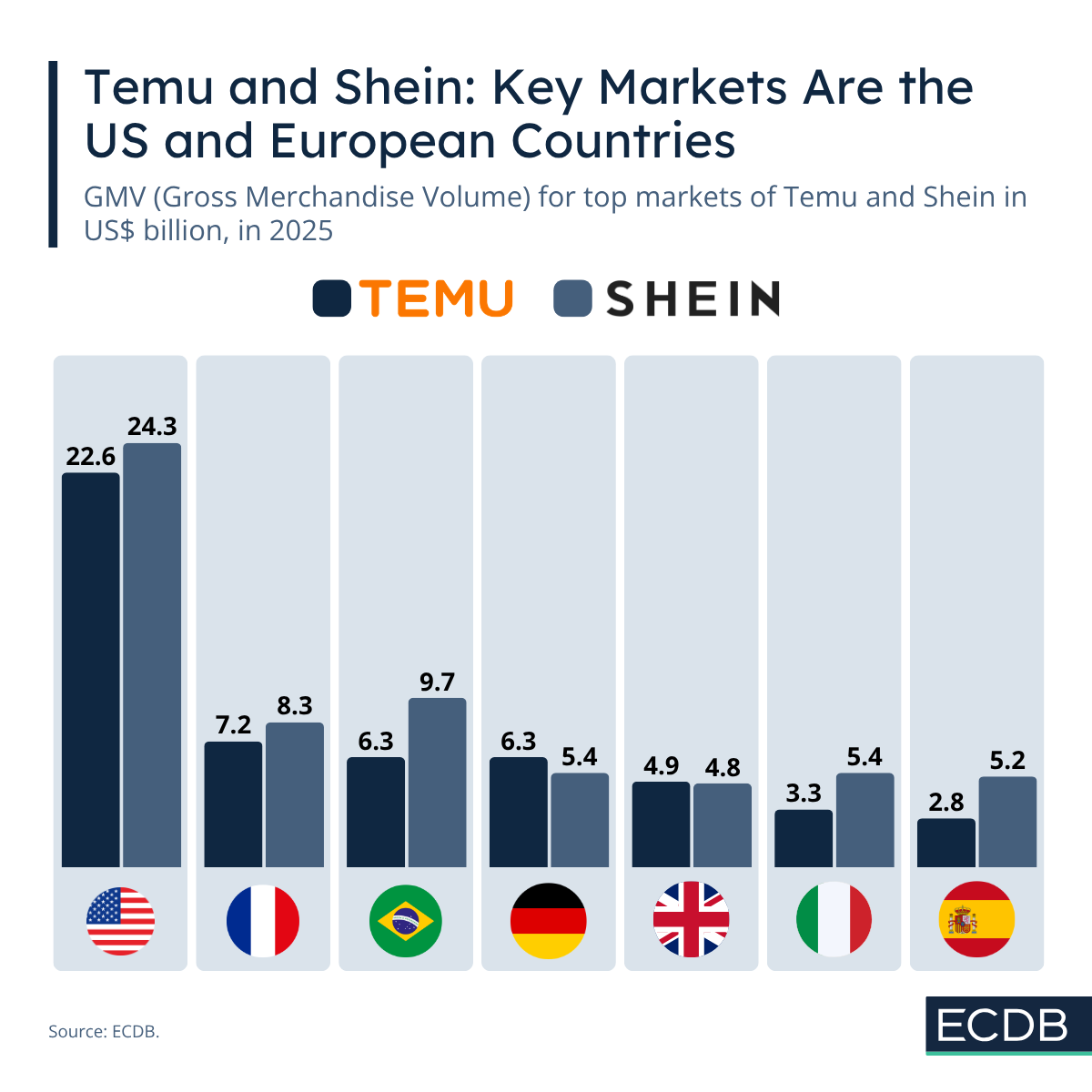
The rivalry between Temu and Shein has made global headlines for years, framed as a duel between two Chinese cross border platforms racing to dominate discount fashion and general merchandise.
What gets less attention is how narrow that duel actually is. Look at where each platform makes its money, and the picture is less "global battle" and more "same handful of markets, fought over twice."
The United States Remains the Most Important Market For Both
Both platforms lean hard on the United States, which is notable given that the US has introduced some of the strictest regulation aimed at curbing platforms like them. In 2025, Shein generated US$24.3 billion in GMV in the US, ahead of Temu's US$22.6 billion.
The gap is real but not decisive, and it confirms that neither company has found a way to diversify away from the one market currently working hardest to limit its influence.
Europe Follows as a Significant Region for Temu and Shein
Outside the US, the overlap continues. With the exception of Brazil, most of each platform's top markets sit in Europe. France leads that group, with Temu generating US$7.2 billion in GMV there and Shein slightly ahead at US$8.3 billion.
Germany, the UK, Italy, and Spain follow behind France. Canada is the one clear point of divergence: it ranks among Temu's top eight markets, a position Shein has not yet reached.
The pattern points to a simple conclusion. North America and Europe are where global e-commerce spending is concentrated, so they are also where Temu and Shein concentrate their growth ambitions.
Future Uncertain Due to Regulatory Shifts
Regulation adds a layer of uncertainty to that picture. Europe is tightening rules on low value parcels entering from third countries, a shift aimed squarely at the shipping model both platforms rely on. How much this will affect their European revenue is still an open question.
The working assumption in the industry is that warehousing workarounds, such as shifting more inventory into local or regional fulfilment, will let both companies keep prices low and competition just as intense as it is today.

Related Articles
All ArticlesReady to Unlock the Full Power of ECDB?
Book a demo to see how ECDB's market intelligence can support your business.