The Top Companies in E-Commerce Worldwide
Alibaba is the largest e-commerce company in the world, bigger than Amazon and Walmart's online businesses combined. Its steady increase in GMV keeps Alibaba at the top of the list.

Article in a Nutshell:
Alibaba leads with US$1.26 trillion in GMV in 2025, more than Amazon and Walmart's e-commerce operations combined (US$1.12 trillion).
PDD Holdings, the parent of Temu and Pinduoduo, ranks second at US$873.0 billion, just ahead of Amazon at US$851.9 billion.
Shopee's parent, Sea Ltd, and Latin America's MercadoLibre are at the lower end of this list, smaller and growing fast.
Alibaba is the world's largest e-commerce company, measured by GMV, the total value of everything sold through its online stores in a year.
The rest of the ranking is a mix of familiar names and companies that don't get talked about nearly as often as their size deserves.
Below is the full top 10, followed by what actually separates the company at the top from the ones growing the fastest underneath it.
The 10 Largest E-Commerce Companies, Ranked by 2025 GMV
Alibaba clearly leads the ranking, at a combined GMV of US$1.26 trillion across platforms.
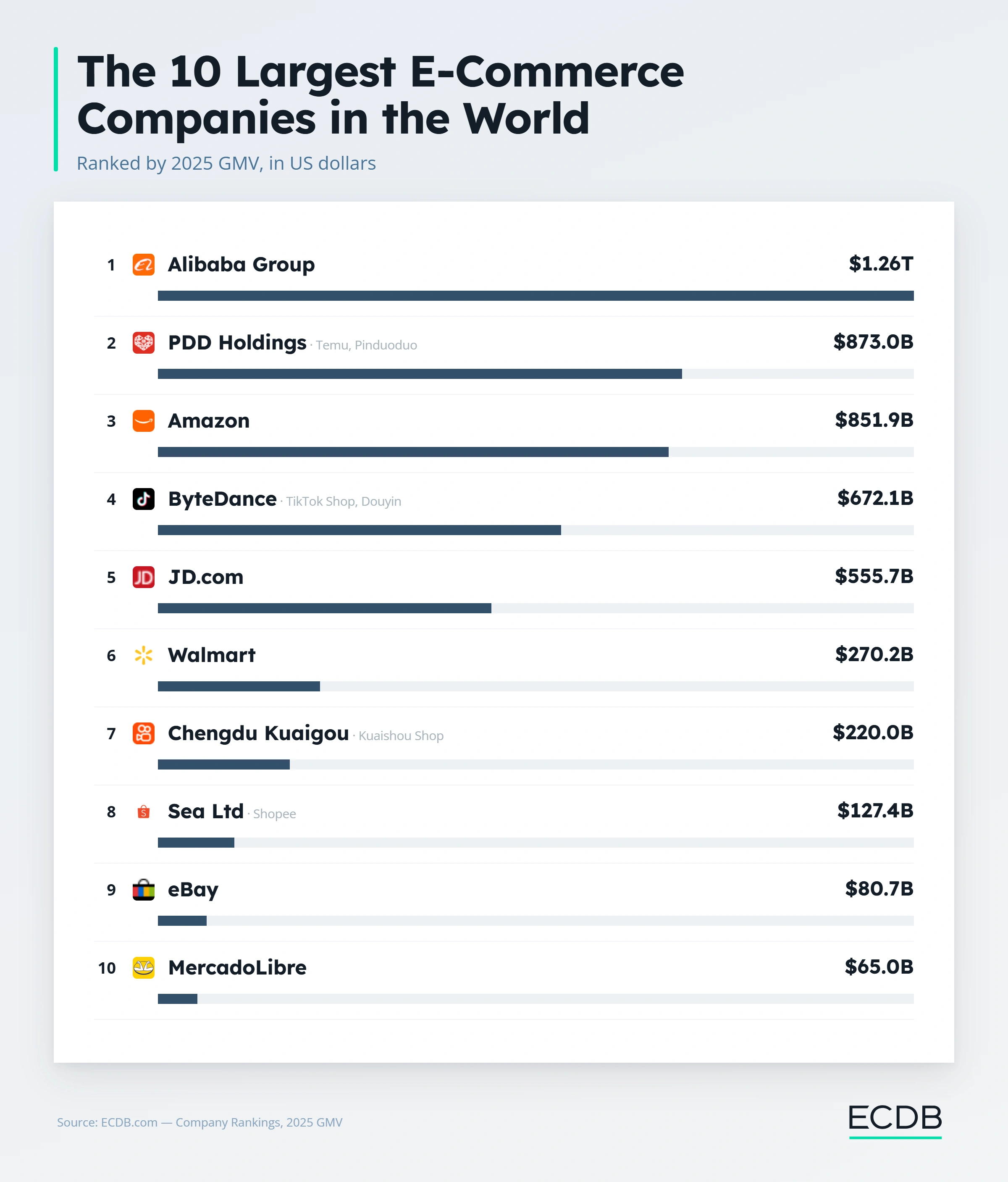
It is followed by PDD Holdings, parent company to Temu and Pinduoduo, with GMVs of US$873.0 billion. Only then comes Amazon, usually at the top of worldwide e-commerce rankings, due to its single-platform success.
Other rankings in the list include:
ByteDance (TikTok Shop) — US$672.1 billion
JD.com — US$555.7 billion
Walmart — US$270.2 billion
Chengdu Kuaigou Technology (Kuaishou's e-commerce arm) — US$220.0 billion
Sea Ltd (Shopee) — US$127.4 billion
eBay — US$80.7 billion
MercadoLibre — US$65.0 billion
Alibaba's Lead Comes From Size, Not Speed
Alibaba stays on top because its base is so large that even modest growth adds more in new sales than most competitors do in total. Its GMV grew 7.4% in 2025, one of the slower growth rates in the entire top 10, yet that percentage alone added roughly US$87 billion in new sales, more than eBay's entire yearly total.
Being the biggest company on this list means that a small percentage gain is worth more in real dollars than a large percentage gain almost anywhere else on the ranking.
Biggest Isn't the Same as Most Global
Alibaba's size comes almost entirely from a single country. China accounts for 88.28% of its GMV, and no other market reaches even 1%: South Korea, its second-largest market, sits at just 0.98%. Amazon, despite trailing Alibaba by roughly US$400 billion in total GMV, is built on a genuinely global base. The United States is its largest market at 50.89%, but eleven other countries, including the UK (9.52%), Germany (7.73%), Japan (6.99%), Canada (4.37%), and India (2.8%), each contribute a meaningful share, together accounting for nearly 95% of its GMV.
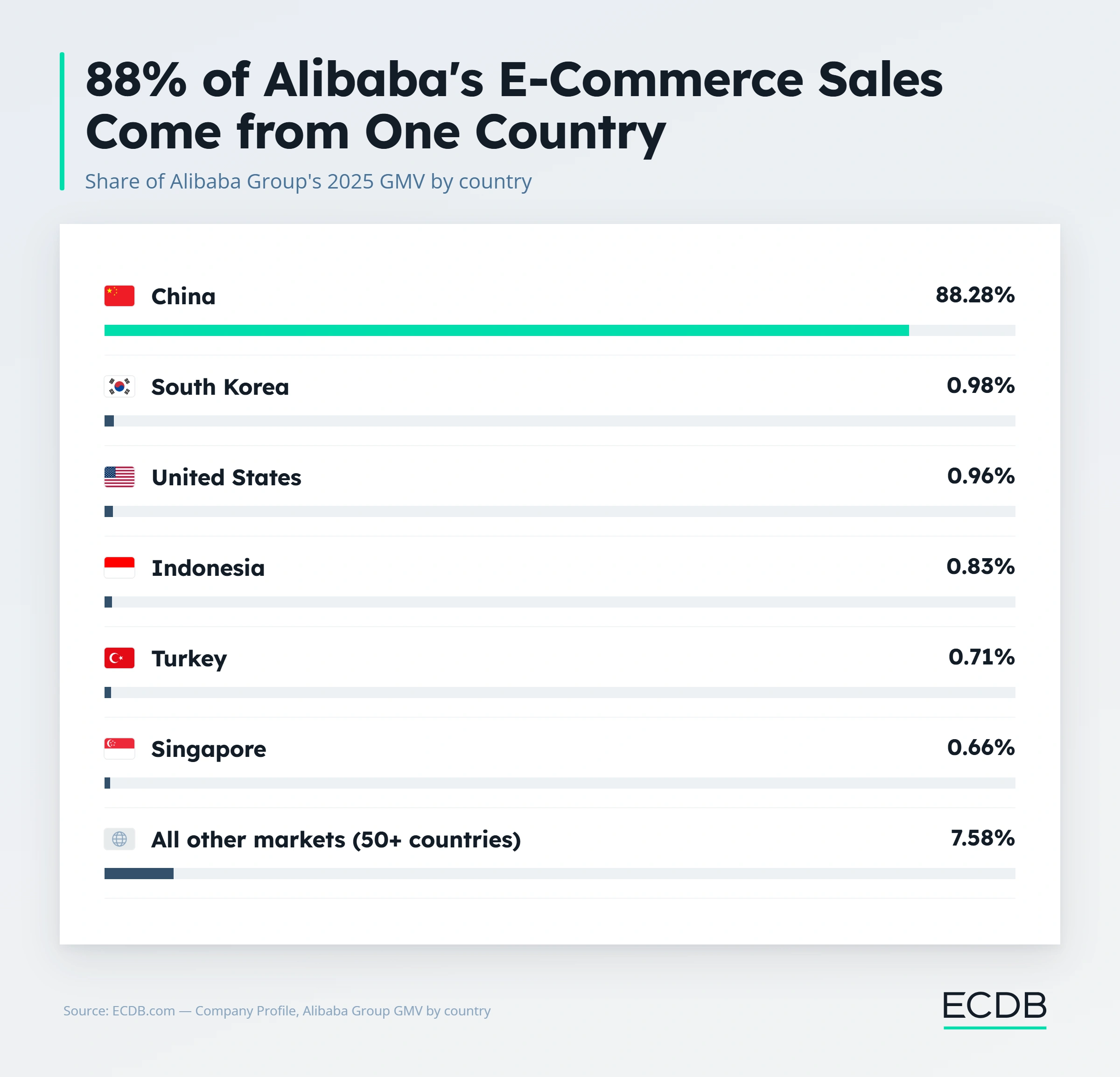
That split matters for how the two companies are actually exposed to risk and opportunity. Alibaba's fortunes rise and fall with a single economy and a single regulatory environment. Amazon's are spread across a dozen. Being the largest e-commerce company in the world and being the most global one turn out to be two different achievements, and Alibaba only holds one of them.
The Real Growth Story Is a Fight Over Brazil
The fastest growth in the top 10, Sea Ltd at 26.77% and MercadoLibre at 26.37%, is happening in the same market: Brazil. MercadoLibre still draws just under half of its GMV from Brazil (49.66%, worth US$32.3 billion), the home market it has dominated for over two decades. Sea Ltd, whose Shopee marketplace built its business in Southeast Asia, now pulls 23.71% of its own GMV from Brazil too, worth US$30.2 billion, a figure that has crept up to nearly match MercadoLibre's home-turf total.
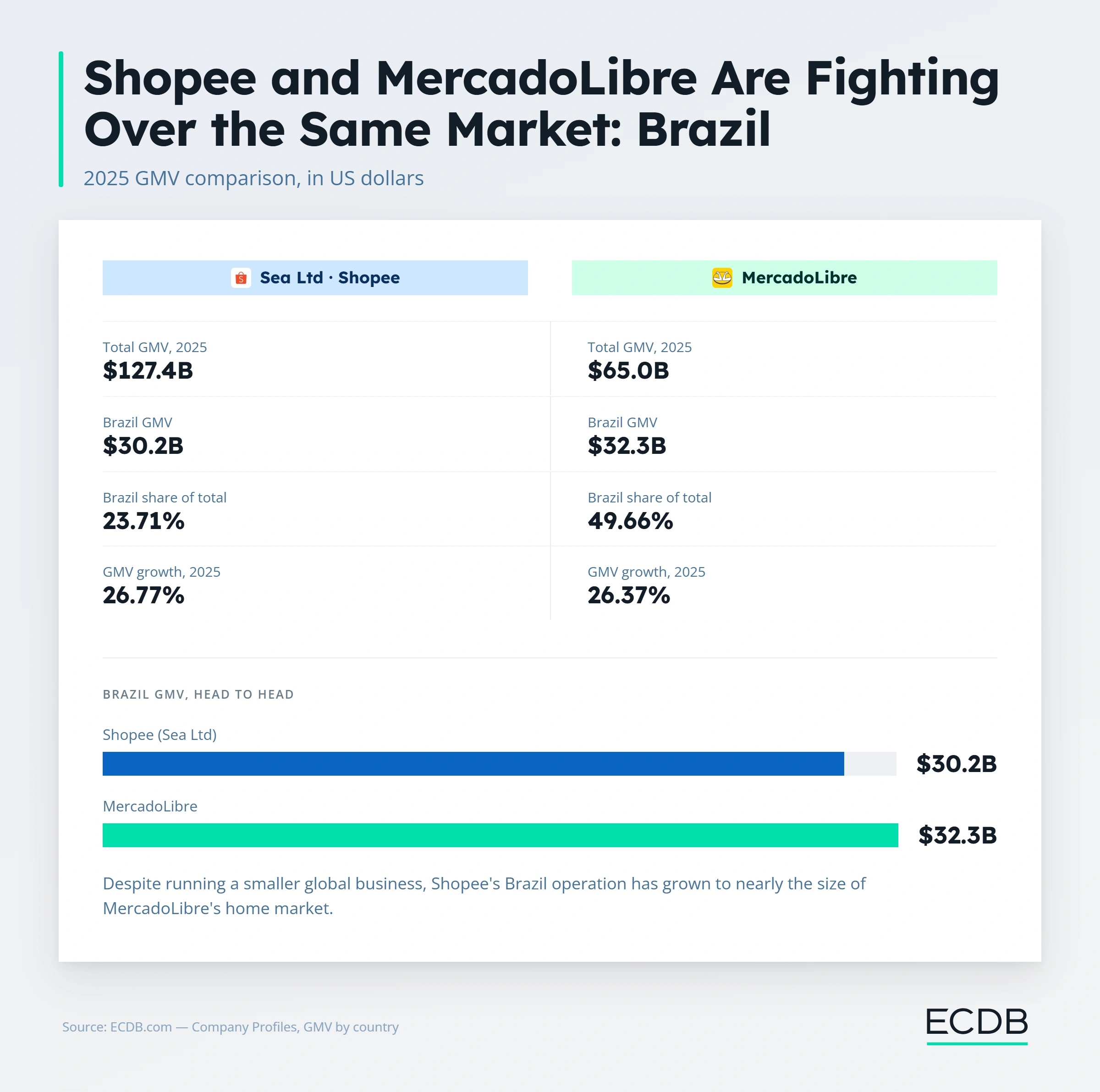
In other words, two of the fastest-growing e-commerce companies in the world are growing quickly in large part because they are colliding in the same country. That is a very different story from either company simply expanding into open, uncontested territory, and it means Brazil's e-commerce market is likely to keep shifting quickly as both companies keep pushing for share there.
What This Ranking Does and Doesn't Measure
GMV measures the total value of goods sold, not company profit, so it isn't the same as looking at a company's earnings or stock performance. It also mixes different business models: some companies on this list sell mostly their own inventory, others mostly host third-party sellers, and the ranking treats a dollar of sales the same way regardless of which model produced it.
That makes GMV the fairest way to compare how much these companies actually move through e-commerce, even though it isn't the number that would show up on their profit and loss statement.
Seeing the Full Picture Behind the Ranking
Every number in this article, GMV, growth rate, and country-by-country breakdown, comes from the same underlying data that ECDB makes available for any company, retailer, or market it tracks.
Anyone sizing up a market entry, a competitor, or an acquisition target can pull the same country, category, and growth breakdowns used in this article, for any of the thousands of companies and stores ECDB tracks worldwide.

Related Articles
All ArticlesReady to Unlock the Full Power of ECDB?
Book a demo to see how ECDB's market intelligence can support your business.