E-Commerce Return Rate by Category: Which Products Get Sent Back Most?
Fashion returns get sent back at more than four times the rate of the lowest category. The reason is deeply tied to user behavior.
Specialist Marketplace Growth Playbook
New data shows that specialist marketplaces grow faster and retain customers better when they expand beyond their core category.

Nadine Koutsou-Wehling
Data Journalist
June 23, 2026
Transactions
Article in a Nutshell:
Specialist marketplaces that expanded into similar categories grew higher and had higher customer engagement stats than mono-category specialists.
Zalando expanded from fashion into care products, lifting GMV per buyer and purchase frequency.
Trendyol deepened its grocery focus, pushing GMV per buyer and purchase frequency up.
Both cases confirm that adjacent category expansion grows customer lifetime value and enables more sustainable growth.
Specialist marketplaces are e-commerce platforms that focus on one category type. We recently identified their primary growth lever, which is less about new business and more about expanding existing customer lifetime value.
The data confirms what works: the platforms pulling ahead are those that have expanded their category offering to increase purchase frequency and basket size among existing customers.
Mono-category specialists are those with at over 95% of their GMV coming from the main category. Compared to specialists who added adjacent categories to their category mix, the mono-category specialists grew much slower, at 13.3% versus 18.0%.
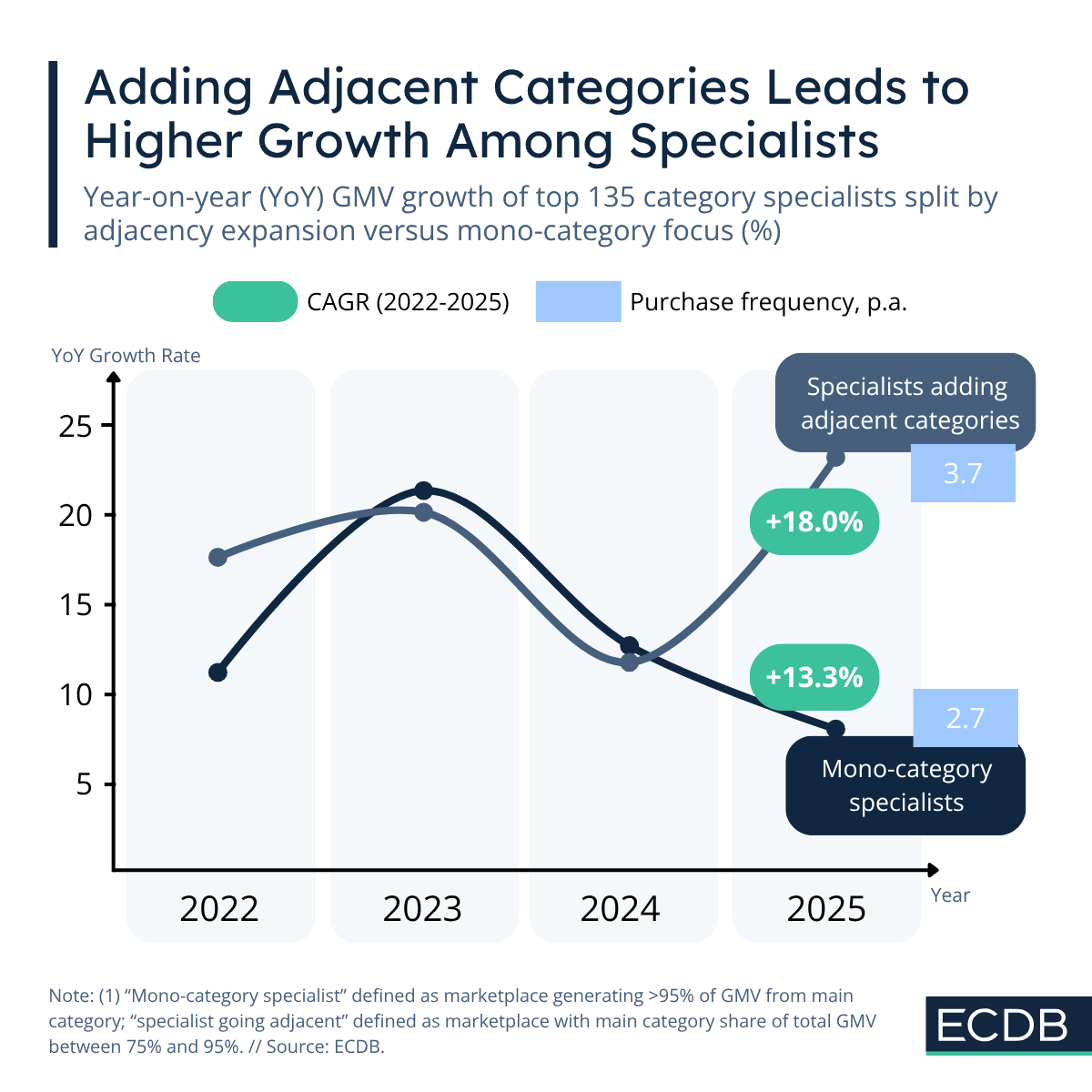
Adjacent category expansion, which means adding similar categories to the product mix, also correlates with a higher purchase frequency of 3.7 times a year. Platforms that stayed within a single category had a customer purchase frequency of 2.7.
Zalando began as a fashion retailer. Between 2023 and 2025, it expanded into care products and new categories, reducing fashion's share of GMV from 92% to 87% while adding breadth.
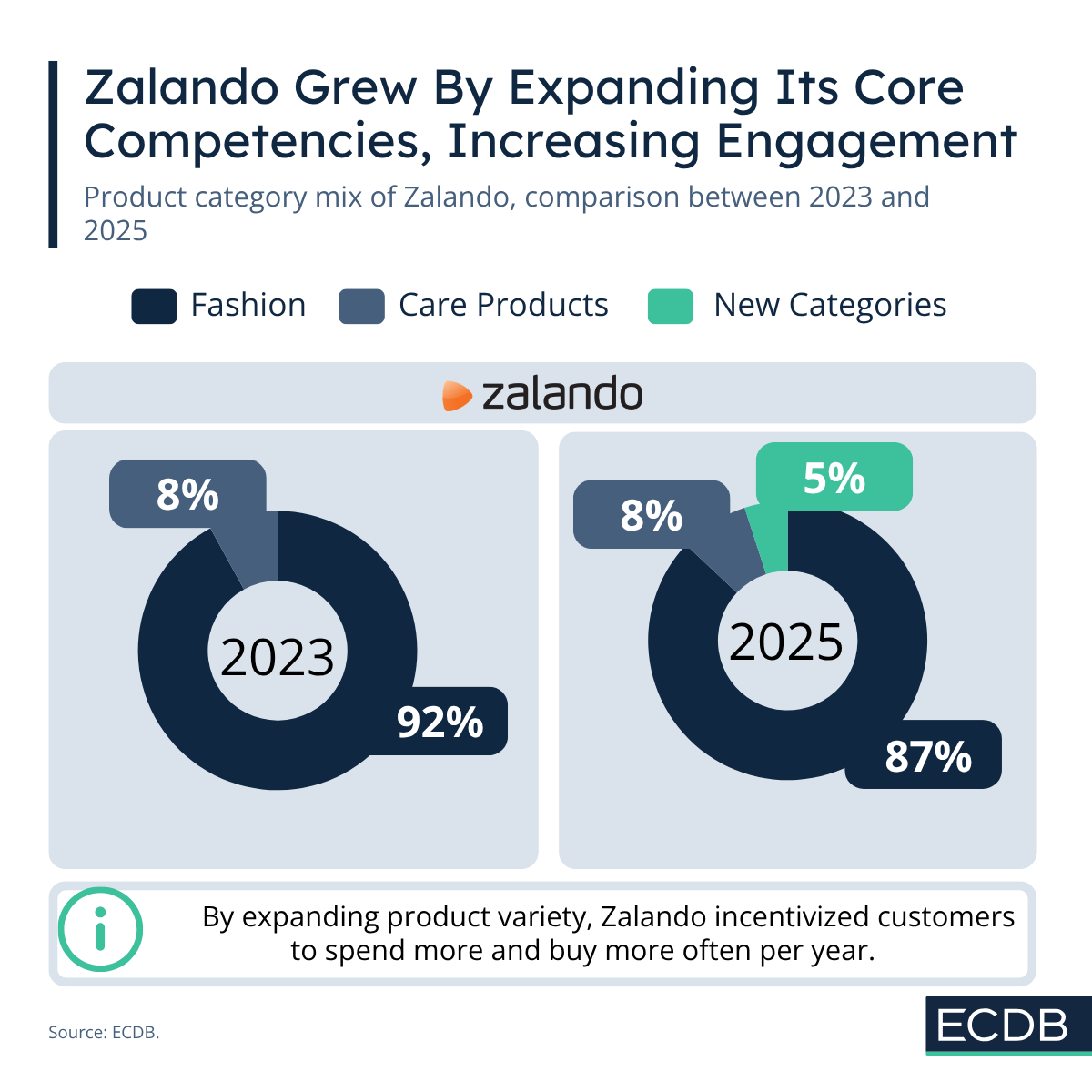
The effect on customer behavior was directly measurable: GMV per buyer rose from US$270 to US$318, and purchase frequency increased from 4.5 to 5.1 orders per year. Customers who had a reason to return more often spent more in total.
Trendyol took a different route to the same outcome. Rather than entering a new category altogether, it deepened an existing segment; grocery. From 2023 to 2025, Trendyol grew its grocery offering by 8 percentage points up to 13% of GMV. Fashion's share of the mix declined from 49% to 31% as grocery became a more regular touchpoint.
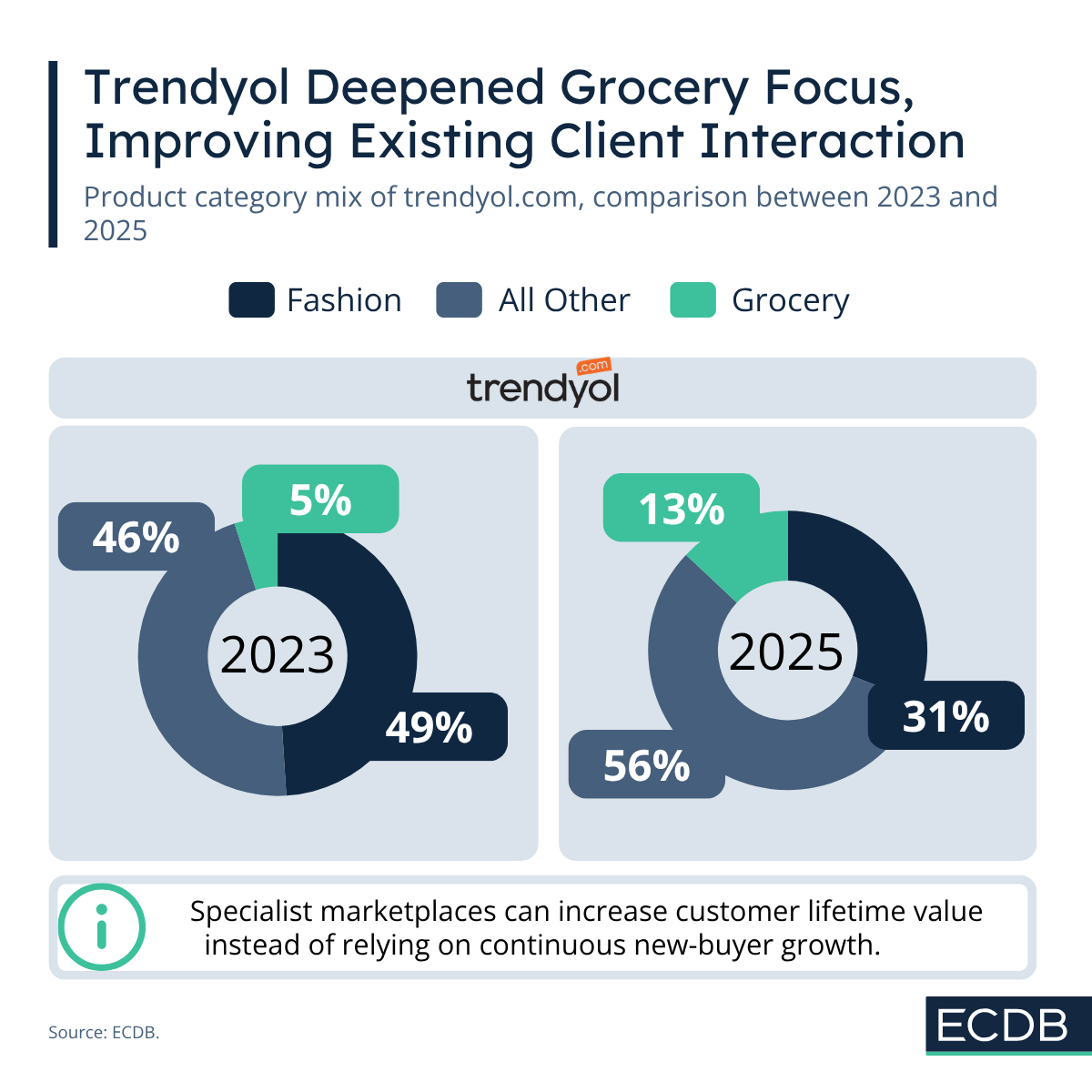
Consequently, GMV per buyer climbed from US$151 to US$173, and purchase frequency rose from 3.6 to 3.9.
Two marketplaces, different category bets, same underlying logic. Adding adjacent categories gives existing customers more reasons to return, which compounds over time into higher customer lifetime value. It is a more defensible growth path than relying on continuous new-buyer acquisition, which is costly and subject to diminishing returns.

Related Articles
Fashion returns get sent back at more than four times the rate of the lowest category. The reason is deeply tied to user behavior.
The United States lead with a purchase frequency of around 28 times in a year. At the same time, almost 1 in 3 US retail dollars is made online. Here is why.
Austrian and German online shoppers purchase most frequently in a year, while other markets reveal different purchasing habits. Greece is one of the cases where frequency does not match revenue. Here are the specifics.

Click here for
more relevant insights from
our partner Mastercard.
Book a demo to see how ECDB's market intelligence can support your business.