Amazon Prime Versus Walmart+: A Clear Winner and Dual Memberships
Amazon Prime is the clear winner when it comes to subscriber count, but Walmart+ has taken over a complimentary role to stay relevant.
Shopee Retailer Profile
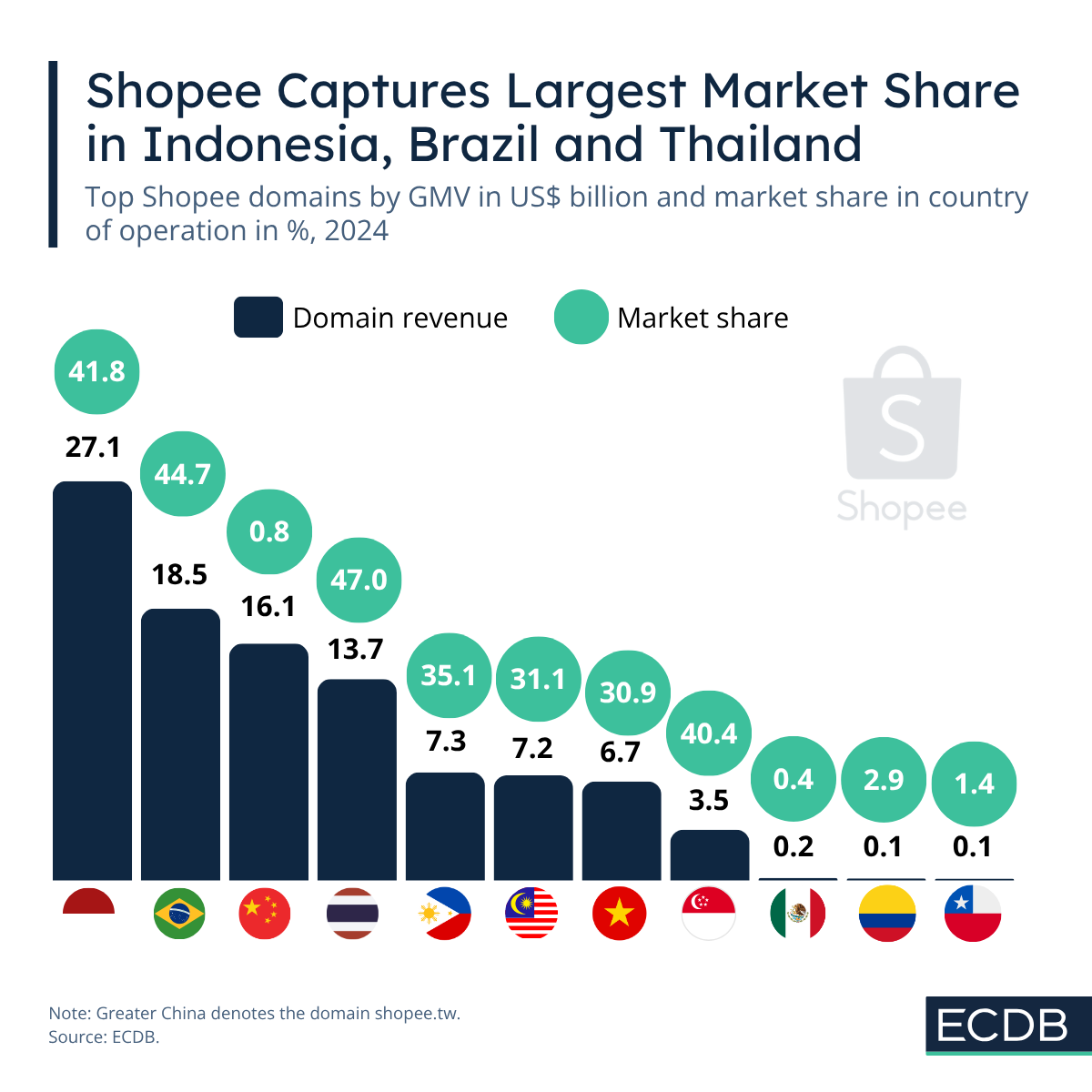
Shopee generates the highest GMV (gross merchandise volume) in Indonesia and accounts for the highest market share in Thailand.

Nadine Koutsou-Wehling
Data Journalist
December 09, 2025
Retailers
Shopee is currently the ninth-largest retailer in the world, with global revenues of US$100.5 billion in 2024. Shopee therefore follows Walmart but is ahead of eBay in tenth place.
Originally established in Singapore, Shopee is a Southeast Asian company with a strong presence in Indonesia. Shopee introduces e-commerce to a wider audience in the region and has now ventured into Latin America as well.
Considering the ECDB Retailer Profile of Shopee, which domains take the lead in its portfolio? How important is it in each market?
Indonesia is Shopee’s strongest domain, with US$27.1 billion in eCommerce GMV by 2024. At the same time, Indonesia is one of the three markets where Shopee contributes the most to total market revenues. Shopee alone covers 41.8% of Indonesian e-commerce market revenues.
Shopee’s significant market share speaks to its importance in the Indonesian e-commerce sector. The marketplace supports nascent online business structures in the region, by operating on both B2C and C2C models. This applies to all of the Southeast Asian markets in which it operates, and some of the Latin American ones as well.
In Brazil, Shopee's second-largest market, the company accounted for 44.7% of market revenues in 2024, with a GMV of US$18.5 billion. But in Thailand the pattern is even more evident with US$13.7. Due to Thailand’s smaller e-commerce sector, valued at US$29.1 billion, Shopee accounts for 47% of market revenues, its biggest contribution yet.
This shows that early participation in e-commerce and investment in digital infrastructure can lead to lasting competitive advantages and market leadership. Shopee.tw, belonging to the wider area of Greater China, has a significant impact in the specific region, which is diluted by Mainland China’s vast revenues.
A second tier of domains consists of Southeast Asian countries in which Shopee holds market shares ranging from 30% to 41%. These are smaller markets that do not have high revenues. For instance, Shopee’s US$7.3 billion in the Philippines accounted for 35.1% of total e-commerce revenues in 2024. Similarly, Malaysia and Vietnam contribute around US$7.0 billion each to Shopee’s GMV, resulting in a 31% market share.
Singapore, which is Shopee’s location of origin, is a city-state that does not generate much e-commerce revenues, with only US$8.5 billion in 2024. Consequently, Shopee's US$3.5 billion GMV constitutes a significant portion of Singapore's total e-commerce market.
In recent years, Latin American countries have joined Shopee’s portfolio. Brazil is now one of the largest markets for the retailer, while Shopee’s GMV and influence are lower in Mexico (US$177.5 million), Colombia (US$145.5 million) and Chile (US$129.2 million).
The conditions for e-commerce in Latin America are similar to those in Southeast Asia, with low e-commerce penetration and a high number of small business sellers ready to bring their merchandise to a wider audience via online retail.
The launches in Colombia and Chile were part of Shopee’s wider expansion into new regions. Shopee even launched in some European markets, namely Spain, Poland, and France, without much success. Its operations were stopped soon afterwards.
Shopee’s appeal therefore lies in its ability to adapt to emerging markets with strong growth potential, rather than competing head-to-head in already saturated e-commerce environments. Shopee successfully connects small businesses with consumers in regions where digital retail is still developing, but what works in some markets is not viable in others.

Related Articles
Amazon Prime is the clear winner when it comes to subscriber count, but Walmart+ has taken over a complimentary role to stay relevant.
The global number of mid-sized retailers is declining from 9,133 to 9,042 between 2023 and 2025. Subsequently, they are losing their grip on overall e-commerce revenues. Why market concentration is a threat to smaller businesses.
Amazon.com is by far Amazon's most important domain, but its relative importance in US e-commerce doesn't reflect that. The underlying market structure explains the divide.

Click here for
more relevant insights from
our partner Mastercard.
Our Tool
We’re not just another blog—we’re an advanced e-commerce data analytics tool. The insights you find here are powered by real data from our platform, providing you with a fact-based perspective on market trends, store performance, industry developments, and more.
Analyze retailers in depth with our extensive Retailer dashboards and compare up to four retailers of your choice.
Learn More
Combine countries and categories of your choice and analyze markets in depth with our advanced market dashboards.
Learn More
Compile detailed rankings by category and country and fine-tune them with our advanced filter options.
Learn More
Discover relevant leads and contacts in your chosen markets, build lists, and download them effortlessly with a single click.
Learn More
Benchmark transactional and conversion funnel KPIs against market standards and gain insight into the key metrics of your relevant market.
Learn More
Our reports provide pre-analysed data and highlight key insights to help you quickly identify key trends.
Learn More
Find your perfect solution and let ECDB empower your e-commerce success.