Amazon Shoppers Order More Often as Income Rises, Walmart Holds Steady
Does a higher household income mean more frequent online shopping? On Amazon, yes. On Walmart, not nearly as much.

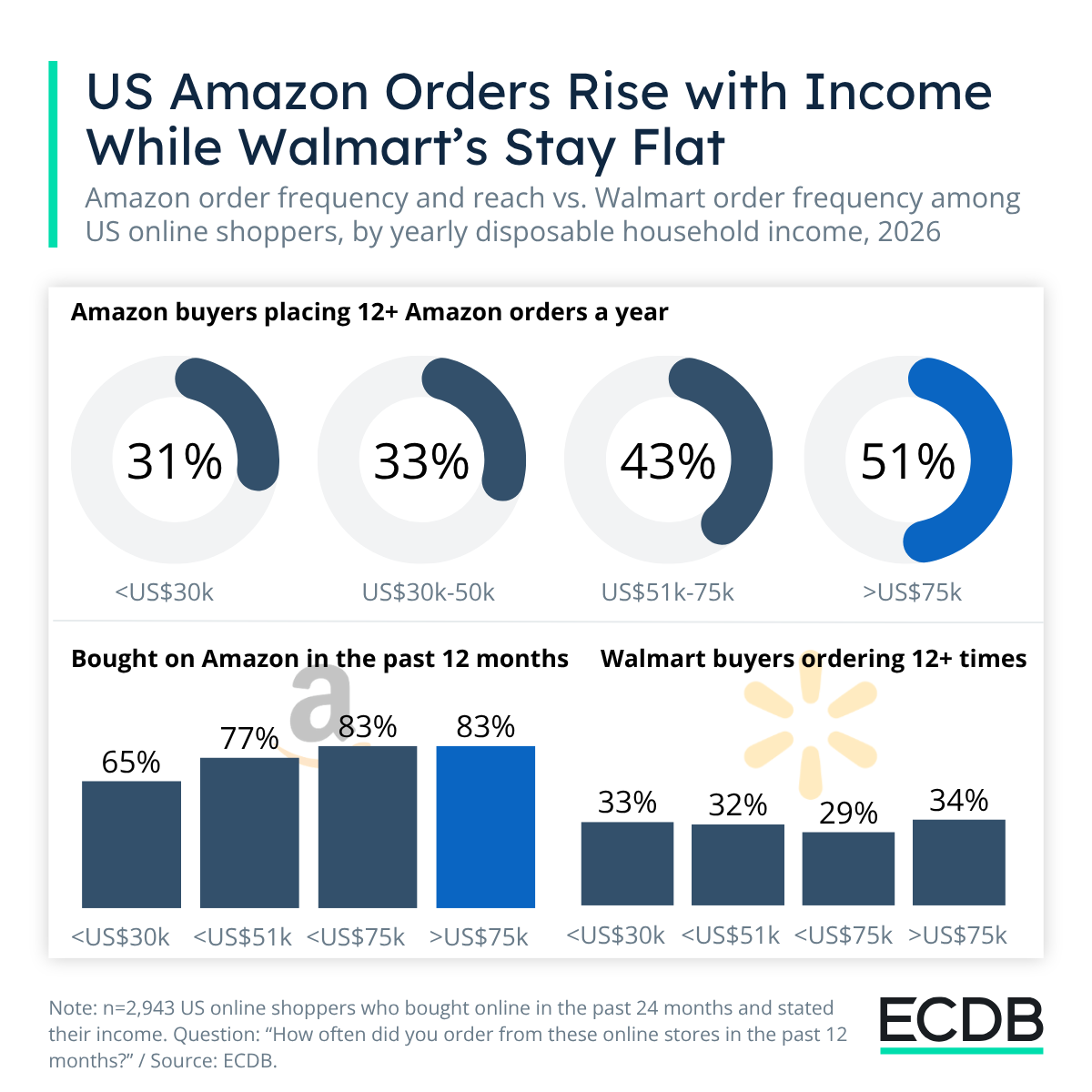
Does a higher household income mean more frequent online shopping? On Amazon, yes. On Walmart, not nearly as much.
ECDB's recent survey of US consumers shows a clear difference in how the two marketplaces attract repeat customers. Income shapes how often shoppers return to Amazon. At Walmart, its effect is small.
Lower-Income Households Shop Both Marketplaces at a Similar Pace
At the lower end of the income range, the two marketplaces look alike. For households earning up to US$51k a year, around one in three Amazon and Walmart customers orders at least once a month. That means 12 or more orders a year.
The gap opens further up as income rises.
Above US$51k, Amazon Pulls Ahead
Above that threshold, income makes a far bigger difference at Amazon than at Walmart. At Walmart, the share of monthly shoppers stays between 29% and 34% across all four income brackets. At Amazon, it climbs above 50% for households earning more than US$75k a year.
The two marketplaces build repeat business in different ways. Higher-income households are considerably more likely to shop frequently on Amazon. Walmart's ordering frequency varies much less with income. Roughly three in ten of its customers order monthly, whatever their income.
Prime Reaches About Eight Times as Many Members as Walmart+
Both marketplaces charge for memberships that reward frequent shopping. Their reach differs considerably. Amazon Prime has a much larger member base, with Walmart+ reaching only around one-eighth of its size.
A paid membership gives shoppers a reason to order often and get the most out of the fee. Prime puts that incentive in front of far more households than Walmart+ does.
Amazon Covers More Purchase Occasions
The difference also reflects what consumers buy on each platform. Amazon is often the starting point for a wide range of purchases. Electronics, home goods and gifts all land in the same cart. Higher-income households make more of these purchases, which gives them more reasons to order frequently.
Walmart serves a different need. A large share of its online orders covers groceries and household essentials. Every household restocks these at a similar pace, whatever it earns. This is why Walmart's ordering frequency remains much more consistent across income groups.
Wrap-Up: Two Marketplaces, Two Reasons to Come Back
Amazon and Walmart may compete for the same customers. The reasons those customers keep coming back are not quite the same. On Amazon, repeat orders rise with income and with the range of things a household buys. On Walmart, they follow the regular cycle of weekly essentials.

Related Articles
All ArticlesReady to Unlock the Full Power of ECDB?
Book a demo to see how ECDB's market intelligence can support your business.