Asia-Pacific Generates More Than Half the World's E-Commerce Revenue
Asia-Pacific, or APAC, accounts for over 50% of global e-commerce revenues. Where its lead has been larger before the pandemic, world dynamics shifted in the crisis. Here is why.

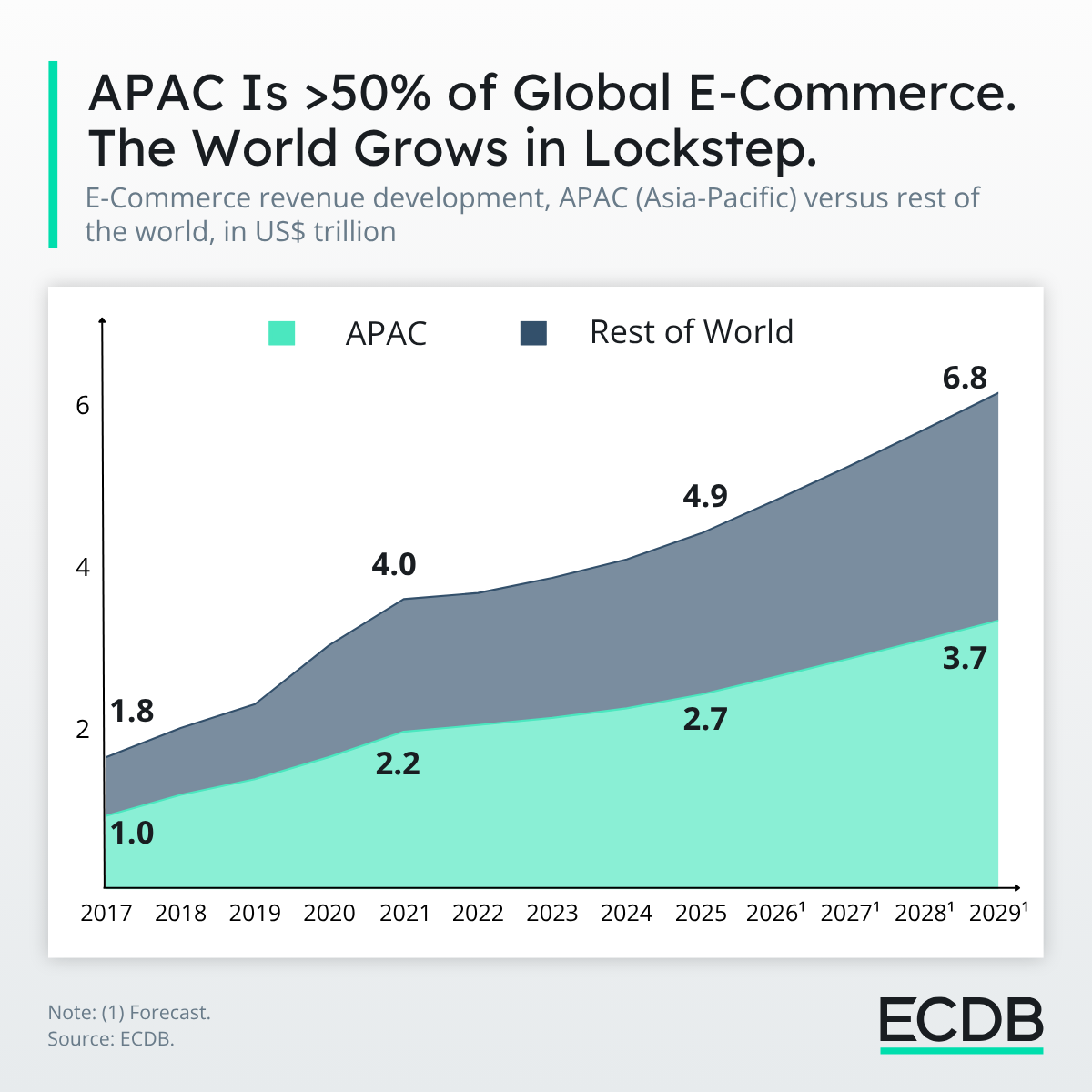
Asia-Pacific generates more than half of all e-commerce revenue worldwide. The region's share peaked in 2019, fell in the years after, and has held at a lower plateau ever since, a pattern forecast to continue through 2029.
The pandemic drove that change. APAC held a 60% majority of global e-commerce revenue before 2020.The rest of the world grew faster during it, pulling APAC's share down to the 54% to 55% range it has held since. Here is how that dynamic comes about.
China Is Most of APAC's Advantage
China accounts for most of that lead. It generated over US$2 trillion in e-commerce revenue in 2025, leaving roughly US$639 billion for the rest of the region combined: Southeast Asia, India, Australia and a long tail of smaller markets.
China's own growth rate has slowed as the market matures. Even so, its absolute gains stay large enough to keep the region on top for years to come. A market this size does not need fast growth to add the most revenue in dollar terms, only steady growth on a base larger than most of the world combined.
Southeast Asia and India Are Where the Growth Sits
Southeast Asia and India are growing faster than China, closing part of the gap in percentage terms even as China keeps leading in absolute dollars. Both markets sit earlier on their own e-commerce adoption curve, the kind of stage where growth rates run higher simply because the starting base is smaller and large numbers of new consumers join the shopper base each year.
That pace puts Southeast Asia and India in the same bracket as other fast-growing regions outside APAC, including Latin America and the Middle East and North Africa (MENA). Fast growth driven through improved infrastructure and the integration of new consumers is exactly what pulled APAC's global share down from its 2019 peak.
The Pandemic Reshuffled Where Growth Landed
APAC's share of world e-commerce revenue sat around 60% before 2020. It has held at 54% to 55% ever since.
Regions that made up a smaller share of global e-commerce before the pandemic grew fastest during it. This happened because many new consumers in remote regions or who did not shop online before began to do so. Many national digitization initiatives supported the move online. That pandemic-era surge outside Asia-Pacific pulled the rest of the world's share up and APAC's share down, even though APAC's own dynamic pointed towards the same way.
Since then, APAC and the rest of the world have grown in lockstep. China drives the largest absolute gains on the APAC side, and the United States drives the largest absolute gains on the other, so the balance between the two groups has held steady for years.
Wrap-Up: World Regional Balance
China is large enough that slower growth still delivers the biggest dollar gains in the region. Southeast Asia and India are growing fast enough to matter but not yet large enough to move APAC's overall share on their own. The pandemic reset the global balance once, and growth on both sides of that new balance has moved in lockstep ever since.
ECDB delivers consistent data on world regions, including geographic and political regions, in a time development spanning decades. If you are interested in our vast database, check out our Profiles or book a demo.

Related Articles
All ArticlesReady to Unlock the Full Power of ECDB?
Book a demo to see how ECDB's market intelligence can support your business.