Africa Leads With a Compound Annual Growth Rate of 13.9% From 2025 to 2030
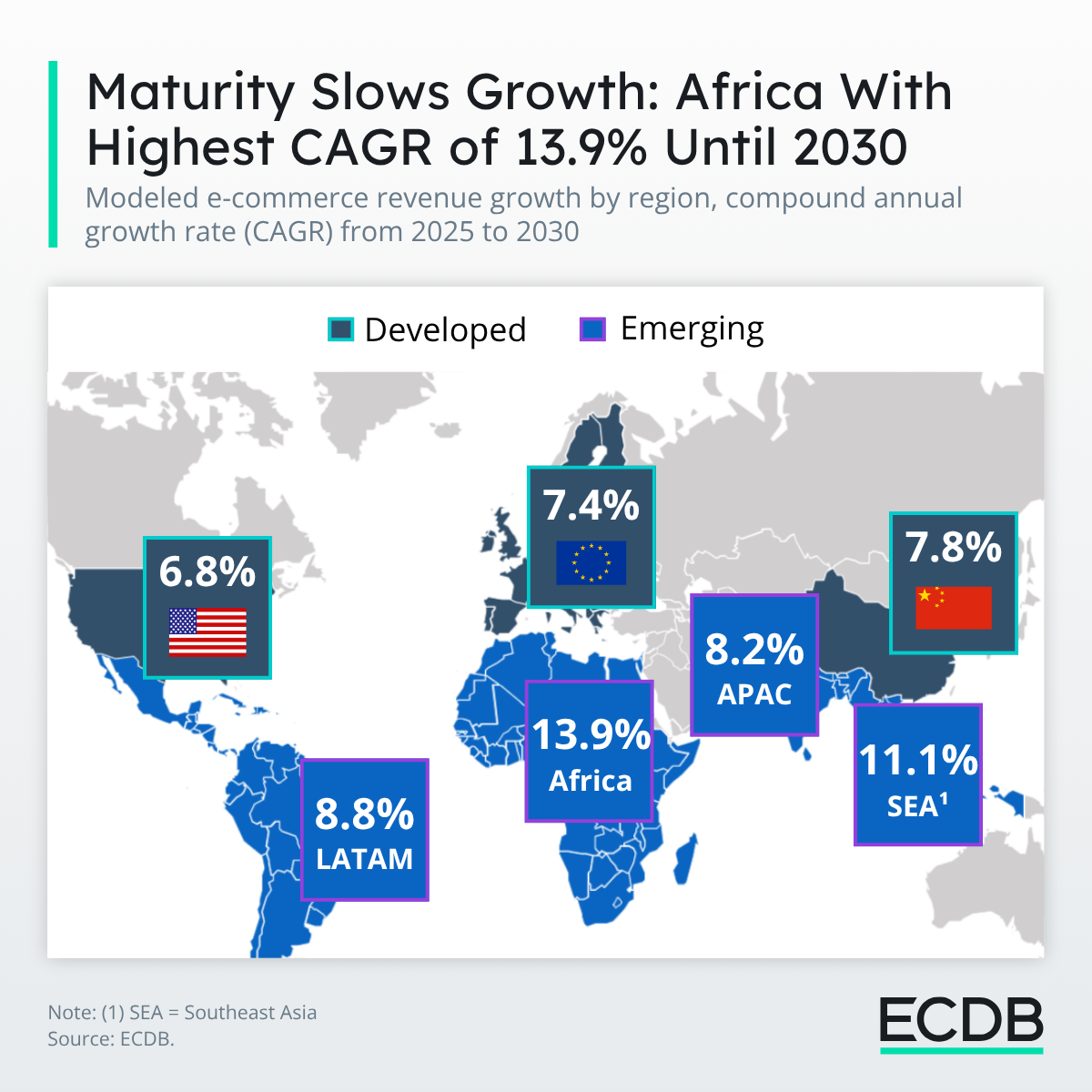
Africa grows at a compound annual growth of 13.9% from 2025 to 2030. But mature markets add most of the absolute gains. Here is what factors account for this development.

Global e-commerce is anything but evenly distributed. The regions growing fastest and the ones contributing most revenue are different regions.
Our forecast data through 2030 shows why, and what that split means for where the market is headed.
Africa and Southeast Asia Lead Growth Through 2030
Africa is the fastest-growing e-commerce region worldwide, with a projected compound annual growth rate (CAGR) of 13.9% between 2025 and 2030. Southeast Asia follows at 11.1%. Both sit well above the global average of 8.5%.
Individual markets push those regional averages even higher. South Africa's e-commerce revenue is forecast to grow at an 18.0% CAGR through 2030, from US$5.6 billion to US$12.8 billion. Egypt follows at 15.7%, the Philippines at 14.8%.
Infrastructure and Base Effects Explain the Gap
Two forces sit behind that lead:
Infrastrucure
In markets where retail still happens mostly offline, every improvement to payment rails, delivery networks, and mobile access pulls more first-time buyers online.
Africa's online share, the portion of total retail that happens online, sits at just 4.3%. Southeast Asia's sits at 9.2%. Both trail the global average of 21.2% by a wide margin. That gap is exactly where the growth comes from.
Base Effects
Africa's population, at 1.34 billion, is nearly as large as China's 1.45 billion. But Africa's e-commerce market is worth US$19.7 billion against China's US$2.04 trillion, more than a hundred times smaller.
Starting from a base that small, even modest dollar gains translate into large percentage growth.
Mature Markets Grow Slower, But Contribute Most Absolute Gains
The United States, the European Union, and China sit at the other end of the growth-rate spectrum. Most of their infrastructure and consumer participation is already in place, leaving less room to grow.
The EU's forecast CAGR through 2030 is 7.4%, the lowest of the three. China follows at 7.8%, still adding nearly US$928 billion in new revenue by 2030 despite the slower rate. This is a reflection of China's US$2.04 trillion starting base and an online share already at 28.1%, the highest of any major market.
The United States grows faster than both, at 9.5% CAGR. Behind Africa and Southeast Asia, but ahead of the other two mature markets.
Base effects work in the leaders' favor too. The same percentage gain on a much bigger revenue base produces a much bigger dollar gain, and that is what keeps concentration rising instead of falling.
Wrap-Up: Reinforcing Concentration
Global e-commerce revenue is projected to grow by US$2.47 trillion between 2025 and 2030. The United States, the European Union, and China together account for US$1.75 trillion of that growth, 71% of the global total. Africa contributes under 1%.
Emerging markets make the wider leaps in growth rate. Mature markets still add the bigger numbers in absolute revenue. That is how concentration reinforces itself: slower growth on a much larger base still outpaces faster growth on a small one, and mature markets keep pulling further ahead in dollar terms even as Africa and Southeast Asia close the growth-rate gap.

Related Articles
All ArticlesReady to Unlock the Full Power of ECDB?
Book a demo to see how ECDB's market intelligence can support your business.