Chinese E-Commerce Exports Still Go Primarily Through the US, Despite Trade Dispute
With the de minimis exemption abolished, US-China trade flows were expected to shrink. E-commerce data shows the bond has persevered.
Cross-Border E-Commerce
Cross-border e-commerce is a core driver of global e-commerce growth. But regional gaps are closing over the years. Who's on top of this development?

Nadine Koutsou-Wehling
Data Journalist
March 10, 2026
Cross-Border eCommerce
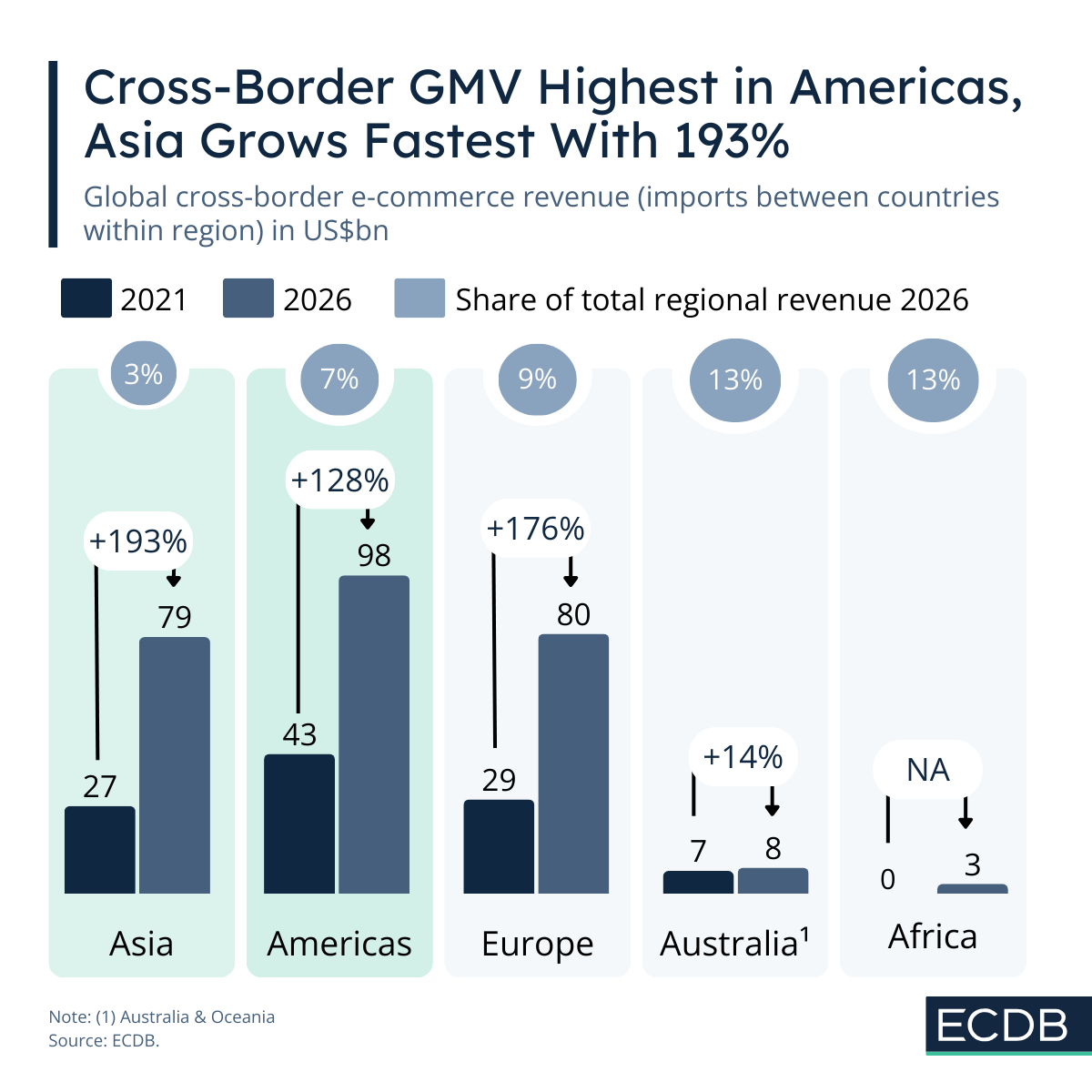
Cross-border e-commerce is one of the most accelerating segments of global digital retail. Just five years ago, cross-border revenues of global regions were thrice lower than they are now. Since then, Asia is leading in growth, Europe holds steady and the Americas are still dominating in overall value.
The Americas continue to move the highest value of cross-border goods. In 2021, US$43 billion were made through cross-border e-commerce in the Americas. By 2026, that number has increased by 128% to US$98 billion.
This dominance is fueled in large part by the logistics and scale of Amazon, which makes international shopping seamless for millions of consumers. But the story doesn’t end in North America. Across Latin America, platforms like Mercado Libre are connecting local retailers to far wider audiences, and thereby enable cross-border commerce to flourish throughout the region.
Europe sits squarely in the middle of the global cross-border map. With the second-highest growth (+176%) and the second-largest cross-border GMV at $80 billion, Europe’s success is rooted in its structure.
Multiple diverse markets are tightly interconnected. They share currencies, cultural ties, and relatively integrated logistics networks, which makes international trade more fluid and efficient.
Asia impresses through its growth. Cross-border revenues have nearly tripled since 2021, growing 193% to reach $79 billion in 2026. This surge is powered by a mix of regional e-commerce platforms such as Shopee and Lazada, alongside Chinese giants like Pinduoduo and Alibaba.
The good news is that cross-border e-commerce is succeeding everywhere. The gap between regions is narrowing fast, and competition is heating up.

Related Articles
With the de minimis exemption abolished, US-China trade flows were expected to shrink. E-commerce data shows the bond has persevered.
Not size is the determining factor, but proximity to major e-commerce hubs. That is why certain markets source most of their e-commerce from foreign platforms, while domestic companies fall behind.
Cross-border online marketplaces have made buying from another country as easy as buying from the shop next door. Trade barriers are rising, but the sector shows no sign of slowing down..

Click here for
more relevant insights from
our partner Mastercard.
Book a demo to see how ECDB's market intelligence can support your business.