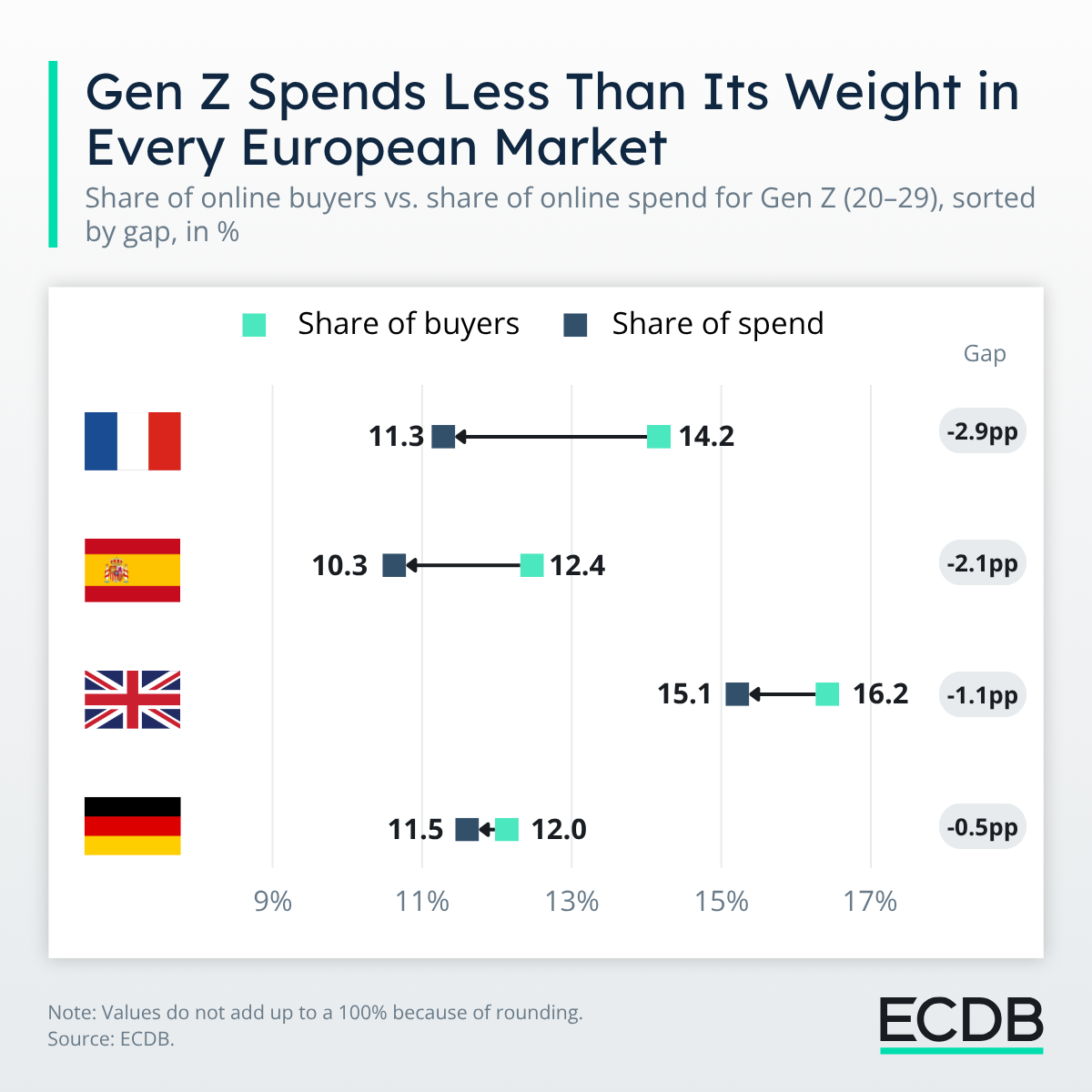
What role does Gen Z play in e-commerce? Its buyer numbers and spend share suggest that it could be bigger, especially when it comes to expenditure. Of the 20- to 29-year-old online shoppers in four key European markets, the buyer base is bigger than the spend share, which has important implications for shopper behavior.
Millennials Still Anchor Europe's Online Buyer Base
Millennials, roughly measured as the cohort between 30 and 39 years, remain the core group of shoppers everywhere, with 28% to 35% of buyers. Gen X follows in second place. Both groups sit in their prime earning years, with established households to shop for.
Gen Z is third largest in the UK and France. In Germany and Spain, it ranks only fourth.
Representing Purchasing Power: The Buyer and Spend Gap
The wider the gap between buyer share and spend share, the more spending power sits unused within a buyer base that already claims its share. France and Spain have the widest gap in this selection, showing that much of Gen Z online shopping sits on unused potential.
France has the widest gap of the four markets, at 2.9 percentage points (pp).
Spain follows at 2.1 pp. Gen Z makes up 12.4% of Spanish online buyers but just 10.3% of online spend.
The United Kingdom has the biggest share of Gen Z present among buyers. Their spend share trails by 1.1 pp.
Germany shows the smallest difference. Gen Z accounts for 12.0% of buyers and 11.5% spend, a 0.5% gap.
What are the reasons behind this consistent pattern? And where do the variations come from? A lot of it comes down to income.
Factors Underlying the Trend: Income, Loyalty, Unemployment & Living Arrangements
Several forces contribute to the observed patterns, the most salient of which is income. In general, younger shoppers tend to spend less, as many are early in their careers or are studying. That means the Gen Z buyer base spends less because of their stage in life, which will naturally evolve as shoppers get older and move into better-paying jobs.
Loyalty is a factor that is specific to Gen Z as a buyer cohort. Gen Z baskets are typically higher than other age groups, but they are less likely to return to the same store. Showing less brand loyalty, it represents a generation that discovers products through social feeds, influencers and search rather than going to stores they already know well.
Structural factors account for the differences in the gap between countries. Taking youth unemployment as a measure, it can explain part of why Gen Z's spend gap is wider in Spain and France than in the UK and Germany. Germany's apprenticeship system puts many young people on a payroll early, and 77% of 20- to 29-year-olds there were employed in 2025, according to Eurostat. In short, young Germans earn earlier, so their spending tracks their buyer share more closely.
Living arrangements add a cultural layer. Young Spaniards leave their parental home at 30.2 years on average, while their French and German peers move out around age 24. In markets where Gen Z stays home longer, part of the spending that benefits young consumers never shows up under their name. In others like France, where moving out happens early but incomes stay low, online spend is toned down to focus on essential purchases.
The UK combines the same forces differently. Young Britons move out early, at around 24 on average, and shop as independent buyers from a young age. That helps explain why the UK has the highest Gen Z buyer share of the four markets. At the same time, youth unemployment has climbed to 16%, its highest level in about a decade. A large, independent buyer base earning under pressure.
Wrap-Up: A Mix of Structural and Behavioral Factors Account for the Gap
Gen Z shoppers don't hold their weight when it comes to e-commerce spend, and the factors for that are various. Some are structural, others behavioral, but most of them seem temporary. Incomes rise with age, youth unemployment recedes as careers progress, and household formation moves spending into Gen Z's own name.
Just the loyalty factor is hard to predict. Does purchase behavior that is tied to social media consumption lead to lower lifetime loyalty, given the fickle nature of attention and trend-driven purchase patterns? Or do recurring purchases that come with established households lead to more routine in online shopping? Whichever way it goes, the retailers that give Gen Z a reason to return now will be the first to find out.