Specialists, Generalists and Social Commerce Compete for US Online Beauty
Online beauty in the US reflects contemporary market trends. TikTok Shop closes in on Sephora with its social commerce strategy, and quick commerce is on the rise too. The established generalists still stay on top. Read on for the details of the ranking.

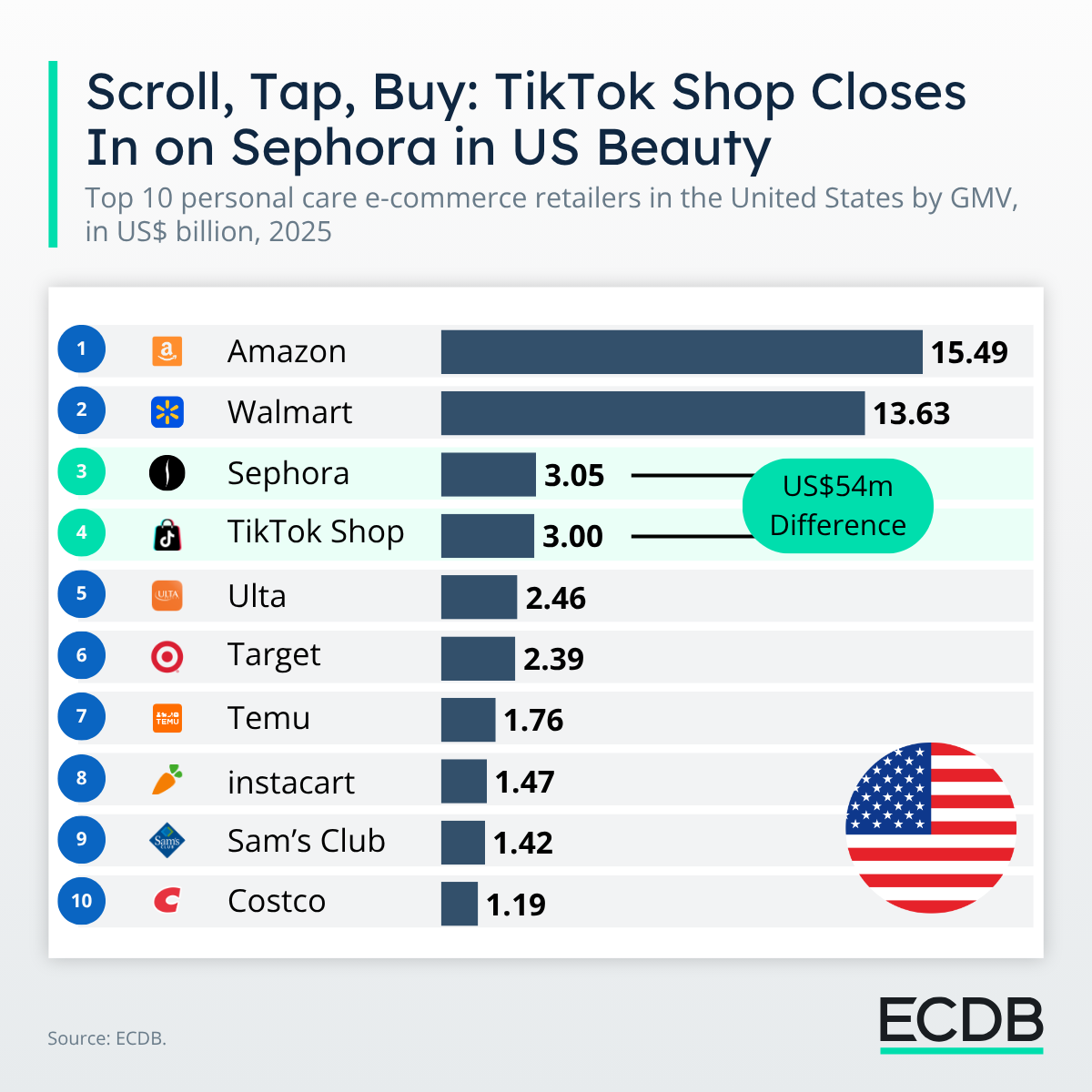
US beauty has a rising star. TikTok Shop now ranks fourth among US online retailers for personal care. Only Amazon, Walmart and Sephora sell more of the category online.
That is a fast climb for a platform built around short videos. TikTok Shop's edge comes from social commerce features designed for product promotion, and the rest of the ranking shows how contested the category has become.
Amazon and Walmart Lead a Crowded US Beauty Ranking
Amazon and Walmart still lead by a wide margin. Both are one-stop shops for every household need, and beauty products travel in the same carts as detergent, snacks and electronics. That reach is hard for any specialist to match.
Below them, the ranking mixes very different business models. Specialists sit next to generalists. Ulta competes with Temu, and Temu competes with Sam's Club.
Seven different business models fill the top ten. Each one reaches beauty shoppers through a different door.
TikTok Shop Turns the Feed Into a Storefront
TikTok Shop's edge lies in discovery and promotion. Products sit directly inside social feeds. Creators use them in videos about entirely different topics, from morning routines to travel vlogs to relationship advice.
Shoppers therefore see beauty products in their most natural environment. A moisturizer shows up on a creator's bathroom shelf, a lip tint in a get-ready-with-me video. The product demonstrates itself before anyone goes looking for it.
Beauty suits this format well. Texture, color and finish are hard to judge from a product page and easier to judge on camera. A short clip answers the questions a shopper would otherwise take into a store.
Sephora Has Viral Momentum of Its Own
Sephora still ranks one place ahead of TikTok Shop. The retailer has built its own social virality. The hashtag #sephorakids shows children making their first foray into beauty, filling carts with cremes, moisturizers and makeup.
That virality still ends in a separate step. A shopper sees the trend on social media, then visits Sephora's site or store to buy. TikTok Shop removes that step. Discovery and checkout happen on the same screen.
If the trend continues, TikTok Shop is on course to overtake Sephora. A shorter path from discovery to purchase is a structural advantage in a category driven this heavily by trends.
Instacart Brings Quick Commerce Into Beauty
Instacart is another noteworthy name in the top ten. The quick commerce platform ranks eighth, ahead of Sam's Club and Costco.
Instacart makes its own way into beauty through instant delivery. Its range runs from groceries to personal care, so shampoo and sunscreen arrive in the same order as milk and bread. For replenishment purchases, speed matters more than browsing. A shopper who runs out of face wash on a Tuesday evening wants it the same day.
Wrap-Up: Three Ways to Win the US Beauty Shopper
Altogether, the US ranking reflects the most contemporary trends in online beauty. TikTok Shop wins on discovery, putting products in front of shoppers before they search. Sephora and Ulta win on specialization, with curated ranges and loyalty built around beauty alone. Instacart wins on speed.
The established generalists still stay far ahead of the rest. Amazon and Walmart owe that lead to their reach as one-stop shops for every household need. Social commerce and quick commerce are closing in from below, and the specialists in between face pressure from both directions.

Related Articles
All ArticlesReady to Unlock the Full Power of ECDB?
Book a demo to see how ECDB's market intelligence can support your business.