As the first quarter of 2025 draws to a close, we took the opportunity to examine the quarterly revenue patterns in eCommerce. Taking the German online market as an example, ECDB provides information on which quarters are the busiest in eCommerce and how the pattern differs by product category.
A closer look at the revenue patterns shows that there are category-specific differences, but one commonality across categories is the importance of the fourth quarter. For each eCommerce category, there are key similarities and differences in quarterly revenues.
Christmas and Shopping Days Impact Q4 Success
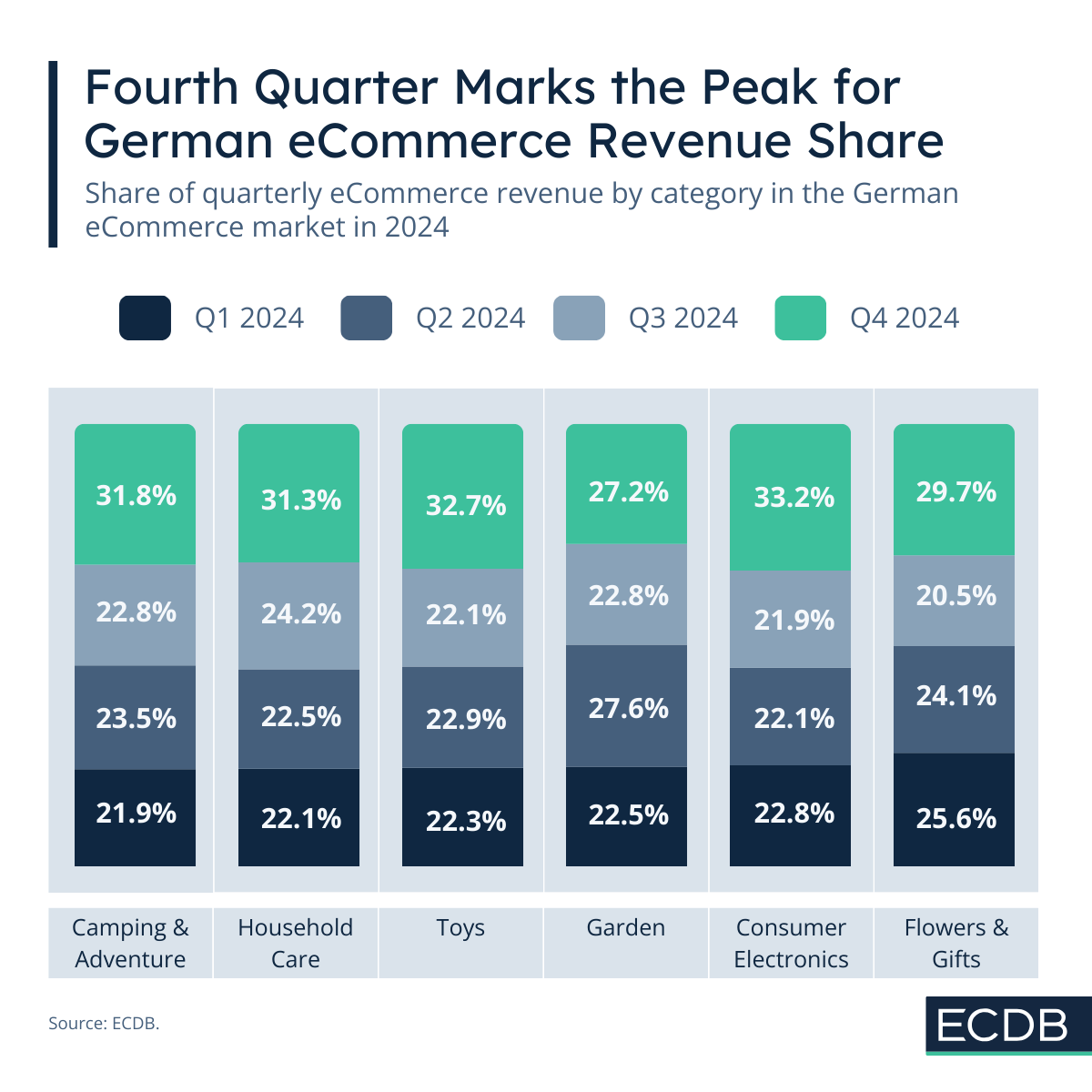
The fourth quarter is the busiest period for eCommerce revenues, which applies for almost all categories. On average, the fourth quarter of 2024 accounted for 31.0% of revenues. The second quarter had a 23.6% share, followed by the first quarter with 22.9% and the third quarter with 22.5%.
The strong Q4 performance is due to the occurrence of major annual shopping days, including Prime Day and Black Week, as well as events like Singles’ Day, which originated in China but has its own adaptation in Germany. The shopping events coincide with Christmas, making them ideal for buying holiday gifts.
Typical gift-giving categories are therefore thriving in this period. While consumers tend to stock up on everyday essentials during the discounting events as well, it is Consumer Electronics (33.2%), Media (32.9%) and Toys (32.7%), which generate outstanding revenue shares of year-end sales.
Fourth-quarter shares dominate in almost every category, but some categories do similarly well at other times of the year.
First Half of the Year Benefits Greenery
Garden products are the most notable departure from the Q4 revenue dominance. Contrary to the norm, Garden eCommerce generates its highest share of revenue in the second quarter (27.6%). This is due to the nature of garden products themselves, which coincide with good weather and spring, when plants and seeds are being prepared for summer growth. Overall, Garden products indicate the highest revenue share for the first half of the year (50.1%).
Similarly, Flowers & Gifts has a comparable first half of the year revenue share of 49.7%. Although the fourth quarter is the strongest for Flowers & Gifts (29.7%), the occurrence of celebrations like Valentine’s Day and Mother’s Day increases the significance of the first half of the year for this category. As a result, Flowers & Gifts has the highest share of total Q1 revenue across the board (25.6%).
In contrast, Camping & Adventure indicates the lowest revenue share for the first quarter. Given the especially cool climate in Germany, the weather can be seen as a major factor in discouraging the purchase of supplies for outdoor activities.
The Weather Plays a Role, but Only Insofar as Consumer Habits Are Concerned
Speaking of weather: the second quarter ushers in spring, when the sun shines longer, it gets warmer and people tend to spend more time outdoors. Hence, revenue share of typical indoor products decreases, such as Consumer Electronics (22.1%), Homeware (22.2%), Media (22.3%) or Household Care (22.5%).
Categories with a stronger outdoor focus experience an upturn in the second quarter. As mentioned above, this includes Garden products (27.6%), but also Footwear (25.8%), Bags & Accessories and Apparel (24.9%) and Tools & Construction Supplies (24.6%).
While the weather does have an impact on shopping habits, it is mostly in the way it affects typical consumer behavior. The German market has its own distinct patterns and preferences that drive eCommerce revenues.