The US Purchase Funnel: Seven in Ten Carts Never Reach Checkout
Only 34 of 1,000 US e-commerce visitors make a purchase, though far more fill a cart. Here is how that gap varies across categories.

Nadine Koutsou-Wehling
Data Journalist
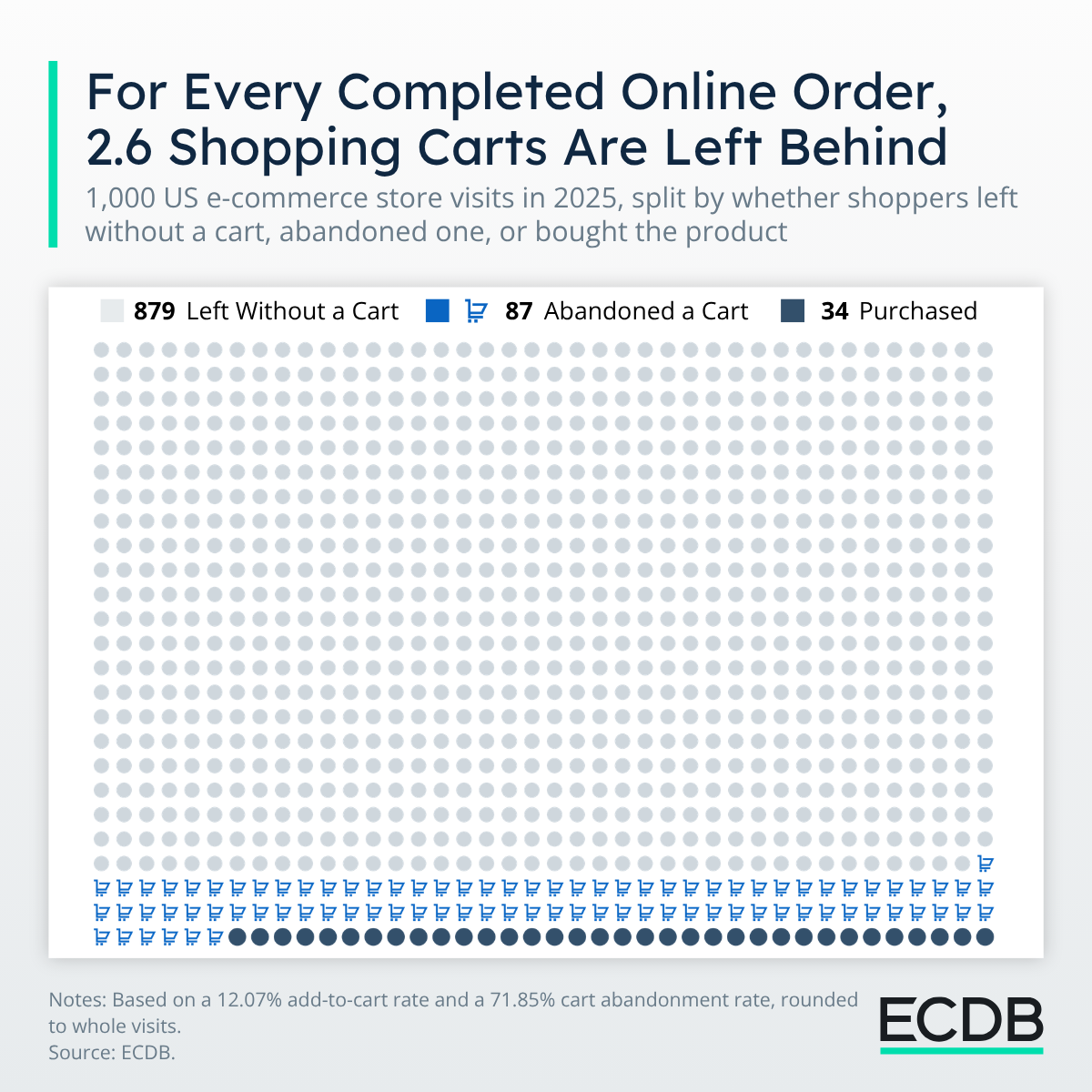
Of a thousand shoppers who visit a US e-commerce store, 121 add a product to their cart. Only 34 complete the purchase, meaning that 87 leave a filled cart behind. That is the typical funnel across all product categories in US e-commerce.
We at ECDB put the average add-to-cart rate at 12.1%, cart abandonment at 71.9% and the conversion rate at 3.4%. But from one category to the next, these figures diverge considerably. This follows a clear logic.
Checkout Is Where the US Funnel Loses Most of Its Value
Getting a product into the cart is a small hurdle, but seven in ten carts never make it through checkout. The categories below show how many buyers purchase per 1,000 visitors:
All categories: 34 buyers per 1,000 visitors
Grocery: 58 buyers
Care Products: 39 buyers
Fashion: 32 buyers
Furniture & Homeware: 25 buyers
Conversion ranges from 2.5% to 5.8% across these four categories. Combined with add-to-cart rates and abandonment rates, this number has important implications on shopper behavior.
Fashion Fills Carts and Then Loses Them
Fashion shoppers add products to their carts more readily than the average. The add-to-cart rate is at 13.6%, against 12.1% across all categories. Far fewer follow through. Cart abandonment in Fashion reaches 76.8%, and conversion lands at 3.2%, below the market average.
In Fashion, the cart often works as a shortlist. Shoppers add several sizes, colors, or styles to compare, then buy one item or nothing at all. Fit is hard to judge on a screen, and the prospect of sending something back adds another pause right before payment.
Other categories see their cart abandoned much less often, because shoppers arrive with a clearer purchase intent.
Grocery Turns the Most Carts Into Orders
Grocery is one of those categories. In this comparison, it has the highest add-to-cart rate of 15.5%, of which only 62.5% are abandoned. The result is a conversion rate of 5.8%, 1.7 times the US average.
That is because grocery purchases are planned and repeated often. Shoppers often arrive not just to browse, they reorder items from earlier baskets, and need the products within days or hours. A low price per item leaves little to deliberate over, and quick delivery gives shoppers a reason to finish the order in one session.
Care Products fall into the same group. Of the 14.9% of shoppers who add a product to their cart, 73.5% abandon it to arrive at an above-average conversion rate of 3.9%. Like Grocery, shampoo, toothpaste, and vitamins are familiar products bought on repeat, and many shoppers reach the product page with the decision already made.
High Tickets Cost Furniture & Homeware the Most Orders
The more a purchase costs, the more likely shoppers are to reconsider it at checkout. Furniture & Homeware shows this most clearly. Its add-to-cart rate of 13.5% is on par with Fashion. Its cart abandonment rate of 81.7% is the highest in the comparison, and only 2.5% of visitors end up buying.
A sofa or a dining table is a large, infrequent purchase. Shoppers measure their space, compare materials, check delivery times for bulky goods, and often want to see the piece in a showroom before committing. Delivery fees for large items tend to surface only at checkout, which gives shoppers one more reason to pause.
Wrap-Up: The 87 Abandoned Carts Are the Biggest Opportunity
Of 1,000 US shoppers, 87 have already chosen a product and still leave without paying. That group is more than twice the size of the 34 who buy. Recovering ten of them would lift orders by almost 30%, without a single extra visitor.
Fashion and Furniture & Homeware have the most to gain. Both generate more add-to-cart intent than the market average. At the market's average abandonment rate, both would convert at around 3.8%, ahead of the US average of 3.4%. Checkout is where they fall behind.
Grocery and Care Products convert higher because their shoppers arrive with fewer doubts. For every category, the same lever applies. Addressing abandonment turns shoppers who already picked a product into customers who pay for it.

Related Articles
All ArticlesReady to Unlock the Full Power of ECDB?
Book a demo to see how ECDB's market intelligence can support your business.