China Captures 9 out of 10 Euros That Leave the EU in E-Commerce
Temu, AliExpress and Shein account for most of cross-border sales in the European Union. The reasons come down to business strategy and definition. This year's new EU customs rules put that lead to the test.

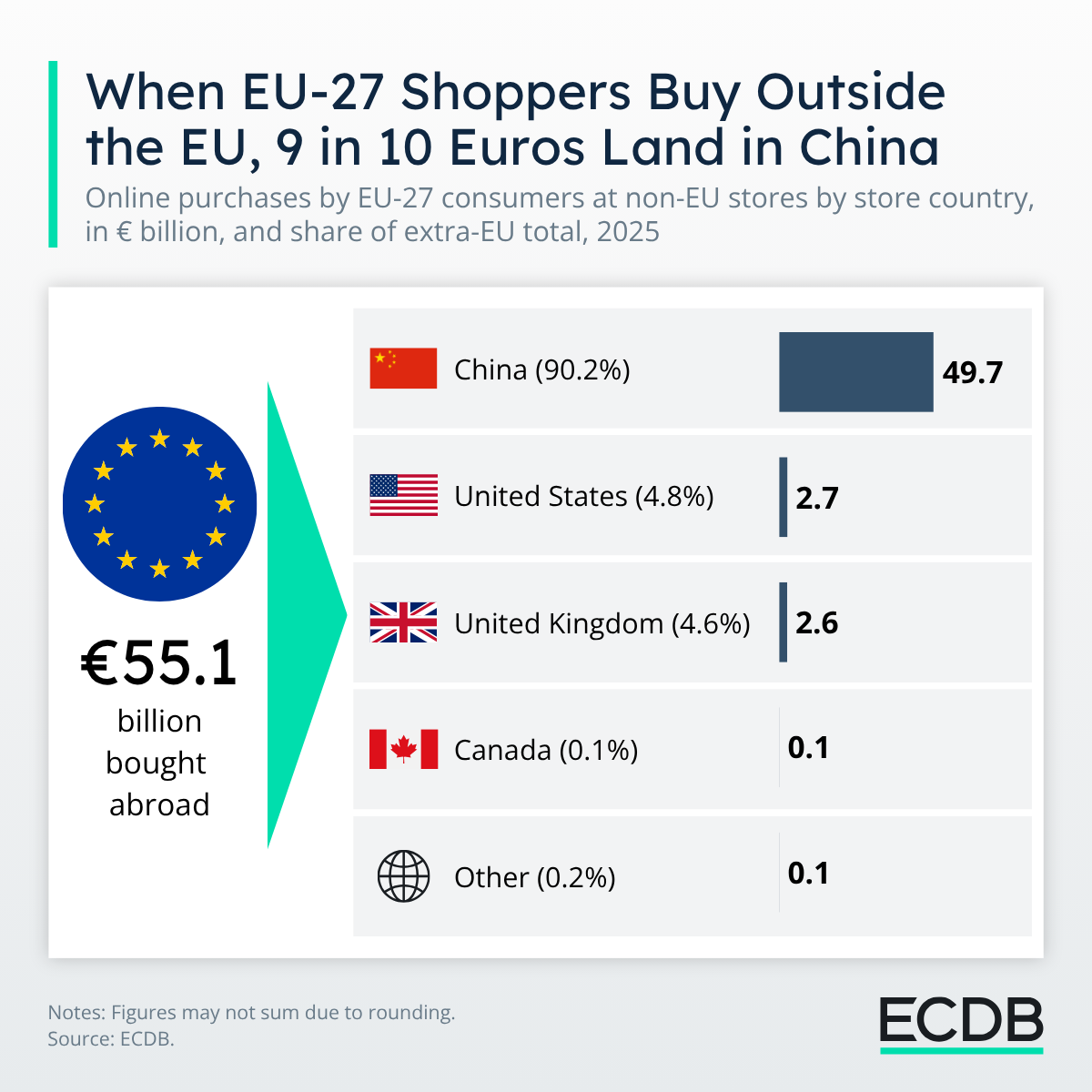
Of the €55.1 billion that left the European Union in e-commerce in 2025, 90.2% landed with Temu, Shein, AliExpress and the like. When EU shoppers buy from a store outside the bloc, they buy from China almost every time.
That dominance comes from a business model built for cross-border sales. It also rests on how cross-border spending is measured. And a regulatory change in July 2026 is about to test it.
China Takes Nine Out of Ten Euros Spent Outside the EU
EU-27 shoppers spent €55.1 billion at non-EU online stores in 2025. Of that, 90.2% went to Chinese retailers. Every other non-EU market shares the remaining tenth.
The names behind that share are familiar. Temu, Shein and AliExpress have become household names across the bloc within a few years. Low prices, vast assortments and pervasive marketing brought them there.
Local Storefronts Keep US Retailers Out of the Cross-Border Count
The US falls behind in that depiction. Much of the gap comes down to definition. US retailers tend to run local storefronts in individual EU countries. A German shopper ordering from a US company's German site, like amazon.de, counts as a domestic purchase. That is why the US share is much lower than China's.
US-based companies therefore appear to have a smaller footprint than they do. Their EU sales exist. They simply show up in domestic e-commerce figures.
Chinese platforms work the other way around. Most of their EU orders ship from outside the bloc, which places them squarely in the cross-border column.
The Factory-to-Customer Model Meets New EU Customs Rules
The typical Chinese model ships straight from factories to customers abroad. It skips local warehouses, intermediaries and much of the cost that comes with them. That model has paid off, and the 2025 data captures that reality.
Its advantage depended in part on low-value parcels entering the EU duty-free. In July 2026, the EU ended duty-free treatment for parcels under €150. A flat €3 customs duty per item now applies instead.
For a business built on millions of small, cheap orders, a per-item charge adds up fast. A €3 duty barely registers on a €100 jacket. On a €5 phone case, it adds 60% to the price.
American Retailers Already Have the Infrastructure in Place
The customs shift favors American retailers. They already run local warehousing, fulfillment and service built to meet EU standards. Goods sit in EU warehouses before a customer ever orders them, so the new per-item duty on small parcels leaves their model largely untouched.
Temu, Shein and AliExpress are only now building the same infrastructure. Local warehouses take time and capital. At the same time, EU regulation increasingly limits how far these platforms can undercut domestic retailers on price.
The Chinese platforms face two adjustments at once. Their logistics model has to move closer to the customer, and their price edge is shrinking while it does.
The United Kingdom, Canada and Others Barely Register
The remaining markets in the mix barely register next to China. They include the United Kingdom, Canada, and countries like Switzerland and Türkiye.
Several of them sit right on the EU's doorstep. Proximity has not translated into cross-border size. As of now, China outpaces all of them, and this pattern extends well beyond the EU.
Wrap-Up: The 2025 Data Marks a High Point for Direct Shipping
The 2025 figures show the factory-to-customer model at full strength. Chinese retailers captured 90.2% of EU spending at non-EU stores under rules that let small parcels in duty-free.
Those rules have now changed. US retailers enter the new regime with local infrastructure already built. Chinese platforms enter it mid-construction, with tighter price regulation on top. The next round of data will show how much of China's share depended on the old customs regime.
Related Articles
All ArticlesReady to Unlock the Full Power of ECDB?
Book a demo to see how ECDB's market intelligence can support your business.