Article in a Nutshell:
Which payment method wins in a region comes down to trust and banking infrastructure.
Missing the right local payment method is one of the clearest ways a checkout fails.
Amazon offers just two payment options in the US against eleven in the UK, and Middle Eastern marketplaces lean heavily on buy-now-pay-later providers barely used elsewhere.
The payment method that converts best is regional. Most checkout pages are still built around the handful of options that work at home, and that's not enough once a store starts selling into a region with different habits.
What follows is a region-by-region look at what actually works, built on the real payment methods retailers offer in each market today.
Europe: Trust in Cards, and a Lingering Preference for Invoice
Cards and digital wallets dominate most of Europe. VISA, Mastercard, and PayPal form the backbone of checkout in France, Italy, and Spain alike.
Underneath that broad pattern, though, sits a layer of local bank-transfer methods that matter enormously in their home country and barely register anywhere else:
These are already how people pay each other locally, and e-commerce simply plugged into that habit.
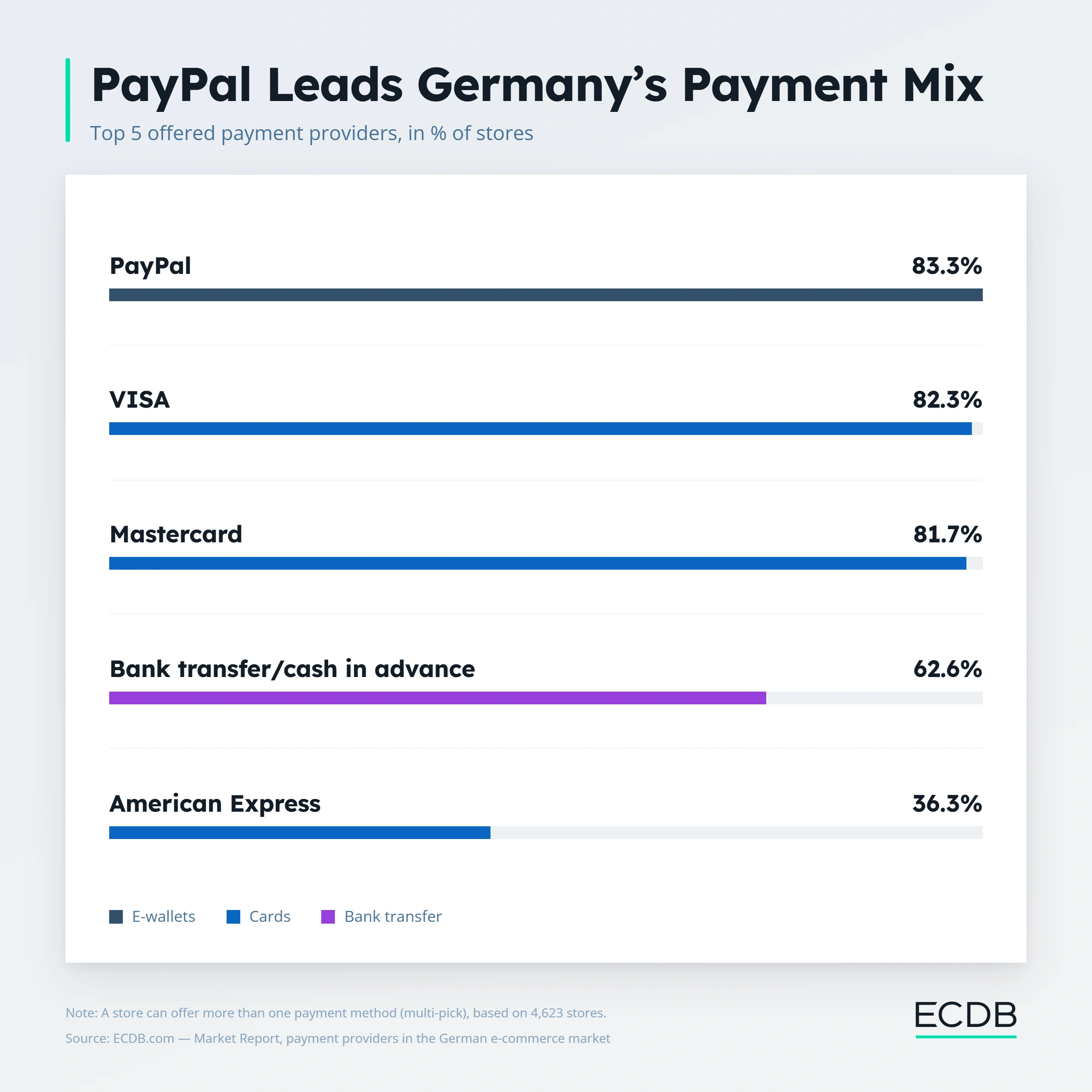
Germany stands apart for a different reason: PayPal is the most offered payment method, ahead of VISA and Mastercard. Another idiosyncracy of the market is a high prevalence of invoice payment, even though the method is not featured among the top 5 methods.
Order first, pay after the item arrives, remains widespread among the country's biggest retailers. It is a convenient way for consumers to purchase online, without needing the trust to pay for items in advance.
North America: Cards, Wallets, and a Fast Rise in Buy-Now-Pay-Later
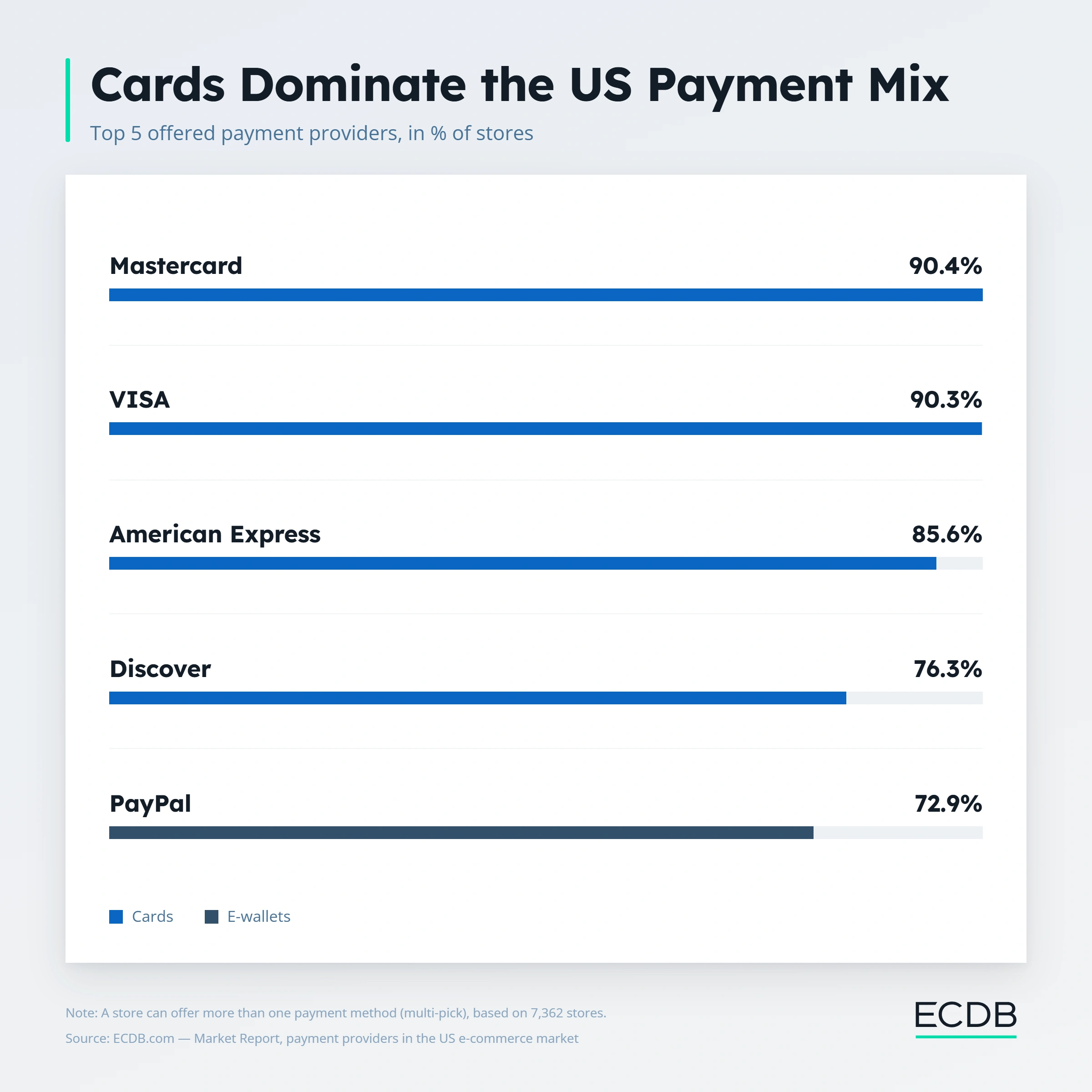
The US market runs wider than any single storefront suggests. Almost every store offers Mastercard and VISA, with American Express following a little behind. Discover belongs to the "big four" US card networks alongside the previous three. Only then follows PayPal with almost 73% of store adoption.
The leading retailers in the US reveal a further feature of the market: Installments are becoming bigger and bigger. Walmart and Target both carry deep card and wallet menus, and Target alone offers five separate buy-now-pay-later providers:
Affirm
Afterpay
Klarna
Sezzle
Zip
Plus PayPal Credit on top. Installment payment has become a real expectation at checkout, and one that benefits both retailers and consumers, as retailers are guaranteed to receive their payment and consumers can spread out larger or many smaller purchases to make them more affordable.
Canada runs on the same card-and-installment backbone as the US, but with its own regional card programs layered in that barely register south of the border.
Even within one continent that shares a language and a currency in spirit, the payment stack still needs a second look per country rather than a single North American default.
China: Wallets Everywhere, but the Specific Wallet Depends on the Ecosystem
China's payment landscape doesn't resemble a card-first market on any major platform.
Tmall leads with Alipay and Huabei, Alipay's own installment product.
JD.com leads with WeChat Pay instead, reflecting its closer ties to Tencent.
Pinduoduo offers both side by side.
The wallet a shopper reaches for depends on which ecosystem they're already in, Alibaba's or Tencent's, more than which retailer they're buying from.
Traditional international card networks barely register on any of the three largest e-commerce players. They are more prevalent in Hong Kong and Taiwan though.
A retailer entering China without both Alipay and WeChat Pay available is asking shoppers to step outside the infrastructure they already use for nearly everything else online.
The Middle East and Türkiye: Installments Have Become the Default Add-On
Gulf marketplaces have adopted installment payment faster than almost anywhere else. Tabby and tamara, two regional buy-now-pay-later providers, sit alongside standard cards and cash on delivery, which still holds a place even in a market rapidly modernizing its checkout.
Türkiye shows the same appetite for splitting a payment through a different mechanism: installment plans by credit card. They are offered directly alongside Troy, the country's own domestic card scheme built as an alternative to Visa and Mastercard.
Splitting a purchase into installments without interest has become close to an expected option across the region.
Africa: Local Wallets, Built Market by Market
Africa's payment landscape is the least standardized of any region here, and that's the point.
In Egypt, valU, a homegrown buy-now-pay-later provider, ranks among the most widely offered payment methods after VISA and Mastercard.
South Africa instead leans on Payflex and Mobicred, two local buy-now-pay-later providers.
Neither wallet has much reach beyond its home country. Where card infrastructure is still uneven, local wallets tied to a specific country's banks are filling the gap one market at a time, rather than one continent-wide solution.
South and Southeast Asia: Cash and Convenience Stores Still Carry Real Weight
Cash on delivery remains genuinely common across South and Southeast Asia, not a legacy option kept around out of habit.
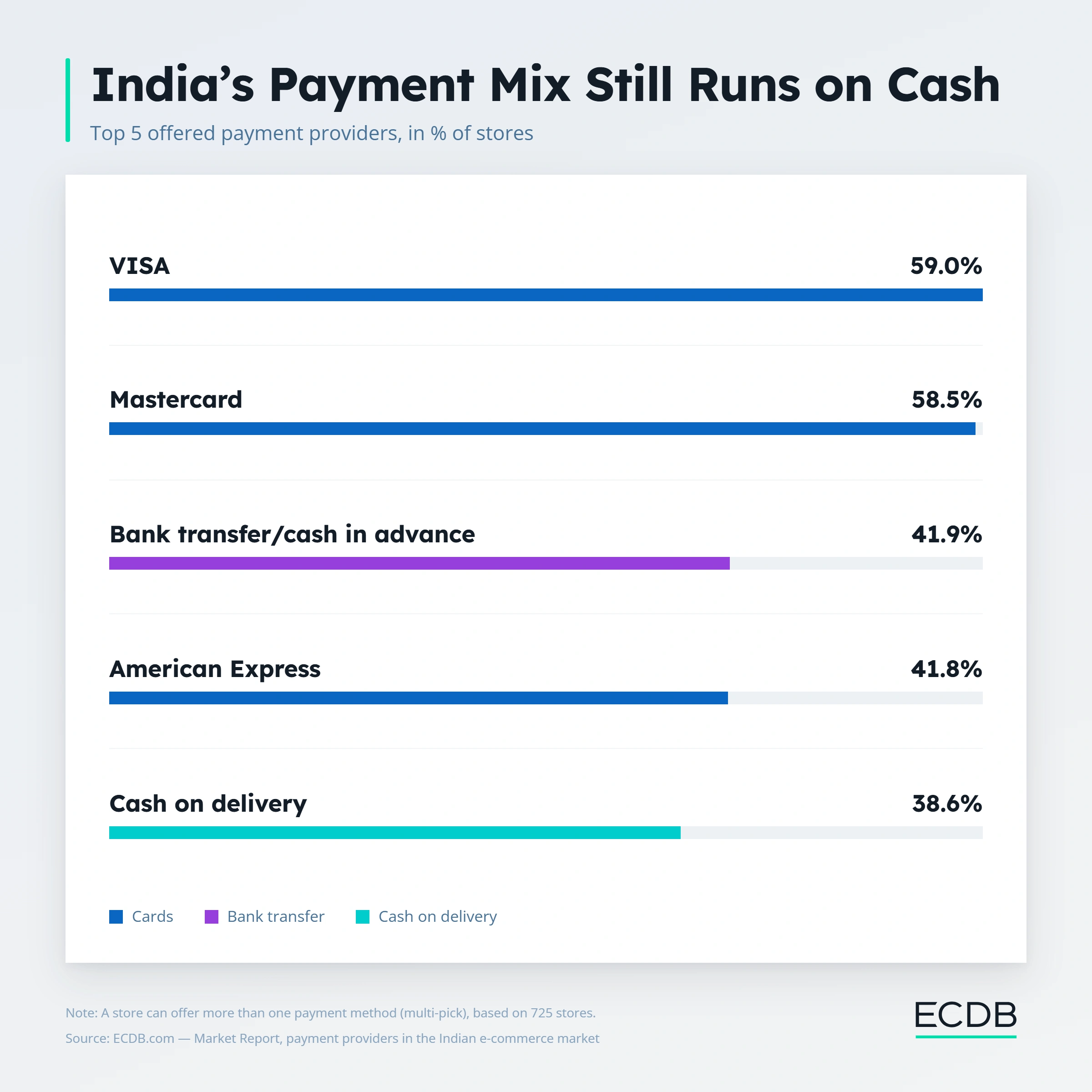
Flipkart in India offers it prominently alongside cards and its domestic RuPay network. Cash in advance is the fifth-most offered payment method in India, after the standard card systems and bank transfers.
Shopee's Indonesian marketplace goes a step further, listing Alfamart and Indomaret, the country's two largest convenience store chains, as payment points where a shopper can pay in cash for an order placed online.
In markets where trust in prepaying online is still building, letting a shopper walk into a familiar store and pay in person is often what closes the sale that a card-only checkout would lose.
What This Means for Choosing Payment Methods by Region
No single payment stack travels well across all of these markets, and building one that tries to do everything everywhere usually means doing nothing particularly well anywhere. A few patterns hold up across the regions above:
Local bank-transfer apps, iDEAL, Bancontact, blik, Pix, Swish, bizum, aren't a secondary option in their home markets, they're often the default, and skipping them costs more conversion than a card-only checkout might suggest.
Markets with lower card penetration, much of Latin America, South Asia, Southeast Asia, and Africa, need a genuine non-card path to purchase, cash on delivery, convenience store payment, or a local wallet, not just a card form with a "coming soon" note underneath it.
Installment and buy-now-pay-later options are shifting from a nice-to-have to a near-default expectation, fastest in the Middle East and Turkey, but spreading well beyond both.
Matching the payment stack to the region isn't a one-time setup either. Card penetration rises, new wallets gain share, and yesterday's essential option can become a legacy one still worth offering but no longer the reason a sale gets completed.
How ECDB Helps You Make the Right Decisions From the Get-Go
You don't have to guess which payment methods actually matter in a given market. ECDB tracks the payment providers real retailers offer, country by country, which is a far more reliable signal than assuming what "should" work based on habits from a home market.
That data is available on our Profiles, so a payment strategy can be built around what retailers already succeeding in a market offer their customers.