Recurring Purchases Are Reshaping the Future of E-Commerce
The fastest-growing categories in e-commerce until 2030 are not the flashy ones. They're the everyday essentials consumers need and reorder again and again.
Monthly E-Commerce Recap
The summer months traditionally mark a seasonal slowdown for e-commerce, with consumers spending more time on travel and outdoor activities while major shopping events remain months away. Nevertheless, the broader global e-commerce trajectory continues to point upward.

Nadine Koutsou-Wehling
Data Journalist
August 04, 2026
Market Trends
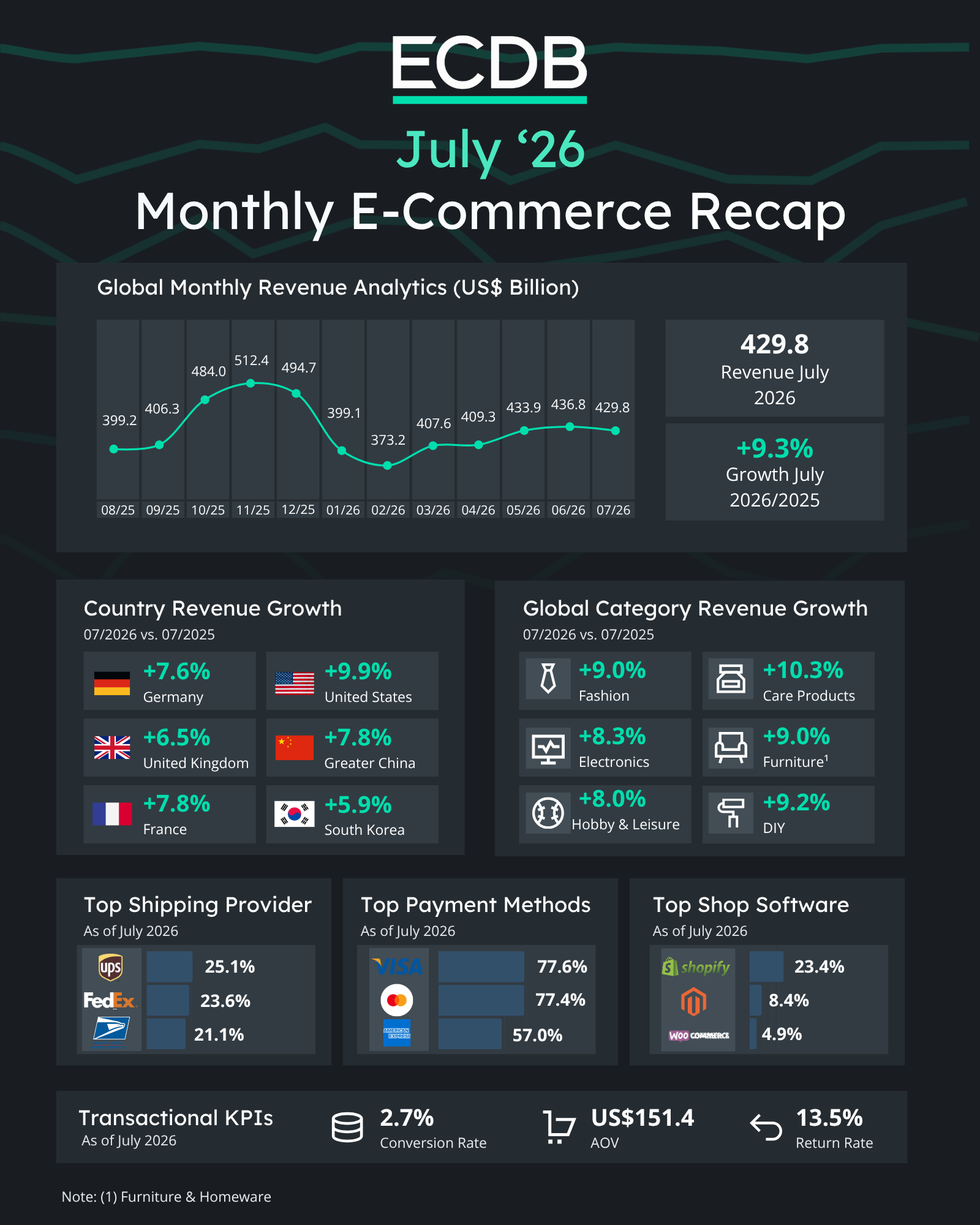
Summer has arrived, and with it, a seasonal slowdown in global e-commerce activity. July 2026 marked the beginning of the typical summer lull, with monthly revenues declining slightly compared to June.
Global e-commerce revenue reached US$429.8 billion in July 2026, which represents a moderate decrease from the previous month. However, the year-on-year perspective paints a better picture: compared to July 2025, global e-commerce grew by 9.3%.
The seasonal dip has not changed the underlying growth trajectory. E-commerce continues to expand steadily, supported by solid performance in key markets and resilient consumer demand.
Among the world's leading e-commerce markets, the United States remained one of the biggest contributors to growth.
US e-commerce revenue increased by 9.9% year on year in July 2026, thereby outperforming several other major markets. The US therefore continues to outperform China in growth, as has been the case in previous months.
Category performance remained relatively stable compared to the prior months, with everyday consumer needs continuing to drive growth.
Care Products once again recorded a substantial year-on-year growth in July, increasing by 10.3%. The category continues to benefit from recurring demand and consumers' growing preference for purchasing essential products online.
Other well-performing categories included:
DIY: +9.2% year on year
Fashion: +9.0% year on year
Furniture & Homeware: +9.0% year on year
The continued performance of these categories demonstrates that e-commerce growth is increasingly supported by both everyday essentials and established online shopping categories.
Payment preferences remained largely unchanged in July.
Visa and Mastercard continued to lead among online stores, each reaching an adoption rate of around 77.5%. American Express followed with an adoption rate of 57.0%.
While July's month-on-month figures reflect typical seasonal patterns, the broader growth trend remains intact.
Global e-commerce continues to expand, driven by solid key market performance, resilient consumer demand, and ongoing improvements in the digital shopping experience. The summer slowdown may affect short-term comparisons, but it has not changed the long-term outlook.

Related Articles
The fastest-growing categories in e-commerce until 2030 are not the flashy ones. They're the everyday essentials consumers need and reorder again and again.
By 2030, e-commerce will be worth US$7 trillion. The trends driving this revenue are essentials over exciting categories, mobile-first omnichannel, and AI standing in for the search bar.
Central Europe consists of heterogeneous e-commerce markets, many of them at different stages of development. The expectation is that a fully autonomous agent will predict needs and carry out purchases with only minimal supervision. But the reality still looks different, depending on where one looks.

Click here for
more relevant insights from
our partner Mastercard.
Book a demo to see how ECDB's market intelligence can support your business.